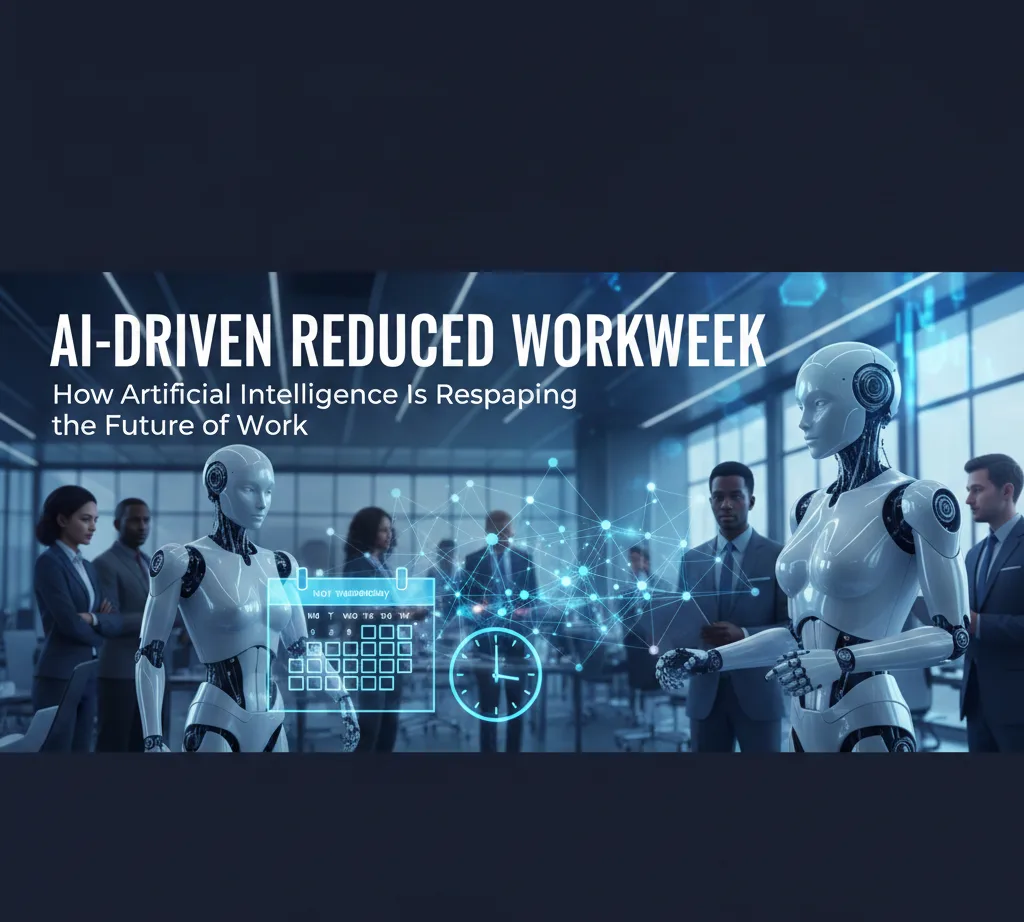

The AI-Driven Reduced Workweek is no longer a futuristic idea it’s becoming a real workplace strategy across the United States. As artificial intelligence automates tasks and improves productivity, companies are exploring how fewer working hours can deliver better outcomes for employees and businesses alike.
What Is an AI-Driven Reduced Workweek?
How it works in practice:
- AI handles data processing, reporting, and repetitive workflows
- Employees focus on high-value, creative, or strategic work
- Output stays the same or improves despite fewer work hours
What Is Driving the Shift Toward Shorter Workweeks?
Several forces are pushing U.S. organizations to rethink traditional work schedules.
Productivity Gains From AI
AI tools now perform tasks that once consumed hours of human effort. Scheduling, customer support, analytics, and content generation are increasingly automated.
According to McKinsey, automation technologies could boost global productivity growth by 0.8% to 1.4% annually.
Employee Burnout and Retention
Long work hours contribute directly to burnout. U.S. workers report rising stress levels, especially in knowledge-based roles.
A Gallup study shows that burned-out employees are 63% more likely to take sick leave and 2.6 times more likely to look for another job.
How AI Enables a Reduced Workweek
Task Automation
AI excels at repetitive, rules-based tasks:
- Data entry
- Invoice processing
- Basic customer queries
- Report generation
This frees employees to focus on decision-making and innovation.
Workflow Optimization
Machine learning systems identify inefficiencies in workflows and recommend improvements. Tasks are completed faster, with fewer errors.
Smarter Collaboration
AI-powered tools summarize meetings, draft follow-ups, and manage schedules—cutting hours of coordination time each week.
The Business Case for an AI-Driven Reduced Workweek
Higher Productivity Per Hour
Research consistently shows that productivity drops after long working hours. AI allows teams to do more in less time.
Microsoft’s Work Trend Index found that AI-assisted employees complete tasks up to 29% faster.
Better Talent Attraction
Shorter workweeks attract skilled professionals, particularly in competitive U.S. tech and knowledge sectors.
Reduced Operational Costs
Fewer work hours can mean lower energy usage, reduced office expenses, and improved employee health outcomes.
Real-World Examples in the United States
Technology Companies
Several U.S.-based startups use AI to support four-day workweeks while maintaining output targets.
Marketing and Media Firms
AI-driven analytics and content tools allow teams to reduce production time dramatically.
Customer Support Operations
AI chatbots now handle first-level inquiries, reducing staff workload without hurting service quality.
Challenges and Risks to Consider
Unequal Access to AI
Not all roles can be automated equally. This may widen gaps between AI-enabled and non-AI roles.
Measurement Problems
Some organizations struggle to measure output accurately, especially for creative or strategic work.
Change Management
Employees and managers may resist shifting away from traditional time-based performance metrics.
How Companies Can Implement This Model Responsibly
Start With Pilot Programs
Test reduced schedules in specific teams before scaling company-wide.
Focus on Outcomes, Not Hours
Performance should be measured by results, not time spent working.
Invest in Training
Employees must understand how to work alongside AI tools effectively.
The Future of Work in the United States
The AI-Driven Reduced Workweek aligns with broader changes in how Americans view work-life balance. As AI adoption grows, flexible schedules may become a competitive necessity rather than a perk.
Organizations that adapt early are likely to see stronger engagement, higher retention, and sustainable productivity gains.
Conclusion: Why This Matters Now
The AI-Driven Reduced Workweek represents a practical evolution of work, not a radical experiment. Artificial intelligence is enabling companies to rethink productivity, employee well-being, and long-term performance.
At Tonic Of Tech, we explore how emerging technologies like AI are shaping the future of work, business innovation, and digital transformation. Stay connected as we continue to track how AI is redefining modern workplaces.
FAQs: AI-Driven Reduced Workweek
1. What is an AI-Driven Reduced Workweek?
It’s a work model where AI automates routine tasks, allowing employees to work fewer hours while maintaining or improving productivity and pay.
2. Does a reduced workweek lower salaries?
Most successful implementations maintain full pay. The goal is higher productivity per hour, not reduced compensation.
3. Which industries benefit most?
Technology, marketing, finance, customer support, and knowledge-based roles benefit the most from AI-enabled efficiency.
4. Is this model realistic for small businesses?
Yes. Many AI tools are affordable and scalable, making reduced workweeks achievable even for smaller U.S. companies.
5. Will AI replace jobs instead of reducing hours?
AI is more likely to reshape roles than eliminate them entirely, especially when companies focus on augmentation rather than replacement.