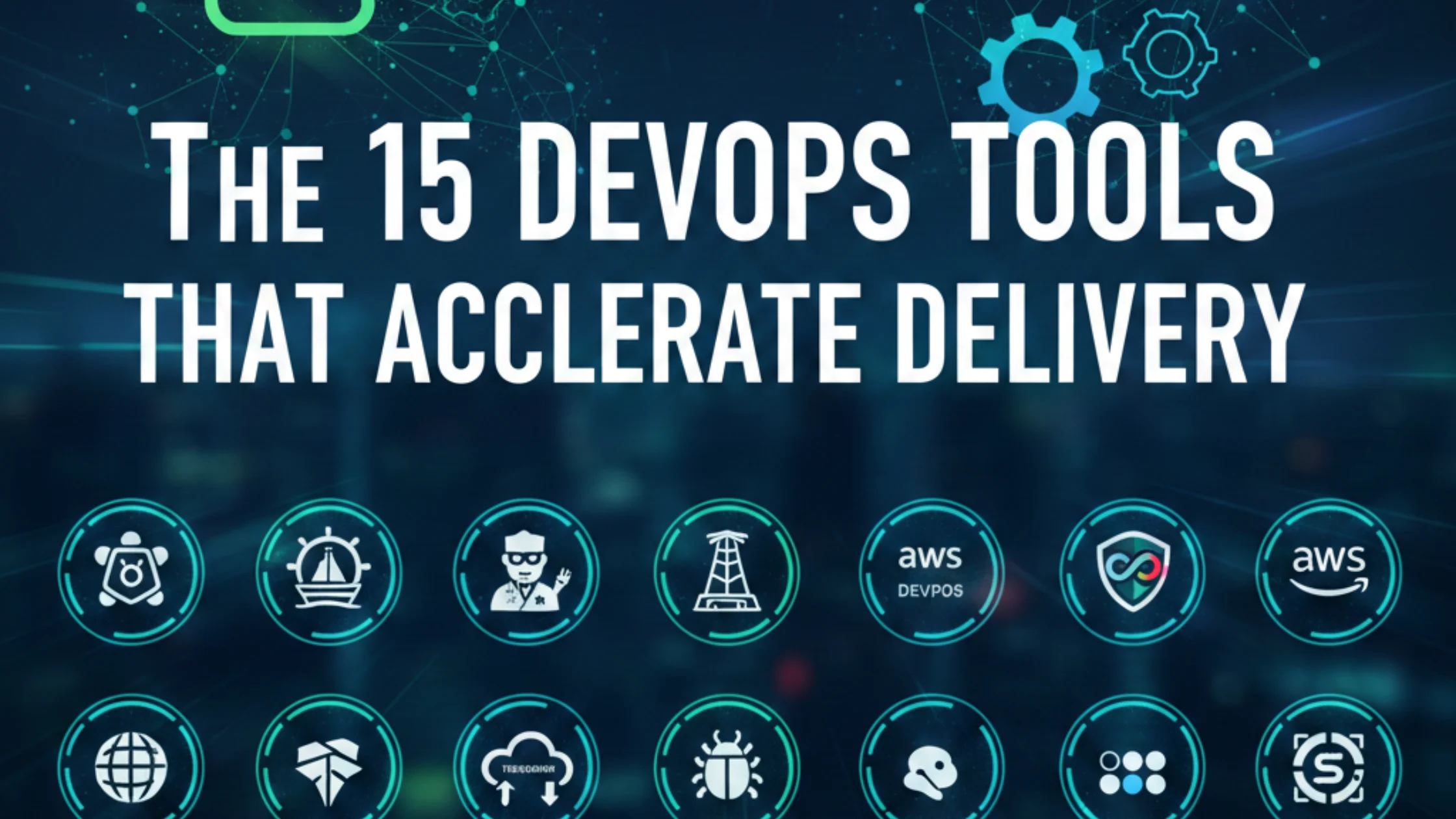

DevOps tools help teams automate builds, testing, deployments, and operations so software ships faster and safer. This guide walks U.S. teams through the top 15 devops tools, why they matter, and where to use them in your CI/CD, infrastructure-as-code, container, monitoring, and security workflows.
Top 15 DevOps tools:
- GitHub Actions for CI/CD automation
- Jenkins for pipelines & automation
- GitLab CI for integrated CI/CD
- Terraform for infrastructure as code
- Ansible for configuration management
- Docker for container runtime
- Kubernetes for container orchestration
- Helm for Kubernetes package manager
- Prometheus for monitoring & metrics
- Grafana for dashboards & visualization
- Datadog for observability platform
- Splunk for log analytics
- Vault for secrets management
- Argo CD for GitOps deployments
- Packer for immutable images
1. CI/CD & Automation
GitHub Actions, Jenkins, GitLab CI are the backbone of modern CI/CD.
GitHub Actions provides workflow-as-code inside GitHub repositories and integrates tightly with source control. Jenkins is a mature, highly extensible automation server used for complex pipelines and many plugins. GitLab CI offers an integrated experience with built-in runners and merge-request pipelines. Use these devops tools to automate builds, tests, and deployments.
2. Infrastructure as Code (IaC)
Terraform, Packer let teams declare cloud infrastructure as code.
Terraform converts human-readable configuration into cloud resources across providers. Packer builds immutable machine and container images to ensure reproducible runtime environments. Together, these devops tools reduce configuration drift and speed deployments.
3. Containers & Orchestration
Docker, Kubernetes, Helm are central to containerized workflows.
Docker packages apps into lightweight containers. Kubernetes schedules and manages containers at scale; Helm manages Kubernetes charts (packaged applications). The Cloud Native ecosystem around these devops tools makes scaling and portability practical for production systems.
Also Read: Google Cloud Free Tier: Guide to Free Cloud Computing
4. Configuration Management
Ansible (agentless) and other config tools automate server and application configuration.
Use Ansible playbooks to enforce consistent system state across environments. These devops tools improve repeatability and simplify rollbacks.
5. Monitoring & Observability
Prometheus, Grafana, Datadog, Splunk provide metrics, traces, and logs.
Prometheus collects time-series metrics. Grafana visualizes dashboards. Datadog and Splunk offer hosted platforms with analytics, alerting, and APM. Observability devops tools help teams detect issues quickly and trace them to root causes
6. Security & Secrets Management
Vault centralizes secrets, keys, and dynamic credentials.
DevSecOps requires embedding security into pipelines secrets management, policy-as-code, and scanning for vulnerabilities. Vault and complementary scanning tools protect credentials and reduce blast radius.
7. GitOps & Deployment (Argo CD)
Argo CD brings GitOps to Kubernetes declarative Git repositories drive live cluster state.
With Argo CD, your Git repo becomes the single source of truth; deployments are auditable and reproducible. It’s one of the fastest-growing devops tools for teams practicing GitOps.
How to choose the right devops tools
- Map tools to outcomes speed, stability, cost, or compliance.
- Start small pick a CI tool and one IaC tool, then expand.
- Prefer tools with strong community, docs, and vendor support.
- Evaluate integration does the tool work with your clouds, repos, and monitoring stack?
These steps help teams avoid tool sprawl and build a maintainable DevOps toolchain.
Data point & authority
Kubernetes is recognized as the de facto container orchestration platform in the cloud-native ecosystem; it remains the most widely used orchestration system and anchors many devops toolchains (see Kubernetes docs and CNCF resources for adoption context). Kubernetes | Terraform | GitHub Actions
Conclusion
Choosing the right devops tools accelerates your team while improving reliability. Start by selecting a CI/CD tool, add IaC and container orchestration, and layer monitoring and secrets management. Ready to modernize your toolchain?
FAQs Related To Devops Tools
1. What are devops tools and why do I need them?
Devops tools are software that automate building, testing, deploying, and operating applications examples include CI/CD systems, IaC, container orchestration, and monitoring. They cut manual work, reduce errors, and speed delivery. Use them to standardize workflows and make deployments repeatable and auditable.
2. Which devops tools should a small team start with?
Small teams should begin with a hosted CI/CD (GitHub Actions), an IaC tool for provisioning (Terraform), and containers (Docker). Add monitoring like Grafana/Prometheus and a secrets manager as you scale. Start with one service to minimize risk and validate automation.
3. Are these devops tools free to use?
Many devops tools offer open-source versions (Jenkins, GitLab CI self-hosted, Kubernetes, Terraform CLI, Prometheus, Grafana). Hosted or enterprise tiers (Datadog, GitHub Actions minutes, managed Kubernetes) have costs. Evaluate total cost including hosting, maintenance, and required integrations.
4. How do devops tools fit into security (DevSecOps)?
DevSecOps integrates security into the pipeline: add vulnerability scanning, secrets management (Vault), and policy-as-code during build/release. Choose devops tools that support scanning and policy hooks to shift security left and stop issues earlier.
5. How to measure success after adopting devops tools?
Track lead time to deploy, change failure rate, mean time to recovery (MTTR), and deployment frequency. Improved metrics (faster deployments, fewer failures) indicate a successful toolchain. Use monitoring and APM to validate improvements.