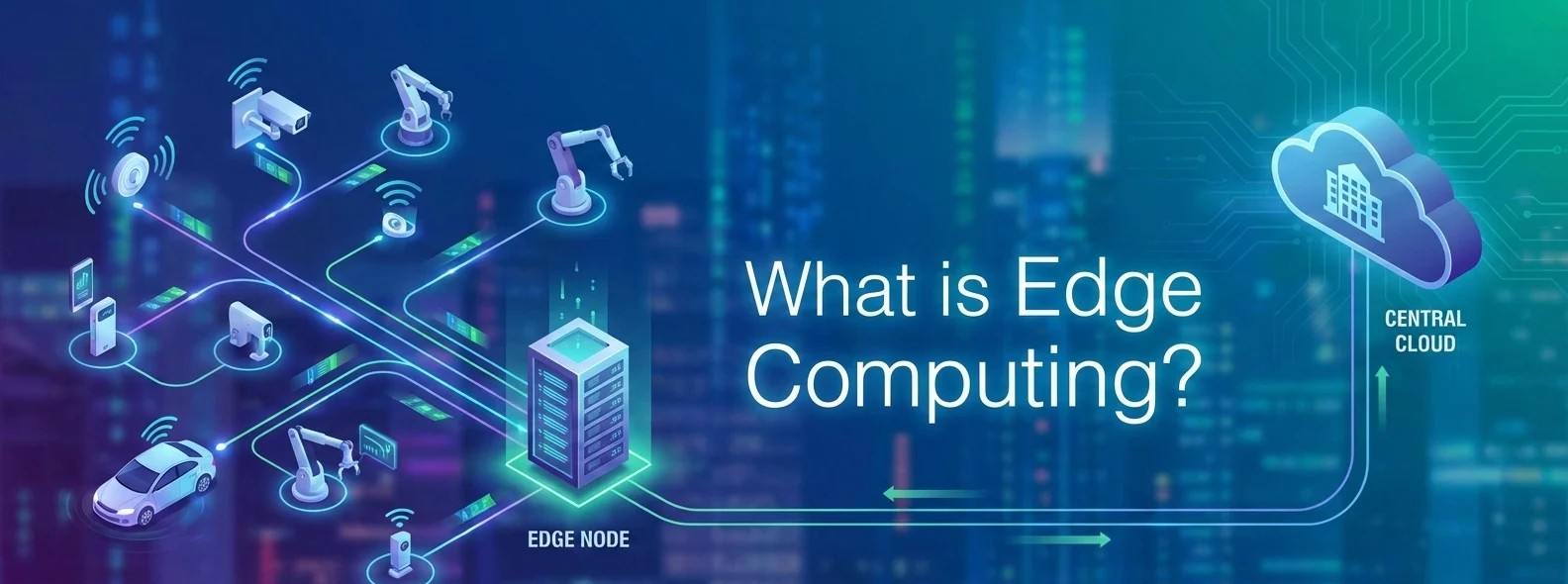

Edge computing is a distributed computing model where data is processed near the source such as sensors, devices, or local servers instead of being sent to a centralized cloud. This reduces latency, improves speed, and enables real-time decision-making.
In simple terms:
- Data is generated at devices (IoT, sensors, vehicles).
- Processing happens locally or at nearby edge servers.
- Only necessary data is sent to the cloud for storage or analysis.
How Edge Computing Works
In traditional systems, data flows from devices to the cloud for processing. Edge computing changes this flow.
Here’s how edge computing works step by step:
- Devices such as sensors, cameras, or machines generate data.
- Edge nodes (gateways, routers, micro data centers) process data locally.
- Only relevant or summarized data is transmitted to the cloud.
This hybrid approach allows organizations to combine local processing with centralized cloud analytics.
Edge Computing vs Cloud Computing
Understanding edge computing vs cloud computing helps clarify when to use each.
Cloud computing
- Centralized data centers
- High scalability
- Ideal for storage, analytics, and batch processing
Edge computing
- Decentralized processing
- Low latency
- Ideal for real-time and mission-critical workloads
In practice, edge computing and cloud computing work together. Edge handles immediate processing, while the cloud provides long-term storage and advanced analytics.
Also Read: AI Chat Bot for Website
Key Benefits of Edge Computing
The growing adoption of edge computing is driven by clear advantages.
Major edge computing benefits
- Low latency: Faster response times for real-time applications
- Reduced bandwidth costs: Less data sent to the cloud
- Improved reliability: Systems continue working even with limited connectivity
- Enhanced privacy: Sensitive data can remain local
- Scalability: Supports massive device deployments
These benefits make edge computing essential for IoT, healthcare, manufacturing, and transportation.
Edge Computing in IoT
Edge computing in IoT is one of the most common use cases. IoT devices generate massive volumes of data that are inefficient to send entirely to the cloud.
Edge computing allows:
- Local data filtering and analysis
- Faster responses to environmental changes
- Reduced network congestion
Examples include smart homes, industrial sensors, and connected medical devices.
Edge Computing in Autonomous Vehicles
Edge computing in autonomous vehicles is critical for safety and performance. Self-driving cars generate terabytes of data daily from cameras, radar, and sensors.
Edge computing enables vehicles to:
- Make split-second driving decisions
- Detect obstacles in real time
- Operate even with limited connectivity
Without edge computing, the latency of cloud-only processing would be unsafe.
Mobile Edge Computing and 5G
Mobile edge computing, often used interchangeably with MEC, brings computing resources closer to mobile users through telecom networks.
With the rise of 5G:
- Latency drops below 10 milliseconds
- Edge servers are deployed at base stations
- Applications like AR/VR and gaming become practical
Mobile edge computing supports ultra-fast, location-aware services.
Multi-Access Edge Computing (MEC)
Multi-access edge computing (MEC) is a standardized framework defined by ETSI. It allows applications to run at the edge of mobile networks.
Key MEC features:
- Access to network information
- Ultra-low latency
- Optimized mobile traffic management
MEC is widely used in smart cities, connected vehicles, and enterprise 5G deployments.
Edge Computing Solutions and Architecture
Modern edge computing solutions include:
- Edge gateways and devices
- Micro data centers
- Edge-enabled cloud platforms
- Containerized workloads
Architecturally, edge computing often integrates with cloud platforms to form a distributed system that balances performance and scalability.
Security Considerations at the Edge
Security remains a key concern for distributed environments.
Challenges include:
- Large attack surface
- Physical access to devices
- Device authentication
Best practices:
- Zero-trust architecture
- Encrypted data transmission
- Centralized monitoring
- Secure device management
Edge security must be built into both hardware and software layers.
Industries Using Edge Computing
Edge computing is widely adopted across industries:
- Healthcare: Remote monitoring and diagnostics
- Manufacturing: Predictive maintenance and robotics
- Retail: Smart shelves and real-time inventory
- Energy: Grid monitoring and fault detection
- Transportation: Traffic management and vehicle systems
These industries rely on low-latency data processing to operate efficiently.
Also Read: What is Cloud Computing?
Challenges and Limitation
Despite its advantages, edge computing has challenges:
- Complex management across distributed nodes
- Higher upfront hardware costs
- Security and maintenance overhead
- Integration with legacy systems
Organizations must balance edge and cloud investments carefully.
Future of Edge Computing
The future of edge computing is closely tied to:
- 5G expansion
- AI at the edge
- Growth of IoT devices
According to Gartner, by 2025, 75% of enterprise-generated data will be processed at the edge, up from 10% in 2018.
Edge computing will continue to reshape digital infrastructure.
Conclusion
Edge computing brings processing power closer to data sources, enabling faster decisions, lower latency, and improved reliability. From IoT to autonomous vehicles and 5G networks, edge computing complements cloud computing and supports next-generation applications.
FAQs
1. What is edge computing in simple terms?
Edge computing means processing data close to where it is created instead of sending it to distant cloud servers. This reduces delays and enables faster responses. It’s especially useful for real-time applications like IoT devices, autonomous vehicles, and industrial systems that cannot wait for cloud round-trip communication.
2. How is edge computing different from cloud computing?
Edge computing processes data locally or nearby, while cloud computing relies on centralized data centers. Edge computing reduces latency and bandwidth use, whereas cloud computing offers massive scalability and storage. Most modern systems use both together to balance performance and flexibility.
3. What are the main benefits of edge computing?
Key benefits include lower latency, faster real-time processing, reduced bandwidth costs, improved reliability, and enhanced data privacy. These advantages make edge computing ideal for applications that require immediate responses or operate in environments with limited connectivity.
4. Where is edge computing used today?
Edge computing is used in IoT, healthcare monitoring, manufacturing automation, smart cities, retail analytics, and autonomous vehicles. Any industry that depends on real-time data processing or operates large numbers of connected devices can benefit from edge computing.
5. Is edge computing secure?
Edge computing can be secure if designed properly. While it introduces more endpoints, security measures such as encryption, zero-trust access, device authentication, and centralized monitoring help protect data. Security must be implemented across devices, networks, and software layers.