
If you work in software, IT, or technology, you’ve likely heard the term DevOps many times. But what is DevOps, and why is it so important in modern software development? In simple terms, DevOps is a way of working that helps teams build, test, and release software faster and more reliably.
This guide explains DevOps in easy language, even if you are a beginner.
What Is DevOps?
DevOps is a combination of two words: Development (Dev) and Operations (Ops). It is a set of practices, tools, and cultural values that help software development teams and IT operations teams work together.
Traditionally, developers wrote code while operations teams handled deployment and infrastructure. This separation often caused delays and errors. DevOps removes these barriers by encouraging collaboration, automation, and continuous improvement.
What Is the Goal of a DevOps Methodology?
The primary goal of a DevOps methodology is to shorten the software development lifecycle while maintaining high quality and stability.
Key goals include:
- Faster software releases
- Fewer deployment failures
- Quick recovery from issues
- Better collaboration between teams
- Improved customer experience
DevOps focuses on continuous feedback so teams can quickly fix problems and improve products.
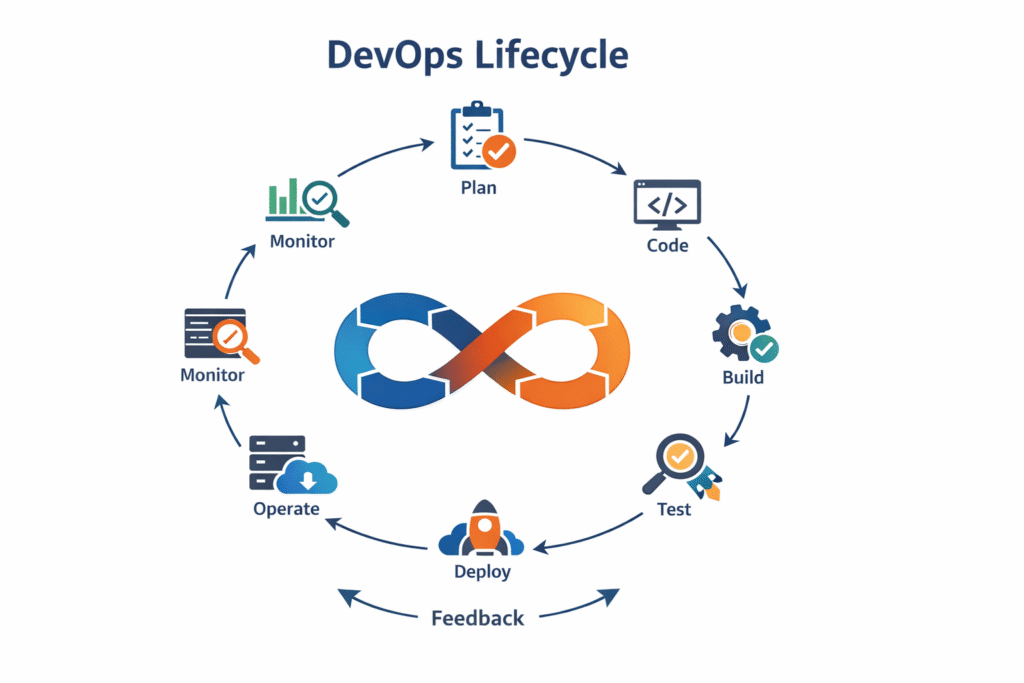
DevOps Lifecycle
DevOps vs Traditional IT: Key Differences
Understanding what is DevOps becomes easier when you compare it with the traditional IT approach.
| Feature | Traditional IT | DevOps |
|---|---|---|
| Team structure | Development and operations work separately | Development and operations work together |
| Software releases | Infrequent and slow | Frequent and fast |
| Testing | Mostly manual, late-stage | Automated and continuous |
| Deployment | Manual, high risk | Automated, low risk |
| Feedback | Delayed | Continuous and real-time |
| Reliability | Reactive issue fixing | Proactive monitoring and improvement |
Summary: Traditional IT focuses on stability but is slow. DevOps balances speed and stability through collaboration and automation.
DevOps Lifecycle Explained
The DevOps lifecycle shows how software moves from an idea to a live product and beyond. It is a continuous loop, not a one-time process.
Key Stages of the DevOps Lifecycle:
- Plan – Define requirements and goals
- Develop – Write and review code
- Build – Compile and package applications
- Test – Run automated tests
- Release – Prepare for deployment
- Deploy – Push code to production
- Operate – Manage infrastructure and uptime
- Monitor – Track performance, logs, and errors
- Feedback – Improve based on insights
This cycle helps teams release updates faster while continuously improving quality.
Also Read: How To Learn JavaScript
Simple DevOps Diagram
Below is a simple DevOps workflow diagram you can convert into an infographic for better UX:
Plan → Code → Build → Test → Release → Deploy → Monitor → Feedback
                  ↑______________________________________________↓
This loop highlights the core DevOps principle: Continuous improvement through constant feedback
Real-World DevOps Workflow Example
Let’s look at a real-world DevOps example to understand how it works in practice.
Scenario: Updating a Website Feature
- A developer updates a feature and commits code to Git.
- CI tools automatically build the code and run tests.
- If tests pass, the pipeline moves to deployment.
- The application is deployed automatically to production.
- Monitoring tools track performance and errors.
- If an issue occurs, alerts are sent instantly.
- Feedback is used to improve the next release.
Without DevOps, this process could take weeks. With DevOps, it can happen in minutes or hours.
What Is a DevOps Engineer?
A common question is what is a DevOps engineer and what does a DevOps engineer do.
A DevOps engineer is a professional who helps automate and manage the process of building, testing, deploying, and monitoring software. They act as a bridge between developers and operations teams.
What Does a DevOps Engineer Do?
- Builds automated deployment pipelines
- Manages cloud infrastructure
- Improves system reliability and performance
- Implements monitoring and observability
- Supports CI/CD processes
In short, DevOps engineering focuses on making software delivery smooth, fast, and secure.
What Is CI and CD in DevOps?
CI/CD is a core concept in DevOps.
- CI (Continuous Integration) means developers regularly merge code into a shared repository. Automated tests run to catch bugs early.
- CD (Continuous Delivery or Continuous Deployment) means code changes are automatically prepared or released to production.
CI/CD helps teams:
- Reduce manual work
- Catch issues early
- Release updates more frequently
What Is a Pipeline in DevOps?
A pipeline in DevOps is an automated workflow that moves code from development to production.
A typical DevOps pipeline includes:
- Code commit
- Build
- Testing
- Security checks
- Deployment
Pipelines ensure consistency and reduce human errors during releases.
What Is DevOps Automation?
DevOps automation means using tools and scripts to handle repetitive tasks such as testing, deployments, and infrastructure setup.
Automation helps by:
- Saving time
- Reducing mistakes
- Increasing deployment speed
- Improving reliability
Without automation, DevOps cannot scale effectively.
What Is DevOps Tools?
DevOps tools support different stages of the DevOps lifecycle.
Common DevOps tools include:
- Version control tools (Git)
- CI/CD tools (Jenkins, GitHub Actions)
- Configuration tools (Ansible, Terraform)
- Monitoring tools (Prometheus, Grafana)
- Cloud platforms (AWS, Azure)
The right DevOps tools help teams work faster and smarter.
What Is Observability in DevOps?
Observability in DevOps refers to the ability to understand what’s happening inside systems by analyzing logs, metrics, and traces.
Observability helps teams:
- Detect issues quickly
- Understand system behavior
- Improve performance
- Reduce downtime
It goes beyond monitoring by providing deeper insights into system health.
What Is DevOps Engineering?
DevOps engineering is the practice of designing, implementing, and maintaining DevOps processes. It combines software engineering, system administration, automation, and cloud skills.
DevOps engineering focuses on:
- Reliable systems
- Scalable infrastructure
- Continuous improvement
Also Read: How To Find Printer IP Address
What Is the Difference Between DevOps and DevSecOps?
Many people ask what is the difference between DevOps and DevSecOps.
- DevOps focuses on speed, collaboration, and automation.
- DevSecOps adds security into every stage of the DevOps process.
In DevSecOps, security checks are automated and integrated early, rather than added at the end.
Why DevOps Matters Today
Modern businesses release software updates frequently. DevOps helps companies:
- Stay competitive
- Reduce downtime
- Improve product quality
- Respond faster to customer needs
That’s why DevOps skills are in high demand worldwide.
Final Thoughts
Now you understand what is DevOps and why it plays a critical role in modern software development. DevOps is not just about tools it’s about teamwork, automation, and continuous improvement. Whether you’re a beginner or exploring DevOps engineering as a career, learning DevOps concepts can open many opportunities in today’s tech-driven world.
For more beginner-friendly tech tutorials, coding guides, and practical learning resources, visit Tonic Of Tech your go-to hub for learning technology the smart way.
FAQs About DevOps
1. What is DevOps in simple words?
DevOps is a way for development and operations teams to work together to build and release software faster and more reliably.
2. Is DevOps only for large companies?
No. DevOps works for startups, mid-size companies, and large enterprises.
3. What skills are needed for DevOps engineering?
Key skills include scripting, cloud platforms, automation, CI/CD, and system monitoring.
4. Is DevOps a tool or a process?
DevOps is a culture and process, supported by tools and automation.
5. Can DevOps improve software security?
Yes. When combined with DevSecOps practices, DevOps significantly improves security.