

Budget uncertainty is the quiet stressor that follows nearly every construction task from the primary estimate to the very last invoice. Owners need a number they can agree with, lenders need a plan that holds up under scrutiny, and contractors need to keep away from the awkward conversation that occurs when real expenses waft far from what was promised. This article explains how deeper, more thorough cost analysis turns financial uncertainty into something some distance greater viable.
Why Shallow Estimates Create Long-Term Budget Problems
A rushed estimate may look whole on paper; however, it often hides assumptions no one sticks to impeach. Missing allowances, outdated unit expenses, and indistinct scope descriptions all create small gaps that widen the longer an undertaking runs. Firms that lean on reliable Construction Estimating Services Florida groups agree with for distinct line-item breakdowns have a tendency to catch these gaps long before they develop into costly surprises.
The Danger of Assumed Costs
Every “we’re going to parent that out later” line item in an estimate is a hazard ready to floor. Left unaddressed, these assumptions almost continually resolve inside the patron’s least preferred course.
How Vague Scope Creates Budget Drift
When scope isn’t clearly described, contractors and clients frequently interpret it otherwise. That mismatch shows up later as a change order no one intended.
Why Detail Now Saves Money Later
Time spent breaking down fees at the estimating stage is almost always less expensive than the price of correcting a budget mid-construction.
Cost Analysis Into a Business Growth Tool
Contractors regarded for precise, defensible numbers naturally attract more referrals and repeat customers, because word travels fast in an industry built on trust. That recognition and an increasing number of leads immediately feed into construction lead generation, as prospective customers look for firms whose past projects stayed within their unique budgets in place of corporations that simply bid the lowest.
Reputation as a Marketing Asset
A log file of accurate budgets will become something a sales team can point to immediately, turning past overall performance into a proper aggressive side.

Referrals Built on Predictability
Clients who by no means have to worry about costs are way more likely to recommend a contractor to colleagues dealing with comparable initiatives.
Standing Out in a Crowded Bidding Field
When each bid on the table appears similar in fee, a documented record of financial accuracy becomes the tiebreaker that wins the process.
Where Design Decisions Intersect With Cost Certainty
Budget uncertainty does not always come from construction line items; it often begins in advance, during the duration of layout. Material choices, finishes, and architectural info all bring value implications that are not always apparent until pricing begins. Coordinating carefully with companies of Exterior Design Services early in the process helps make certain that aesthetic choices are priced as they should be from the beginning, in place of triggering redesigns as soon as the numbers come back higher than expected.
Aligning Design Ambition With Budget Reality
Beautiful layout concepts on occasion outpace what finances can clearly support.
Making Aesthetic Choices Cost-Transparent
When designers and estimators plan together from the start, customers get a realistic image of what their imagination and vision will cost.
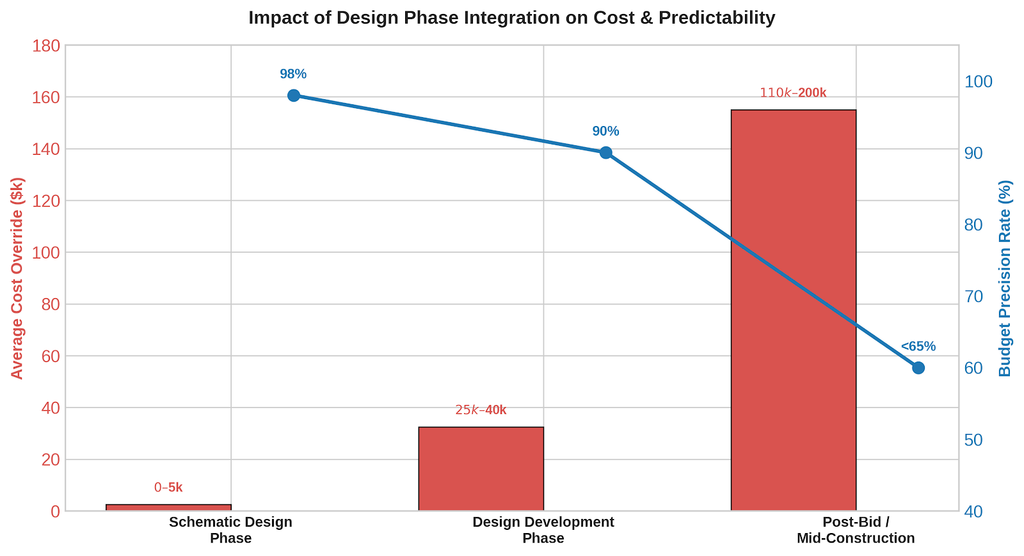
| Design Phase Integration | Mid-Project Redesign Risk | Avg. Cost Override | Turnaround Delay | Budget Predictability |
| Schematic Design Phase | Low (< 2%) | $0 – $5,000 | 0 Days | 98% Precision Rate |
| Design Development Phase | Moderate (8% – 12%) | $25,000 – $40,000 | 7–10 Days | 90% Precision Rate |
| Post-Bid / Mid-Construction | Severe (> 35%) | $110,000 – $200,000 | 21–45 Days | < 65% Precision Rate |
Common Blind Spots That Quietly Inflate Budgets
Some of the most destructive budget gaps are not dramatic mistakes; they may be small oversights that repeat across initiatives without everybody noticing:
- Outdated material pricing that hasn’t been updated in months
- Underestimated labor hours for forte or custom paintings
- Contingency allowances set too low to cover practical hazards.
None of those problems are uncommon on their own; however, left unchecked across more than one initiative, they quietly grow to be the difference between an organization that is truly regarded for dependable numbers and one that is continuously explaining overruns to pissed-off customers.
Steps Toward More Predictable Project Budgets
Building budget certainty is less about dramatic overhauls and greater approximately consistent, disciplined habits implemented on every task:
- Update pricing databases regularly in place of counting on the ultimate 12 months’ numbers
- Set contingency allowances primarily based on project complexity, not a flat percentage
- Review completed tasks to pick out where estimates continuously missed the mark
Applied constantly, this behavior flips value evaluation from a one-time exercise into an ongoing process that gets sharper with each undertaking completed, which is precisely what makes budgets predictable rather than annoying.

Final Thoughts
Budget uncertainty hardly ever comes from horrific success; it comes from cost analysis that wasn’t given sufficient attention at the beginning. Contractors who invest the time to break down expenses thoroughly, coordinate closely with layout partners, and research beyond initiatives consistently deliver budgets that hold up under pressure. In a market where clients have grown cautious of hidden charges, that kind of reliability isn’t always simply a precise exercise; it is an authentic business gain.
FAQs
1. What causes maximum construction price range overruns?
Overruns normally stem from shallow initial estimates, indistinct scope definitions, and outdated pricing instead of unpredictable outside factors alone.
2. How does certain fee evaluation reduce price range uncertainty?
Breaking down expenses line by way of line exposes hidden assumptions and gaps early, before they grow into high-priced surprises during creation.
3. Why is design coordination counted for cost accuracy?
Design selections made without value engineering often lead to steeply priced mid-mission redesigns once actual pricing comes back better than anticipated.
4. How much contingency should a construction budget consist of?
Contingency ought to reflect an undertaking’s real complexity and risk stage in preference to a set percent applied to each task irrespective of scope.
5. Can a strong track record of financial accuracy help win new commercial enterprise?
Yes. Contractors acknowledged for predictable budgets often entice more referrals and repeat clients, since reliability builds trust in an aggressive marketplace.