
Not long ago, placing a trade meant calling your broker and hoping the price hadn’t moved by the time they picked up. Today, software watches the charts, fires off orders, and closes positions while you sleep.
This shift touches everyone from hedge funds to people trading on their lunch break. Below, we’ll look at how automation took over the markets, what it does well, where it can go wrong, and how regulators are keeping up.
From Open Outcry Pits to Server Racks
Picture a trading floor in the 1980s. Hundreds of people in colorful jackets packed into a pit, shouting prices and flashing hand signals at each other. Every trade ended up on a paper ticket that someone had to process by hand. It was loud, chaotic, and slow, and only the people standing in that room got a real shot at the best prices.
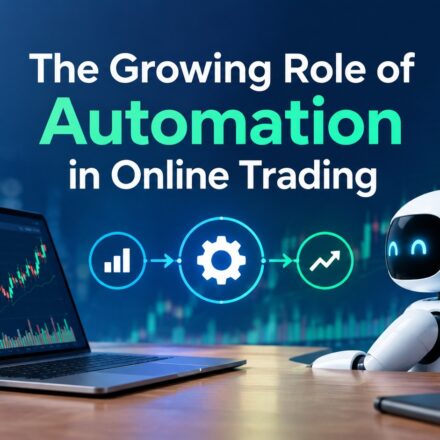
Fast forward to today, and a retail trader with a decent laptop can run an AI trading bot that scans charts and places orders around the clock. The kind of automation that once belonged to big banks now sits on your kitchen table, and you can set it up in an afternoon without writing a single line of code.
Of course, this didn’t happen overnight. Nasdaq launched in 1971 as the first electronic stock market, and computers slowly started matching buyers and sellers without a human in the middle. Institutions then began using simple algorithms to split large orders into smaller chunks, so they could build big positions without pushing the price against themselves.
So, what actually changed? Speed is the obvious answer, since trades that used to take minutes now happen in fractions of a second. Commissions also dropped to almost nothing, and many brokers now let you trade without paying a fee at all. Add broker APIs that anyone can connect to, and automation stops being a luxury for the few.
What Automated Systems Handle for Traders Today
Execution is where most automation starts. When you click buy on a volatile asset, the price you get can differ from the price you saw a second earlier. Traders call this slippage, and it adds up fast over hundreds of trades. Automated systems break orders into smaller pieces, choose better fill times, and keep that gap as small as possible.
Rebalancing is another job software handles well. Say you want 60% of your portfolio in stocks and 40% in bonds. After a strong month for stocks, that split drifts out of shape. A bot can check your allocation every week or every quarter and buy or sell just enough to bring everything back in line, without you opening a spreadsheet.
You see, most people know they should cut a losing trade at a certain point, but when the moment arrives, they hesitate and hope for a bounce. Automated stop-loss and take-profit orders don’t care about hope. They close the position at the exact level you set in advance, whether the market moves at noon or at 3 a.m.
Then there’s the sheer volume of information. A person can maybe track a dozen charts before their eyes glaze over. Software can watch hundreds of stocks, currency pairs, and crypto tokens at once, flag the ones that match your criteria, and alert you (or trade for you) the moment a setup appears. Nobody sitting at a desk can keep up with that.
Why Retail Traders Are Handing Over the Controls
Fear and greed wreck more trading accounts than bad strategies do. You set a plan, the market dips, and suddenly you sell at the bottom because it feels safer. A bot follows the rules you gave it, every single time. It doesn’t panic after three losses in a row, and it doesn’t get cocky after a lucky win either.
Most retail traders also have day jobs, kids, and a need for sleep. Crypto markets never close, and forex runs 24 hours a day on weekdays. Automation lets you take part in those markets without staring at your phone during meetings. Your strategy keeps running while you commute, cook dinner, or finally get eight hours of rest.
Before automation went mainstream, testing an idea usually meant trading it with real money and learning the hard way. Backtesting changes that. You run your strategy against years of historical data and see how it would have performed through crashes, rallies, and boring sideways months. It won’t predict the future, but it quickly exposes ideas that never worked in the first place.
Cost used to keep regular people out of this game. Institutional platforms charged a fortune, and building your own system required serious programming skills. Now, brokers with zero commissions and visual strategy builders let you assemble a working bot in an evening. If you can describe your rules in plain English, there’s a good chance some tool out there can turn them into trades.
Machine Learning Moves Into Signal Generation
Traditional trading bots follow fixed instructions, like buying when one moving average crosses another. Machine learning takes a different route. Models study years of price and volume data and pick up on patterns that a person would struggle to spot, such as how certain stocks behave in the hour before earnings or right after a sudden spike in trading volume.
Prices don’t move on numbers alone, though. A single news headline or a viral post can send a stock flying or tanking within minutes. Sentiment analysis tools read news articles, earnings call transcripts, and social media chatter, then score the overall mood around an asset. Traders use those scores as one more signal, alongside charts and fundamentals, before deciding whether to act.
Fixed rule sets have a big weakness. A strategy that worked great during a calm bull market can fall apart once volatility picks up. Adaptive models try to solve this by retraining on fresh data and adjusting their behavior as conditions shift. However, that flexibility cuts both ways, since a model that keeps changing is also harder to understand and audit.
Overfitting is the trap every machine learning trader eventually runs into. A model can get so good at explaining past data that it basically memorizes it, including random noise. The backtest looks amazing, and then the strategy falls flat once real money hits the market. Testing on data the model has never seen is the simplest way to catch this before it costs you.
Wrap Up
Automation has come a long way from the shouting pits of the 1980s. Today, it handles execution, rebalancing, and risk management, and it can even read the news, which puts serious tools in the hands of everyday traders.
Still, a bot only works as well as the strategy and oversight behind it. Test your ideas, watch out for scams, and keep learning, so you stay in charge of your money while the software does the heavy lifting.