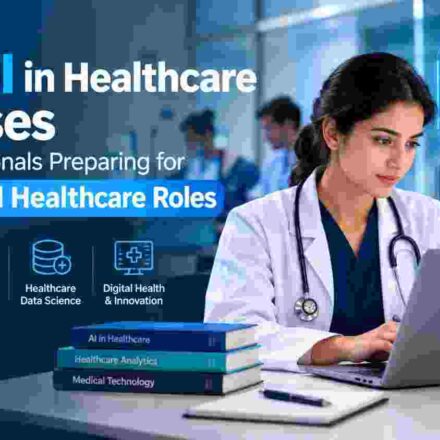

A hospital can invest heavily in AI and still struggle to use it properly. An algorithm may predict patient deterioration, but that prediction means little if clinicians cannot interpret it or the warning arrives too late.
Healthcare professionals now need to understand more than what AI can do. They must judge its reliability, work with clinical data, recognize risks, and understand how these systems fit into patient care.
The following five programs approach those responsibilities differently, from clinical decision support and healthcare operations to machine learning, medical software, and AI governance.
5 AI in Healthcare Courses
| # | Program & Provider | Duration | Fee | Best Aligned With |
| 1 | AI and Agentic AI in Healthcare – Johns Hopkins University | 10 weeks | US$2,990 | Clinical AI, decision support, agentic workflows |
| 2 | AI in Healthcare – Cornell University | 2 months | US$3,750 | Healthcare data, machine learning, NLP |
| 3 | AI in Health Care Systems – Harvard T.H. Chan School of Public Health | 12 weeks | US$3,200 | AI deployment, governance, health systems |
| 4 | Medical Software and Medical Artificial Intelligence – Yale University | 16-week curriculum | US$5,000 | Medical AI, regulation, software development |
| 5 | Applications of Machine Learning in Medicine – Stanford University | Self-paced, 20 learning hours | US$1,425 | Clinical datasets, prediction, ML deployment |
1. AI and Agentic AI in Healthcare – Johns Hopkins University
Johns Hopkins approaches healthcare AI through clinical problems rather than expecting participants to start with programming. This program for AI for healthcare professionals examines how predictive models, large language models, and autonomous workflows can support medical decisions.
The curriculum covers disease prediction, patient risk assessment, population health, and AI adoption. It also asks an important question: when should clinicians trust an automated recommendation?
Delivery & Duration: Ten weeks online, requiring about six to eight hours per week. Includes faculty masterclasses, mentoring, and healthcare case studies.
Credentials: Certificate of Completion and 6 CEUs from Johns Hopkins University.
Program Highlights: Clinical decision support, predictive analytics, R.O.A.D. Management Framework, healthcare ethics, agentic AI, and human oversight.
Hands-on Learning: Eight or more case studies, including AI-assisted chest X-rays and agentic clinical documentation. A masterclass examines pre-visit risk assessment using n8n.
Outcomes: Participants learn to evaluate clinical AI applications, assess model performance, and plan responsible implementation.
Why should you choose this course?
- No previous programming experience is required, making it accessible to clinicians and healthcare managers.
- Clinical cases connect AI concepts with patient safety and actual hospital workflows.
2. AI in Healthcare – Cornell University
Hospital records are rarely neat datasets. Missing information, inconsistent entries, and unstructured clinical notes can complicate even a promising AI project.
Cornell addresses these problems through technical coursework developed by Weill Cornell Medicine faculty. Participants work with healthcare databases, predictive models, and natural language processing rather than studying AI only from a management perspective.
Delivery & Duration: Two months online, with five to seven hours of weekly study.
Credentials: AI in Healthcare Certificate from Cornell University.
Program Highlights: Healthcare data management, SQL, Python, machine learning, natural language processing, and human-centered digital health design.
Outcomes: Learners practice preparing clinical datasets, developing predictive models, and extracting information from medical text.
Why should you choose this course?
- Technical assignments provide practical experience working with healthcare data.
- It suits professionals who already understand Python and machine learning and want to apply them to healthcare.
3. AI in Health Care Systems: Deploying AI Solutions at Scale – Harvard T.H. Chan School of Public Health
A successful AI pilot does not mean a hospital is ready for widespread deployment. Staff training, patient privacy, regulatory approval, and clinical workflows can all affect whether the technology delivers value.
Harvard Chan’s ai in healthcare course concentrates on these implementation challenges. Participants study how AI fits into healthcare systems, from identifying problems worth solving to monitoring deployed solutions.
Delivery & Duration: Twelve weeks online, with approximately six to eight hours of weekly study, faculty masterclasses, and mentorship.
Credentials: Certificate of Completion from Harvard T.H. Chan School of Public Health.
Program Highlights: Predictive, generative, and agentic AI, clinical workflow integration, healthcare systems analysis, algorithmic bias, and AI governance.
Hands-on Learning: A capstone requires participants to design an AI solution covering deployment, regulation, safety, scaling, and performance measurement.
Outcomes: Learners develop skills to assess healthcare AI opportunities and prepare implementation plans.
Why should you choose this course?
- It examines healthcare AI at the system level, including operations, safety, and accountability.
- The capstone produces a practical proposal for decision-makers rather than a purely theoretical assessment.
4. Medical Software and Medical Artificial Intelligence – Yale University
Medical AI is not simply an algorithm connected to a hospital database. Software reliability, regulatory requirements, cybersecurity, and clinical testing matter just as much.
Yale’s certificate combines medical software engineering with machine learning. Participants examine how healthcare applications are developed, evaluated, and regulated before reaching clinical environments.
Delivery & Duration: A 16-week online curriculum combining recorded lectures and live discussions.
Credentials: Non-degree certificate from Yale University.
Program Highlights: Machine learning, neural networks, generative AI, software engineering, FDA regulation, risk management, clinical decision support, and medical imaging.
Outcomes: Participants will understand medical AI development, software validation, regulatory responsibilities, and deployment risks.
Why should you choose this course?
- Medical software engineering receives attention alongside AI algorithms.
- Regulatory and safety topics make it relevant to medical-device and digital-health professionals.
5. Applications of Machine Learning in Medicine – Stanford University
Stanford focuses on the data behind medical prediction. Its two-course program examines how electronic health records, clinical notes, and patient histories can be prepared for machine learning.
The curriculum then moves into model development, evaluation, and the practical difficulties of using predictions in healthcare settings.
Delivery & Duration: Two self-paced online courses, each containing approximately ten learning hours. The All-Access Plan provides one year of access.
Credentials: Stanford Certificate of Achievement.
Program Highlights: Clinical datasets, electronic phenotyping, natural language processing, deep learning, model validation, and responsible deployment.
Outcomes: Participants practice preparing healthcare data, evaluating predictive models, and identifying limitations affecting clinical applications.
Why should you choose this course?
- It gives professionals focused exposure to clinical data preparation and prediction.
- The self-paced format suits learners who prefer a shorter, technically focused program.
Conclusion
Healthcare AI roles are not identical. A clinical manager may need stronger implementation judgment, while an analyst may benefit from experience with datasets, algorithms, and model evaluation.
Before selecting a program, consider what your current role demands and where your knowledge falls short. The most useful AI in healthcare education should help you make sound decisions about technology that affects actual patients, not simply recognize the latest AI terminology.