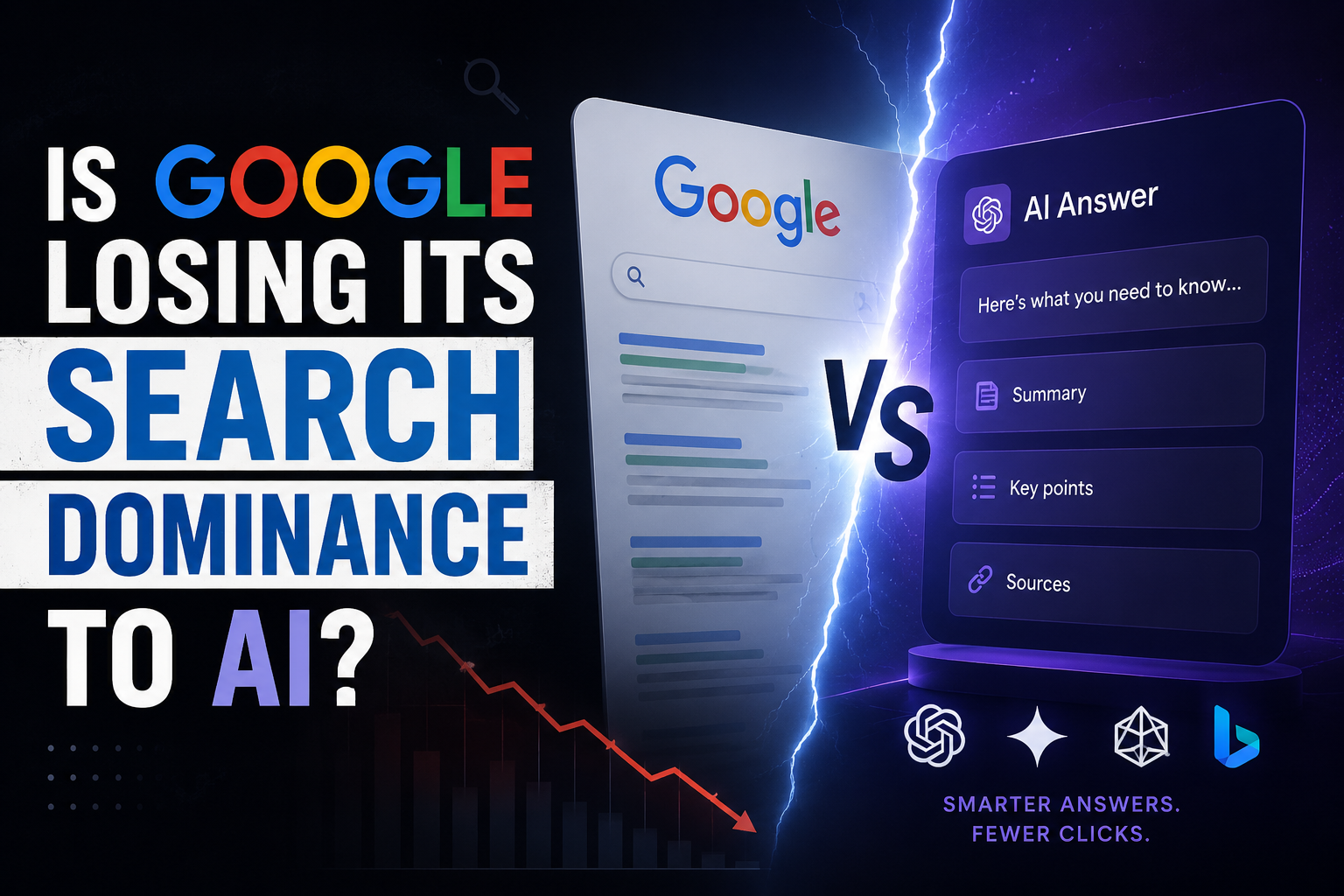

No, Google is not losing its dominance outright — it still controls roughly 90% of global search and revenue keeps growing. But real cracks are forming: Google lost two senior AI researchers to rivals in one week, DuckDuckGo’s “no-AI” search install rate is up 40% weekly, search traffic dipped slightly while ChatGPT usage rose, and Google’s own AI Overviews threaten the ad-click business model that funds the company. Google is dominant but no longer untouchable.
Key Facts at a Glance
- Google still holds about 90% global search market share
- Alphabet stock has more than doubled in the past year
- Google lost 2 senior AI researchers to rivals in one week (June 2026)
- DuckDuckGo installs are up 40% week-over-week
- ~50% of Americans say AI makes them “more concerned than excited” (Pew)
- Google ad revenue = ~75% of Alphabet’s total revenue
- Google’s 2026 AI infrastructure spend: $190–200 billion
- AI Overviews reach 2.5 billion+ monthly users
- Microsoft’s Bing crossed 1 billion users for the first time
- ChatGPT is the #1 free app on Apple’s App Store; Gemini and Claude trail behind it
What Does “Google’s Dominance Is Cracking” Actually Mean?
It means Google’s market position is still strong by the numbers, but the trend lines are bending in the wrong direction. Google’s search traffic dipped slightly over the past month while ChatGPT’s usage rose over the same period. Neither shift is dramatic alone, but together they signal that user attention is gradually migrating away from traditional search and toward AI chat interfaces — even as Google’s headline revenue and query-volume numbers stay healthy.
Why Did Google Lose Two AI Researchers in One Week?
Google lost two high-profile AI researchers to competing labs within the same week in June 2026, most notably a DeepMind engineering fellow who left after nine years to join Anthropic. He co-created AlphaFold, the AI system that has predicted the structure of more than 200 million proteins.
Analysts at Jefferies attribute this to an industry-wide bidding war for AI talent rather than a sign Google is falling behind technically. Every major AI lab — OpenAI, Anthropic, Meta — is offering enormous compensation packages to top researchers right now, and Google is not the only company losing people to it. The timing simply compounded existing investor anxiety: the departures landed right after Alphabet stock had its worst single day in over a year, and shortly after Microsoft CEO Satya Nadella publicly said the AI model market was becoming “commoditized.”
Why Are People Switching to “No-AI” Search Engines?
People are switching to no-AI search engines because they want to research and click through web pages themselves rather than receive an AI-generated summary. DuckDuckGo, a privacy-focused search engine, has seen install rates jump by up to 40% in a single week. It recently launched browser extensions that let users default to a “no-AI” version of its search engine that strips out AI-generated summaries entirely.
This isn’t a fringe behavior. A Pew Research Center survey found that roughly half of Americans say AI in their daily lives leaves them more concerned than excited about it. Search is often where that discomfort shows up first, since AI Overviews insert a synthesized answer between the user and the websites they intended to visit.
Why Does AI Search Threaten Google’s Business Model?
AI search threatens Google’s business model because the company’s ad revenue depends on users clicking through to websites, and AI-generated answers reduce the need to click at all. Advertising still accounts for roughly three-quarters of Alphabet’s total revenue, and that revenue funds everything from the company’s $190–200 billion annual AI infrastructure spending to long-term bets like Waymo.
When an AI Overview answers a query directly inside the search results page, there’s often no click, no visit to the source website, and no ad impression. This puts Google in a bind: it must keep adding AI features to compete with ChatGPT, but every AI feature it adds risks cannibalizing the ad-click model that pays for the AI buildout in the first place.
This is also the core of the publisher backlash against Google. For years, the arrangement was simple — publishers created content, Google indexed and ranked it, and a share of search traffic flowed back to the source. AI Overviews disrupts that exchange: the underlying article supplies the facts, but the AI summary may capture the visit instead. Publishers increasingly describe this as a structural rewrite of the value exchange that built the open web, not just an algorithm update.
Is Google’s AI Strategy Actually Working?
Yes, by usage numbers, Google’s AI strategy is working: AI Overviews reaches more than 2.5 billion monthly users, and AI Mode passed 1 billion monthly users within roughly a year of launch. Search revenue is still climbing, and query volume is at an all-time high. Most of Wall Street still views Google as one of the strongest companies in AI given its custom TPU chips, massive Android distribution, and cloud growth.
What’s changed isn’t Google’s performance — it’s the perception around it. For years Google looked untouchable in search. Now it looks merely dominant, and dominant incumbents draw far more scrutiny over small signs of strain than smaller competitors do.
How Does Bing Fit Into This?
Microsoft’s Bing crossed 1 billion users for the first time in the most recent quarter, partly on the strength of its own AI chat integrations. This matters because it shows Google isn’t only losing ground to AI chatbots like ChatGPT — its long-standing search rival is also gaining momentum, helped by the same generative AI wave that’s pressuring Google.
There’s a mobile dimension too: ChatGPT has consistently ranked as the top free app on Apple’s App Store, with Google’s own Gemini ranked further down the list and Anthropic’s Claude recently sitting just one spot behind it. That ranking reflects a behavior shift — more people are opening a chatbot app first instead of opening a browser and typing into Google.
Frequently Asked Questions
Is Google losing market share to ChatGPT? Not in raw market share terms — Google still controls about 90% of global search. But Google’s search traffic dipped slightly over the past month while ChatGPT usage rose, suggesting a gradual shift in user attention rather than an immediate loss of dominance.
What percentage of Google’s revenue comes from ads? Roughly three-quarters (about 75%) of Alphabet’s total revenue comes from advertising, which is why AI-driven, zero-click search results pose a financial risk to the company.
Why did Google’s stock drop in June 2026? Alphabet had its worst single trading day in over a year after losing two high-profile AI researchers to rival labs in the same week, compounding existing investor concerns about AI competition and capital spending.
What is DuckDuckGo’s “no-AI” search engine? It’s a version of DuckDuckGo’s search results, accessible through new browser extensions, that strips out AI-generated summaries so users see traditional, link-based results instead.
Will AI Overviews replace Google Search? Not entirely — Google’s AI Overviews and AI Mode already reach billions of monthly users and search revenue continues to grow. But the more Google’s AI summarizes answers directly, the more it risks reducing the website clicks that its ad business depends on.
The Takeaway
Google’s grip on the internet is loosening at the edges, not breaking. It’s being squeezed from several directions at once: rival AI labs poaching its talent, chatbot apps competing for the time people used to spend in a browser, Bing quietly crossing the billion-user mark, and a real segment of users actively opting out of AI-powered search altogether. How Google balances staying competitive in AI without undermining the ad-funded model that pays for it all is likely the defining tech story of the rest of 2026.
If you’re tracking how AI is reshaping the tools we use every day, that’s exactly the kind of story we cover here at Tonic of Tech.