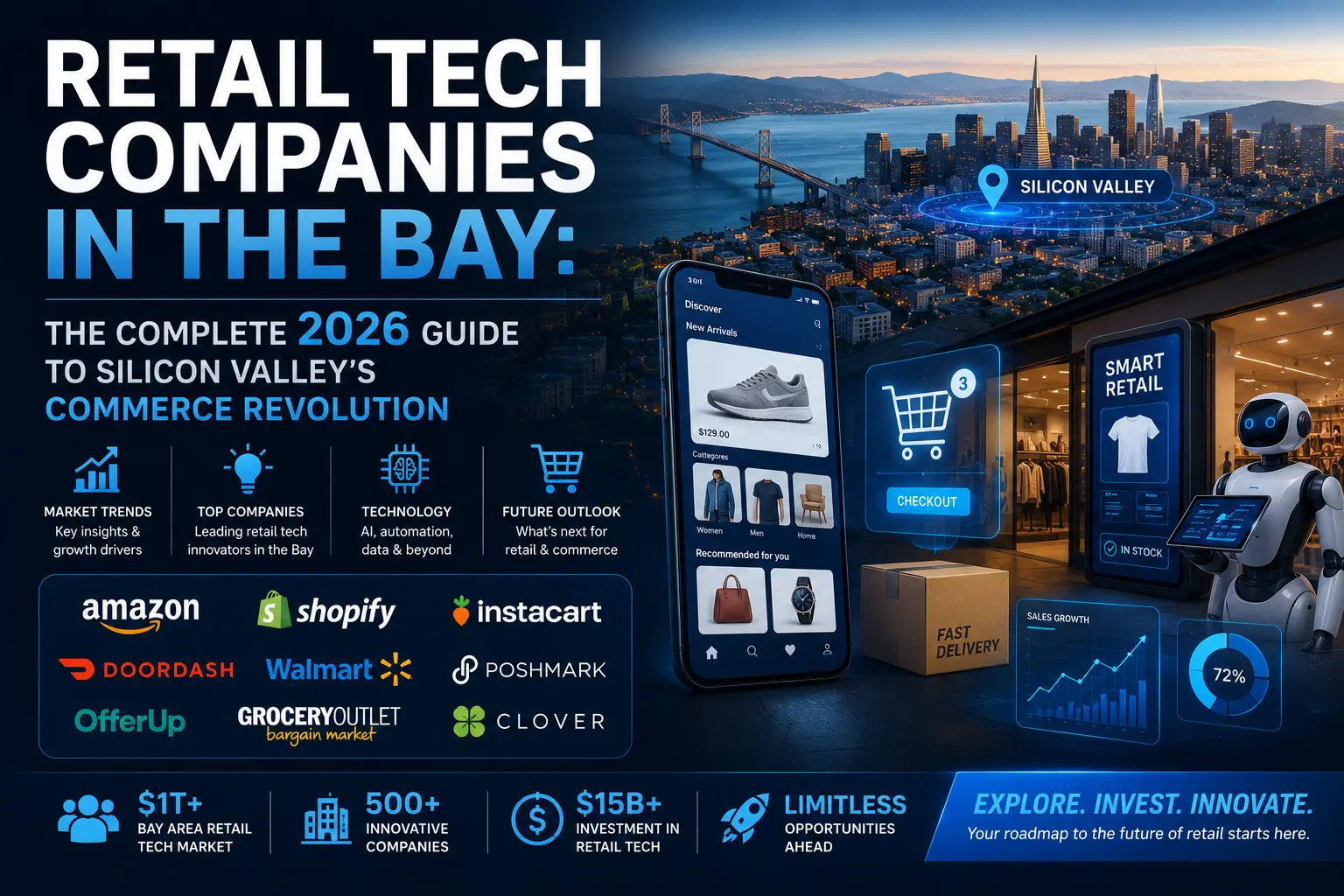

When people talk about retail tech companies in the Bay, they are referring to one of the most concentrated ecosystems of commerce innovation on Earth. The San Francisco Bay Area — spanning San Francisco, Silicon Valley, Oakland, and the broader nine-county region — is home to an astonishing density of companies that are fundamentally rewiring retail as we know it.
From billion-dollar public companies like Instacart and DoorDash, to scrappy Y Combinator-backed startups building checkout-free stores, to enterprise giants like Salesforce and Stripe processing trillions of dollars in commerce — the Bay Area has an unmatched grip on retail’s future.
This guide covers the top retail tech companies in the Bay, organized by category, with details on what they do, why they matter, and what makes each one worth watching in 2026 and beyond.
Quick Stat: Bay Area startups collectively raised over $111 billion in venture funding through Q3 2025 alone — the highest on record — fueling an extraordinary wave of retail tech innovation.
What You Will Find in This Guide
- What makes the Bay Area the hub of retail tech
- Grocery & delivery tech leaders
- Payments & point-of-sale innovators
- Wholesale & B2B marketplace platforms
- AI, personalization & commerce intelligence
- Logistics, supply chain & fulfillment companies
- Checkout-free & in-store technology
- Emerging startups to watch in 2026
- FAQs about retail tech in the Bay Area
Section 1: What Makes the Bay Area the Epicenter of Retail Tech?
The Bay Area’s dominance in retail technology is not an accident. It is the product of decades of compounding advantages that no other region has been able to replicate.
1. The World’s Densest Startup Ecosystem
With approximately 6,263 startups per 100,000 residents, San Francisco has the highest startup density on Earth. This concentration means that retail entrepreneurs, engineers, and investors are constantly in the same rooms, conferences, and coffee shops — accelerating the speed at which ideas turn into funded companies.
2. Access to Tier-1 Venture Capital
Firms like Sequoia Capital, Andreessen Horowitz, Y Combinator, and Kleiner Perkins — the investors who funded Amazon, Stripe, Instacart, DoorDash, and Faire — are all headquartered in the Bay. Retail tech startups here have immediate access to capital that founders in other cities have to fly to meet.
3. A Culture of Rapid Iteration
The Bay Area’s tech culture prizes speed over perfection. This ‘ship it and iterate’ mindset is particularly well-suited to consumer-facing retail tech, where user feedback loops are fast and product-market fit can be found quickly through real-world testing.
4. Cross-Industry Talent Pipelines
Stanford, UC Berkeley, and UCSF feed world-class engineers, data scientists, and designers into the local talent pool. Many of the AI and machine learning capabilities powering today’s retail tech companies were incubated in Bay Area university labs.
5. Infrastructure Network Effects
The Bay is home to the core infrastructure layers that power modern retail: Stripe for payments, Salesforce for CRM and commerce cloud, Algolia for search, Snowflake for data, and Flexport for global logistics. When every company in the ecosystem is using and building on top of each other’s infrastructure, innovation compounds quickly.
Also Read: Interventional Radiology Tech: Complete Career Guide for 2026
Section 2: Grocery & On-Demand Delivery Leaders
Perhaps no retail vertical has been more dramatically reshaped by Bay Area tech than grocery and on-demand delivery. What started with Instacart’s 2012 launch in San Francisco has grown into a multi-billion-dollar industry.
Instacart (Maplebear Inc.) — San Francisco
Location: San Francisco, CA | NASDAQ: CART
Focus: Grocery technology, same-day delivery, retail media, in-store AI
Instacart is the leading grocery technology company in North America, partnering with more than 2,200 retail banners representing nearly 100,000 stores. The company’s platform covers three distinct businesses: the Instacart Marketplace (consumer-facing delivery), Instacart Enterprise (white-label technology for grocers), and Instacart Ads (a $1B+ retail media business). In 2025, Instacart generated over $1 billion in advertising and other revenue, and in 2026 it acquired global fulfillment platform Instaleap to expand internationally into Europe, Latin America, and the Middle East. Instacart’s AI-powered Caper Cart — a smart shopping cart that lets customers checkout without going to a register — is being deployed in stores across the U.S.
DoorDash — San Francisco
Location: San Francisco, CA | NASDAQ: DASH
Focus: Last-mile delivery, on-demand commerce, logistics infrastructure
Founded in 2013, DoorDash started as a restaurant delivery platform and has evolved into a comprehensive last-mile commerce infrastructure company. DoorDash’s technology connects millions of consumers with local businesses — not just restaurants, but grocery stores, convenience stores, beauty retailers, and pet supply shops. The company’s DashMart convenience stores and its partnership with major retailers like Ulta Beauty make it a central player in the broader retail delivery ecosystem.
Together, Instacart and DoorDash represent the two biggest Bay Area bets on the convergence of retail and logistics — and both are now aggressively expanding their retail media and enterprise technology offerings.
Section 3: Payments & Point-of-Sale Innovators
The Bay Area has produced the most important payments and point-of-sale companies of the past two decades. These companies are not just payment processors — they are becoming the operating systems for retail businesses of all sizes.
Stripe — San Francisco
Location: San Francisco, CA (Private)
Focus: Payments infrastructure, commerce APIs, embedded financial services
Stripe is the financial backbone of modern retail. Founded in 2010 by Patrick and John Collison, Stripe processed approximately $1.4 trillion in payment volume in 2025, making it one of the most critical infrastructure providers in global commerce. For retailers, Stripe offers everything from seamless online checkout to in-person point-of-sale hardware, subscription billing, fraud prevention via machine learning, and embedded financial services through Stripe Capital and Stripe Issuing. Valued at approximately $107 billion, Stripe is the world’s most valuable private fintech company.
Block (Square) — San Francisco
Location: San Francisco, CA | NYSE: SQ
Focus: Point-of-sale hardware and software, payments, omnichannel commerce
Block (formerly Square) was founded in 2009 by Jack Dorsey and Jim McKelvey with the insight that small businesses deserved the same payment infrastructure as large retailers. Today, Square’s ecosystem covers point-of-sale hardware, inventory management, employee scheduling, online store builders, and loyalty programs — all in an integrated omnichannel suite. Square remains the most widely used POS system for independent retailers in the U.S., and its Cash App business has expanded financial access for millions of consumers.
Key Insight: Between Stripe and Square/Block, the Bay Area is responsible for processing a significant majority of all card-present and card-not-present retail transactions in the United States.
Section 4: Wholesale & B2B Marketplace Platforms
Retail does not begin with the consumer — it begins with the supply chain. Several of the most innovative retail tech companies in the Bay are focused on transforming how goods flow from brands to the retailers who sell them.
Faire — San Francisco
Location: San Francisco, CA (Private, YC-backed)
Focus: B2B wholesale marketplace, independent retail, machine learning-driven matching
Faire is one of the most consequential Bay Area retail tech companies that most consumers have never heard of. The company operates an online wholesale marketplace that uses machine learning to match independent retailers with brands and products uniquely suited to their stores. With more than 2 million independent retailers in North America and Europe generating over $2 trillion in combined revenue, Faire is targeting a massive and underserved market. The platform’s data-driven approach eliminates inventory risk for retailers by offering free returns on opening orders, and provides access to capital that was previously only available to large chains.
Flexport — San Francisco
Location: San Francisco, CA (Private, YC-backed)
Focus: Global trade, freight forwarding, supply chain technology
Flexport’s mission is to make global trade easy for everyone — and it is doing so by building the technology platform for global logistics. The company works with more than 40,000 customers across industries including manufacturing, retail, electronics, consumer goods, and apparel. For retailers importing products from overseas suppliers, Flexport provides end-to-end visibility into shipments, customs clearance, and delivery timelines — dramatically reducing the opacity that has historically made international sourcing a headache.
Also Read: Is Google Losing Its Search Dominance to AI? Here’s What’s Actually Happening
Section 5: AI, Personalization & Commerce Intelligence
Artificial intelligence is rapidly becoming the defining technology of modern retail, and the Bay Area is leading the charge. From search and personalization to predictive analytics and conversational commerce, these companies are helping retailers make smarter decisions and deliver more relevant experiences.
Algolia — San Francisco
Location: San Francisco, CA
Focus: AI-powered search and discovery APIs for retail and e-commerce
Algolia provides the search and discovery infrastructure that powers product discovery on thousands of retail websites and mobile apps. More than 9,000 companies rely on Algolia to handle over 50 billion search queries per month, helping shoppers find the right products faster. For retailers, better search directly correlates with higher conversion rates — and Algolia’s AI-driven relevance tuning has made it the default choice for engineering teams building serious e-commerce experiences.
Salesforce (Commerce Cloud) — San Francisco
Location: San Francisco, CA | NYSE: CRM
Focus: CRM, e-commerce platform, AI-powered retail personalization, retail media
Salesforce is one of the most important enterprise technology companies in the world, and its Commerce Cloud division is a major player in the retail technology landscape. Salesforce Commerce Cloud powers e-commerce operations for hundreds of major brands and retailers globally. The company’s Vertex AI-integrated tools enable personalized product search, conversational shopping assistants, and predictive recommendations — all powered by the enormous customer data sets Salesforce manages through its CRM platform.
GrubMarket — San Francisco
Location: San Francisco, CA (YC-backed)
Focus: AI-powered food supply chain technology, B2B food commerce
GrubMarket is transforming the American food supply chain — one of the largest and most analog industries in the country — with AI-powered e-commerce and software technology. The company connects food producers, distributors, and retailers on a single digital platform, reducing waste and inefficiency across the supply chain. For grocery retailers in particular, GrubMarket’s technology offers a path from manual, phone-based ordering to a fully digitized procurement workflow.
Section 6: Logistics, Fulfillment & Supply Chain
Fast, reliable fulfillment is now a baseline expectation for retail consumers. The Bay Area is home to companies building the next generation of logistics infrastructure — from warehouse robotics to hyperlocal delivery networks.
Narvar — San Francisco
Location: San Francisco, CA
Focus: Post-purchase experience, order tracking, returns management
Narvar powers the post-purchase experience for hundreds of the world’s largest retailers and brands. After a customer clicks ‘buy,’ Narvar’s platform handles order tracking communications, delivery notifications, and the returns process. In a competitive retail environment where customer loyalty is earned and lost in the delivery experience, Narvar’s focus on the ‘last mile of trust’ has made it an essential infrastructure layer for retail operations teams.
Additionally, the Bay Area hosts a cluster of warehouse robotics startups — many backed by Y Combinator — that are building swarms of small autonomous robots to automate the $10 billion per year that U.S. retailers spend on manual warehouse labor. These companies are deploying into existing warehouse facilities at a fraction of the cost of traditional automation solutions.
Section 7: Checkout-Free & In-Store Technology
One of the most exciting frontiers in retail tech is the transformation of the physical store experience. Bay Area companies are leading the development of checkout-free technology, smart carts, and AI-powered in-store analytics.
Zippin — San Francisco
Location: San Francisco, CA
Focus: Checkout-free retail technology, sensor fusion, computer vision
Zippin has developed next-generation checkout-free technology that enables retailers to quickly deploy frictionless shopping experiences in their stores. Rather than requiring massive infrastructure investments, Zippin’s platform uses AI, machine learning, and sensor fusion to track products and shoppers throughout the store — allowing customers to pick up items and walk out without stopping at a checkout line or self-scanner. Zippin’s approach represents the fastest path for existing retailers to offer the Amazon Go-style experience at scale.
Instacart’s Caper AI division — acquired for $350 million in 2021 — is also Bay Area-based, and its AI-powered smart carts are being deployed in grocery stores across the country, scanning items as shoppers place them in the cart and enabling seamless checkout.
Section 8: Consumer Platforms & Marketplaces
Beyond infrastructure, the Bay Area has produced some of the most influential consumer-facing retail platforms in the world — services that millions of shoppers interact with every day.
Babylist — Oakland
Location: Oakland, CA
Focus: Baby registry technology, parenting platform, e-commerce
Babylist is the trusted platform for millions of growing families, combining baby registry technology with a full-service commerce and community platform. With over 9 million people using the service annually, Babylist has evolved from a registry tool into a comprehensive destination for product discovery, expert advice, and purchasing — making it one of the most successful vertical e-commerce platforms in the Bay Area.
ShopStyle — San Francisco
Location: San Francisco, CA
Focus: Fashion and lifestyle shopping platform, influencer commerce, affiliate technology
ShopStyle is the leading fashion and lifestyle shopping platform for influencers and consumers. The San Francisco-based company connects brands and retailers with influencers and shoppers through best-in-class technology, data, and tools designed to drive new customers and sales. With localized sites in the U.S., U.K., Japan, Canada, and Australia, ShopStyle has built one of the most sophisticated influencer commerce platforms in the world.
Section 9: Emerging Retail Tech Startups to Watch in 2026
The Bay Area’s startup pipeline ensures a constant supply of new retail tech companies challenging incumbents and opening new categories. Here are the most promising emerging companies to watch:
- Nash — Hyperlocal delivery infrastructure that democratizes local delivery for businesses of all sizes, providing the merchant-facing technology layer above the carrier networks.
- Flare — The leading delivery date platform for Shopify Plus brands globally, powering checkout delivery logic for over 700 merchants and processing more than $100 million in orders annually.
- Warehouse robotics startups (YC cohorts) — Multiple Bay Area companies building swarms of mobile robots for case picking and palletization in existing warehouses, with installation costs far below traditional automation.
- Float — Building the payments rails and intelligence layer for consumer benefits, targeting the $300B+ market in healthcare and loyalty benefits that remains largely offline.
- Madison Reed — San Francisco-based e-commerce company revolutionizing the $50 billion hair care market with technology-driven personalization and a direct-to-consumer model.
Section 10: Quick Reference — Top Retail Tech Companies in the Bay
Use this table as a quick reference when evaluating the Bay Area retail tech landscape:
| Company | Headquarters | Category | Stage / Status |
| Instacart | San Francisco | Grocery Tech / Delivery | Public (NASDAQ: CART) |
| DoorDash | San Francisco | Last-Mile Delivery | Public (NASDAQ: DASH) |
| Stripe | San Francisco | Payments Infrastructure | Private ($107B valuation) |
| Block / Square | San Francisco | POS & Payments | Public (NYSE: SQ) |
| Faire | San Francisco | B2B Wholesale Marketplace | Private (YC-backed) |
| Flexport | San Francisco | Global Logistics | Private (YC-backed) |
| Algolia | San Francisco | Search & Discovery AI | Private |
| Salesforce | San Francisco | Enterprise Commerce Cloud | Public (NYSE: CRM) |
| GrubMarket | San Francisco | Food Supply Chain AI | Private (YC-backed) |
| Zippin | San Francisco | Checkout-Free Technology | Private |
| Babylist | Oakland | Baby Registry & Commerce | Private |
| ShopStyle | San Francisco | Fashion Commerce Platform | Private |
| Narvar | San Francisco | Post-Purchase Experience | Private |
| Nash | San Francisco | Local Delivery Infrastructure | Private |
Also Read: Steam Machine vs PS5: Which Should You Buy in 2026?
Section 11: Key Trends Shaping Retail Tech in the Bay in 2026
The retail tech ecosystem in the Bay is not static. Several powerful trends are reshaping which companies rise, which categories consolidate, and where the next generation of startups will emerge.
1. AI-Native Commerce
Generative AI and large language models are rapidly moving from experiments to production systems in retail. Bay Area companies — with access to the world’s best AI talent and infrastructure — are leading the deployment of AI-powered shopping assistants, personalized product recommendations, dynamic pricing, and conversational commerce interfaces.
2. Retail Media Networks
Retailers have discovered that their first-party shopper data is enormously valuable to brands seeking to advertise against high-intent consumers. Instacart’s $1 billion advertising business in 2025 is the clearest example, but virtually every major Bay Area retail tech platform is building retail media capabilities.
3. Checkout-Free Expansion
Checkout-free technology — once a novelty limited to Amazon Go stores — is going mainstream. Multiple Bay Area companies, including Zippin and Instacart’s Caper AI, are making frictionless retail accessible to mid-sized and independent retailers at reasonable cost.
4. Composable Commerce
Enterprise retailers are moving away from monolithic e-commerce platforms toward composable architectures — assembling best-of-breed solutions from specialized vendors for search, payments, fulfillment, CRM, and loyalty. This trend plays directly into the strengths of the Bay Area ecosystem, where specialized point solutions are abundant.
5. Cross-Border and International Expansion
Bay Area retail tech companies are increasingly expanding beyond North America. Instacart’s acquisition of Instaleap in 2026, giving it a foothold across Europe and Latin America, is a bellwether for this trend. Faire’s marketplace, already active across Europe, is another example.
Conclusion: The Bay Area’s Retail Tech Moment
The retail tech companies in the Bay are not just building apps — they are rebuilding the fundamental infrastructure of global commerce. From the moment a brand manufactures a product to the instant it lands on a consumer’s doorstep (or is picked up in a frictionless checkout-free store), Bay Area technology is increasingly touching every step of the journey.
The companies profiled in this guide represent the most important players in this ecosystem today. But if history is any guide, the Bay Area’s startup pipeline will produce a new generation of retail tech challengers — backed by AI capabilities that did not exist five years ago — that will reshape this landscape further in the years to come.
Whether you are an investor looking for the next breakout retail tech opportunity, a retailer evaluating technology vendors, a job seeker looking to work at the intersection of commerce and technology, or simply a curious observer of how the world is changing — the Bay Area retail tech ecosystem is the place to watch.
Frequently Asked Questions: Retail Tech Companies in the Bay
Q: What is a retail tech company?
A retail tech company is any business that provides technology — software, hardware, platforms, or infrastructure — that helps retailers sell products more efficiently, reach more customers, or deliver better shopping experiences. This includes everything from e-commerce platforms and payment processors to inventory management systems and delivery logistics software.
Q: Why are so many retail tech companies based in the Bay Area?
The Bay Area offers an unparalleled combination of venture capital access, engineering talent, a startup-friendly culture, and network effects from existing retail tech infrastructure (payments, cloud, AI) that is concentrated in the region. Companies here can move faster, raise more capital, and recruit better talent than in virtually any other city.
Q: Who are the biggest retail tech companies headquartered in the Bay Area?
By market cap or valuation, the largest retail tech companies in the Bay include Salesforce (NYSE: CRM), Block/Square (NYSE: SQ), Instacart (NASDAQ: CART), DoorDash (NASDAQ: DASH), and Stripe (private, ~$107B valuation). Among private companies, Faire and Flexport are also significant players.
Q: Are there retail tech incubators or accelerators in the Bay Area?
Yes. Y Combinator, headquartered in Mountain View, has backed dozens of retail tech startups including Faire, Flexport, and GrubMarket. Plug and Play Tech Center in Sunnyvale runs a dedicated retail and e-commerce accelerator. Many other Bay Area accelerators and venture studios also support commerce-focused startups.
Q: Is the Bay Area retail tech scene growing or shrinking?
Growing significantly. Despite broader tech layoffs in 2023-2024, the retail tech sector in the Bay has benefited from the AI wave, increased consumer demand for digital commerce, and a post-pandemic normalization of online shopping habits. Funding for Bay Area retail tech startups rebounded strongly in 2025 and 2026.
Q: How can I find a job at a retail tech company in the Bay Area?
Major job boards like LinkedIn, Wellfound (formerly AngelList Talent), and BuiltIn San Francisco list thousands of open roles at Bay Area retail tech companies. Y Combinator’s Work at a Startup platform focuses specifically on YC-backed companies. For senior and executive roles, specialized tech recruiting firms in San Francisco are active across the retail tech sector.