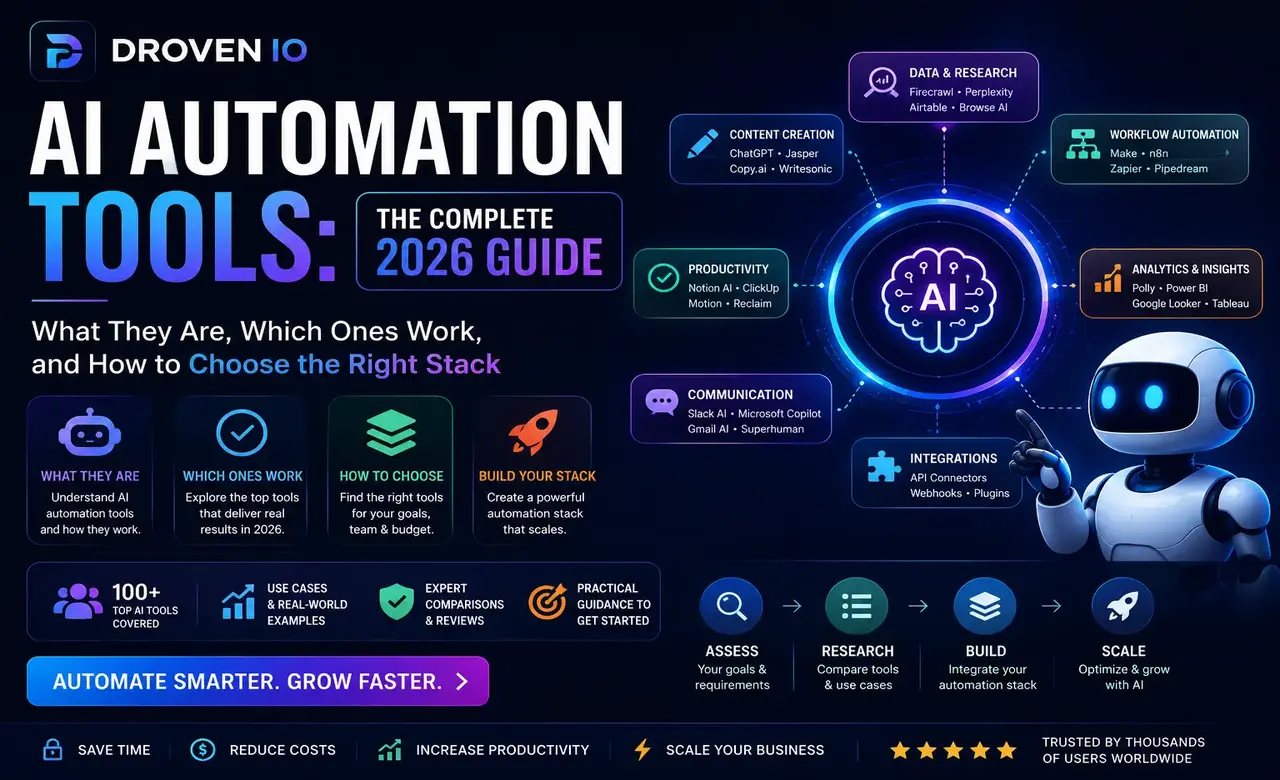

This is the most complete, vendor-neutral guide to Droven IO AI automation tools in 2026. We cover what Droven.io actually is, the top 10 AI automation tools it documents, how to match each tool to your specific use case, real industry deployment examples, honest failure modes, security risks most guides skip, and a step-by-step decision framework — so you can choose your automation stack with confidence and without a sales pitch attached.
Why This Guide Exists: The Problem with Most Droven IO Content
Search for ‘Droven IO AI automation tools’ and you will find dozens of articles. Most of them have one thing in common: they were written by companies trying to sell you something. Agency blogs that list the same tools, declare them ‘the best,’ and then offer to deploy them for a fee. Review platforms with undisclosed affiliate relationships with the vendors they rank. Content farms regurgitating the same surface-level tool list with no real-world context.
This guide is different. We have read every major competitor article ranking for this keyword. We know what they cover. More importantly, we know what they all skip: the failure modes, the security risks, the ‘this tool is wrong for your use case’ warnings, the honest comparison of Droven.io against similar platforms, and the practical decision framework that lets you choose correctly without booking a sales call first.
Here is everything you actually need to know about Droven IO AI automation tools in 2026.
What Is Droven.io? The Honest Definition (And What It Is NOT)
Droven.io is a free, editorially independent AI and technology knowledge platform. It publishes structured, research-backed educational content on artificial intelligence, automation, machine learning, cloud computing, and cybersecurity — without selling software, offering certifications, or maintaining affiliate relationships with the vendors it covers.
The name itself carries meaning. ‘Droven’ draws from an older regional English usage — an informal past participle of ‘drive.’ The founders chose it to reflect the platform’s core positioning: driven by curiosity, driven by purpose, and driven by a commitment to making technology knowledge accessible without a sales agenda.
Think of Droven.io as a trusted technology analyst, not a product marketplace. It explains the landscape before you spend a dollar on it.
What Droven.io IS:
- An editorial knowledge platform covering AI, automation, RPA, cloud computing, ML, and cybersecurity
- A vendor-neutral resource that explains what tools do, who they serve, and where they fail
- A practical starting point for businesses mapping their automation strategy before selecting tools
- A reference hub for business owners, developers, marketers, and operations professionals
- US-focused technology intelligence — with detailed coverage of Silicon Valley, enterprise AI adoption, and the American AI job market
What Droven.io IS NOT:
- It is NOT a software product — it does not run automations, connect apps, or integrate systems directly
- It is NOT a course platform — no certificates, no structured curricula, no assessments
- It is NOT a community forum — no peer learning environment or discussion threads
- It is NOT an implementation partner — it cannot deploy or configure your automation stack
- It is NOT a real-time news publication — content focuses on enduring knowledge, not daily breaking tech news
- It does NOT have a mobile app — the experience is browser-based only
The most important thing to understand: Droven.io is the research layer, not the execution layer. Use it to build clarity before choosing tools. Use a specialist or your own technical team to build and deploy the actual automation.
Also Read: Top Tech Influencers in 2026: The Ultimate Guide Across YouTube, Instagram, TikTok & LinkedIn
How Droven.io Compares to Similar Platforms in 2026
Understanding where Droven.io sits in the broader information ecosystem helps you use it correctly and understand when you need a different resource.
| Platform | Type | What It Does Well | Key Limitation |
| Droven.io | Knowledge Hub | Vendor-neutral AI/automation education, tool context, failure mode analysis | No hands-on tools, no certifications, browser-only |
| Coursera / Udemy | Course Platform | Structured curricula, credentials, hands-on learning paths | Often outdated content; credentials may not reflect current tool versions |
| MIT Technology Review | Tech Journalism | Deep research reporting, academic-adjacent coverage | Requires subscription; too technical for non-engineers |
| Towards Data Science | Practitioner Community | Code-level ML tutorials, practitioner perspectives | Requires engineering background to extract value |
| G2 / Capterra | Review Platforms | User reviews, software comparison, pricing data | Financially incentivized by vendors; reviews skewed toward paying customers |
| Vendor Blogs (HubSpot, Zapier, etc.) | Marketing Content | Product-specific tutorials and use cases | Structurally biased; never recommends a competitor |
Droven.io fills a specific gap: it sits between the vendor sales pitch and the academic research paper. For business professionals who need to make real decisions about AI automation tools without an engineering background, it is the most useful starting point available in 2026.
What Are ‘Droven IO AI Automation Tools’? The Search Category Explained
When people search for ‘Droven IO AI automation tools,’ they are typically looking for one of two things: either an explanation of what Droven.io is and covers, or a list of the specific AI automation tools that Droven.io documents and recommends. This guide covers both.
The five core categories of AI automation tools documented by Droven.io are:
1. Workflow Automation Platforms — Tools like n8n, Make, and Zapier AI that connect systems and trigger automated sequences based on logic or AI-detected conditions. These are the backbone of modern business automation.
2. Conversational AI Systems — LLM-powered chatbots and voice agents built on GPT-4o, Claude, or Gemini that handle customer interactions, lead qualification, appointment booking, and support at scale without human involvement.
3. Robotic Process Automation (RPA) — Tools like UiPath and Automation Anywhere that automate screen-level repetitive tasks: data entry, invoice processing, compliance reporting, and cross-system data movement.
4. AI-Enhanced CRM Platforms — GoHighLevel, HubSpot AI, and Salesforce Einstein that layer predictive analytics, automated follow-up, and AI-driven lead scoring onto customer relationship management workflows.
5. RAG-Powered Knowledge Systems — Retrieval-Augmented Generation pipelines that connect AI models to live business data — product catalogues, policy documents, CRM records — producing accurate, context-specific responses without hallucination.
Key distinction: Traditional automation follows fixed, pre-defined rules. AI automation learns from patterns in data, adapts to new conditions, and makes contextual decisions. A traditional chatbot routes keywords. An AI chatbot understands intent, asks clarifying questions, and escalates with context.
The 10 Best AI Automation Tools in 2026: Honest Profiles With What Others Don’t Tell You
Every competing article on this keyword lists the same tools. None of them tell you when a tool is the wrong choice. Here is the most complete and honest breakdown available:
1. n8n — Best for Custom, High-Volume Workflow Automation
Category: Open-source workflow automation
Best For: Development teams and technical operations needing custom API integrations, self-hosted data control, and high-volume execution without per-execution pricing
Not Ideal For: Non-technical business owners with no developer resource — the configuration overhead is real
Verdict: n8n is the most powerful workflow automation tool in 2026 for teams with technical capability. Its open-source architecture means zero vendor lock-in and dramatically lower per-execution costs than Zapier at scale. The February 2026 critical vulnerability (sandbox escape risk in self-hosted deployments) was addressed in v1.82.3 — if you are self-hosting n8n and have not patched, this is urgent. Cloud-hosted n8n mitigates this risk automatically.
2. Make (Integromat) — Best for Visual Multi-Branch Automation
Category: Visual workflow automation platform
Best For: Agencies, marketing teams, and SMBs managing complex multi-branch automation logic across 1,000+ app integrations without heavy coding requirements
Not Ideal For: Enterprise teams needing on-premise deployment or strict data residency — Make is cloud-only
Verdict: Make strikes the best balance between visual accessibility and logical complexity in the mid-market. Its scenario builder handles multi-path conditional logic that Zapier struggles with, and its pricing is significantly more predictable than Zapier at moderate execution volumes. The ideal upgrade path from Zapier when your workflows outgrow simple trigger-action logic.
3. Zapier AI — Best for Non-Technical Teams Starting Their Automation Journey
Category: AI-enhanced workflow automation
Best For: Small businesses, solopreneurs, and non-technical marketing teams needing quick automation between popular SaaS tools without any coding
Not Ideal For: High-volume operations — Zapier’s per-task pricing becomes expensive above 10,000–50,000 monthly executions; switch to n8n or Make at that scale
Verdict: Zapier’s 2025–2026 AI enhancements — including natural language Zap building and AI-powered conditional logic — have significantly expanded what non-technical users can automate. Its 6,000+ app integrations remain unmatched. The honest caution: Zapier is the right entry point, not the long-term answer for serious automation at scale.
4. GoHighLevel — Best for Service Businesses and Agencies Automating CRM + Marketing
Category: AI CRM and marketing automation platform
Best For: Marketing agencies, real estate teams, insurance brokers, consultants, and service businesses needing lead capture + follow-up + pipeline management in one integrated platform
Not Ideal For: E-commerce, manufacturing, or enterprise use cases needing deep ERP integration — GoHighLevel is purpose-built for service businesses, not general-purpose enterprises
Verdict: For service businesses with defined sales pipelines and repeat lead sources, GoHighLevel delivers faster automation ROI than any other tool on this list — typically 45–60 days to positive return. The all-in-one nature (CRM + SMS + email + chatbot + pipeline + calendar booking) eliminates the integration overhead that kills automation projects at smaller companies.
5. UiPath — Best for Enterprise Back-Office RPA
Category: Robotic Process Automation (RPA) platform
Best For: Finance, HR, healthcare, and legal operations teams automating structured, high-volume screen-level tasks: invoice processing, compliance data entry, payroll reconciliation, regulatory reporting
Not Ideal For: SMBs — UiPath’s enterprise pricing and implementation complexity is overkill for businesses under 200 employees. Zapier or Make will serve the same automation need at a fraction of the cost and complexity
Verdict: UiPath is the market leader in enterprise RPA for a reason. Its attended and unattended robot deployment model, combined with its AI Document Understanding feature, makes it uniquely capable for industries with heavy document processing workloads. The implementation cost is real — expect 3–6 months to production for complex enterprise deployments — but the ROI at scale justifies it.
6. Custom LLM Pipelines (GPT-4o / Claude) — Best for Bespoke Conversational AI
Category: Custom AI development
Best For: Businesses needing AI chatbots, voice agents, or document intelligence systems trained on their specific data — product knowledge, policies, CRM history — where off-the-shelf chatbot tools produce inaccurate or generic responses
Not Ideal For: Businesses without technical implementation resources or a clear, well-defined use case — custom LLM pipelines are high-leverage but require careful architecture to avoid costly failures
Verdict: The fastest-growing category in business AI deployment in 2026. When a business needs an AI that knows their specific products, handles their specific objection patterns, and escalates with context to human agents — a custom LLM pipeline is the only real answer. The implementation complexity is higher than any tool on this list, which is exactly why 68% of these projects fail without specialist architecture.
7. HubSpot AI — Best for Inbound Marketing Teams and SMB Sales Operations
Category: AI-enhanced CRM and marketing automation
Best For: B2B companies with inbound marketing programs, content-driven lead generation, and defined sales pipelines needing predictive lead scoring and AI-assisted outreach
Not Ideal For: Outbound-heavy sales teams or businesses with very short sales cycles where pipeline complexity is low — simpler, cheaper tools deliver equivalent value
Verdict: HubSpot’s AI capabilities have matured significantly in 2025–2026. AI-generated email drafts, predictive deal scoring, and content optimization suggestions are now production-ready features, not experiments. The platform’s core strength remains its unified marketing-sales-service architecture — when the full stack is deployed, the data flywheel it creates is genuinely powerful.
8. Salesforce Einstein — Best for Enterprise CRM AI at Scale
Category: Enterprise AI CRM platform
Best For: Large enterprises with complex, multi-stakeholder sales cycles, large customer databases, and the technical team to configure and maintain Salesforce at depth
Not Ideal For: Companies under $5M revenue or without a dedicated Salesforce admin — the platform’s ROI is directly proportional to implementation quality and data quality, both of which require significant ongoing investment
Verdict: Salesforce Einstein’s Autonomous Agents feature — launched at Dreamforce 2024 and now in wide production deployment — represents the most advanced enterprise AI automation available in a CRM platform. For large sales organizations with mature Salesforce deployments, Einstein can materially reduce the cost per opportunity while improving forecast accuracy. The prerequisite is clean, well-structured CRM data: garbage in, garbage predictions out.
9. Microsoft Power Automate — Best for Microsoft 365 Ecosystems
Category: Workflow automation and RPA
Best For: Organizations deeply embedded in the Microsoft 365 ecosystem — SharePoint, Teams, Outlook, Dynamics 365 — needing workflow automation that integrates natively without custom connectors
Not Ideal For: Non-Microsoft environments — Power Automate’s integration depth outside the Microsoft ecosystem is significantly weaker than n8n or Make
Verdict: If your business runs on Microsoft 365, Power Automate is the most cost-effective and deeply integrated automation option available. Its desktop flows (RPA) and cloud flows (API integration) combined with native Microsoft Copilot integration make it a genuinely powerful platform for organizations already inside the Microsoft orbit.
10. RAG-as-a-Service (Retrieval-Augmented Generation) — Best for AI That Knows Your Business
Category: AI knowledge infrastructure
Best For: Customer support chatbots, internal knowledge bases, and document intelligence systems where AI accuracy on specific business data is critical and hallucination is unacceptable
Not Ideal For: General-purpose chatbots where document accuracy is not mission-critical — standard LLM APIs without RAG are simpler and cheaper for low-stakes conversational use cases
Verdict: RAG pipelines are the solution to the most common AI chatbot failure: giving confidently wrong answers. By grounding AI responses in your actual business documents — product specs, policy manuals, CRM data, order history — RAG systems eliminate hallucination for domain-specific queries. In 2026, any customer-facing AI chatbot deployed without RAG architecture is an unreliable liability.
Also Read: Retail Tech Companies in the Bay: The Complete 2026 Guide to Silicon Valley’s Commerce Revolution
At-a-Glance Comparison: Which Droven IO AI Automation Tool Is Right for You?
| Tool | Best For | Technical Level | ROI Timeline | Pricing Model |
| n8n | Custom high-vol workflows | High (dev team) | 60-90 days | Free self-host / cloud from $20/mo |
| Make | Agency / visual automation | Medium | 45-75 days | From $9/mo; operations-based |
| Zapier AI | Non-tech teams, entry-level | Low | 30-60 days | Free tier; from $19.99/mo |
| GoHighLevel | Service biz / agencies | Low-Medium | 45-60 days | $97-$497/mo flat |
| UiPath | Enterprise RPA back-office | High (enterprise) | 3-6 months | Enterprise pricing; ~$3,600+/yr |
| Custom LLM Pipeline | Bespoke AI chatbot/voice | High (specialist) | 60-120 days | Custom build + hosting |
| HubSpot AI | Inbound marketing + CRM | Low-Medium | 60-90 days | Free CRM; Pro from $800/mo |
| Salesforce Einstein | Enterprise CRM at scale | Very High | 6-12 months | Enterprise; $75-$300+/user/mo |
| Power Automate | Microsoft 365 ecosystems | Medium | 45-75 days | From $15/user/mo |
| RAG-as-a-Service | Accurate domain AI | High (specialist) | 60-90 days | Custom build + vector DB hosting |
The 5-Question Decision Framework: How to Choose Your AI Automation Tool
The most common automation mistake businesses make is choosing a tool before answering these five questions. Work through them in order — the answers will narrow your shortlist faster than any comparison article.
Question 1: What is the single highest-volume, highest-cost manual process in your business?
Start here, not with the tool. Automation ROI is determined by process selection before tool selection. The process with the highest volume multiplied by the highest cost-per-execution is your entry point. Common answers: lead follow-up, customer support responses, invoice processing, appointment scheduling, data entry across systems.
Question 2: Do you have a technical team, or are you non-technical?
This is the most important filter in your shortlist. n8n, custom LLM pipelines, and RAG-as-a-Service require engineering capability to configure, deploy, and maintain. If you do not have a developer, start with Zapier, Make, or GoHighLevel. The right tool for your technical context is more important than the objectively ‘best’ tool in the category.
Question 3: Is your data clean and well-structured?
AI automation performance is directly proportional to data quality. A predictive lead scoring system built on incomplete CRM data produces unreliable scores. A RAG chatbot trained on poorly organized documents gives poorly organized answers. Before selecting any AI tool, audit the data it will depend on. If your CRM has 40% data gaps, fix that before buying the AI.
Question 4: What does ‘success’ look like in 90 days?
Define your success metric before you select a tool. If success is ‘reduce customer response time to under 2 minutes’ — you need a conversational AI system. If success is ‘eliminate manual invoice entry for 500 invoices per month’ — you need RPA. If success is ‘increase lead-to-meeting conversion by 20%’ — you need CRM automation. The metric determines the category; the category determines the tool.
Question 5: What is your realistic implementation resource?
The #1 reason AI automation projects fail is not tool selection — it is implementation quality. 68% of failed automation projects fail because of poor integration architecture, inadequate data preparation, or absence of defined escalation paths (Gartner, 2025). Budget for implementation time as seriously as you budget for software cost. A badly configured $10/month Zapier workflow will underperform a well-configured $500/month enterprise system every time.
Decision shortcut: If you are a service business with a defined sales pipeline — GoHighLevel. If you need to connect SaaS apps and your team is non-technical — Zapier or Make. If you have a developer and need custom integrations — n8n. If you need enterprise back-office automation — UiPath or Power Automate (Microsoft). If you need an AI that knows your specific business — custom LLM pipeline with RAG.
Also Read: Pentagon Big Tech and Tesla Cybertruck: Why the U.S. Military Is Paying Attention
Droven IO AI Automation Tools in Practice: Real Industry Use Cases
Real Estate: Lead Capture to Booked Appointment in 4 Minutes
A residential real estate team uses GoHighLevel to capture leads from Facebook Ads, Zillow, and their website simultaneously. The moment a lead submits a form, an AI chatbot qualifies them (budget, timeline, property type), books a call with the right agent, sends a personalized listing recommendation via SMS, and updates the CRM pipeline — all without human involvement. Average time from lead submission to confirmed appointment: 4 minutes. Industry average without automation: 4.2 hours.
E-Commerce: Customer Support Automation with RAG
An e-commerce brand with 15,000 monthly support tickets deploys a RAG-powered chatbot trained on their product catalogue, shipping policies, and return procedures. The system resolves 67% of tickets without human escalation, provides accurate order status updates in real time by integrating with their fulfillment system, and escalates complex cases to human agents with a full conversation summary. Human support workload reduced by 58% within 90 days of deployment.
Financial Services: Invoice Processing via RPA
A mid-sized accounting firm uses UiPath to automate invoice processing across 12 client accounting platforms. Invoices received by email are automatically extracted, classified, matched against purchase orders, and posted to the relevant accounting system. Exception handling flags mismatches for human review. Processing time per invoice reduced from 8 minutes to under 30 seconds. Error rate reduced from 3.2% to 0.1%.
Healthcare: Patient Communication Workflow Automation
A multi-location medical practice uses a combination of Make and a custom HIPAA-compliant AI chatbot to automate appointment reminders, pre-visit intake form collection, and post-visit follow-up surveys. The automation integrates with their EHR system for real-time appointment data and sends communications through their compliant messaging platform. No-show rate reduced by 34%. Administrative staff freed from 4 hours per day of manual reminder calls.
SaaS: Lead Qualification and Demo Booking
A B2B SaaS company uses n8n to build a fully custom lead qualification workflow. Inbound trial signups are scored using a machine learning model trained on their historical conversion data, routed to the appropriate sales tier (PLG self-serve, SMB AE, or enterprise team) based on score, and enrolled in a personalized email nurture sequence via HubSpot. High-intent leads are automatically flagged for same-day outreach. Demo booking rate increased by 41% within 60 days of deployment.
Security Risks of AI Automation Tools: What Most Guides Don’t Tell You
Most competing articles on Droven IO AI automation tools omit security entirely. This is a significant gap — especially as automation systems gain access to CRM data, financial records, customer communications, and internal systems. Here are the real risks to understand before deployment:
Critical: In February 2026, critical vulnerabilities in self-hosted n8n deployments were publicly disclosed that could enable sandbox escape — allowing malicious payloads in automation workflows to execute arbitrary code on the host server. Patched in n8n v1.82.3. If you run a self-hosted n8n instance below this version, update immediately.
1. Data Residency and Vendor Infrastructure
Cloud-based automation tools (Zapier, Make, GoHighLevel) route your business data — customer records, communications, financial information — through vendor-managed infrastructure. For businesses handling EU citizen data, this creates GDPR compliance obligations. For HIPAA-regulated healthcare data, most standard cloud automation platforms are not covered entities and cannot sign Business Associate Agreements without enterprise contracts. Audit data flows before connecting sensitive systems to any cloud automation platform.
2. API Authentication Vulnerabilities
Automation platforms operate via API connections between your systems. Compromised API keys — through account breach, insecure storage, or over-permissioned access scopes — can give attackers the ability to read, modify, or delete data across every connected system simultaneously. Use environment variable storage for API keys (never hardcode them), rotate credentials regularly, apply least-privilege scopes, and audit connected apps quarterly.
3. AI Output Errors in Automated Pipelines
AI automation introduces a failure mode that traditional software does not have: the confident wrong answer. An AI that automates customer communications can send incorrect information at scale before any human notices. Build human review checkpoints into any automation that produces customer-facing output, define confidence thresholds below which the system escalates rather than acts, and monitor AI output quality with structured sampling during the first 90 days of deployment.
4. Dependency Chain Failures
Complex automation workflows create dependency chains: System A triggers System B triggers System C. When any component fails — API downtime, rate limit breach, schema change in a connected app — the entire chain can fail silently or produce incorrect partial outputs. Build explicit error handling, alerting, and fallback paths into every production automation workflow. Silent failures are more dangerous than loud ones.
5. Prompt Injection in LLM-Powered Automations
AI automations that process user-generated input — customer messages, form submissions, uploaded documents — are vulnerable to prompt injection attacks, where malicious input attempts to hijack the AI’s behavior. For any LLM-powered automation processing external input, implement input sanitization, constrain the AI’s output scope, and maintain human review of flagged interactions.
Baseline security requirements for any production AI automation deployment: data classification and access controls, encryption in transit and at rest, API credential rotation schedule, human escalation paths for AI decision failures, audit logging, and a documented incident response procedure for automation failures.
Also Read: ios app etruesports
Key AI Automation Statistics for 2026: The Data Behind the Decision
These are the statistics that matter for business decision-makers evaluating AI automation investments in 2026:
- Global AI automation market: $407 billion projected by 2027, growing at 28.5% CAGR from $140B in 2023 (MarketsandMarkets)
- Task throughput improvement: 40% average increase reported by employees using AI automation tools (McKinsey Global Institute, 2025)
- Operational cost reduction: 30-60% average in automated process categories; steepest in customer service, invoice processing, and lead management (IBM Institute for Business Value, 2025)
- Enterprise adoption: 77% of North American enterprises now use at least one AI automation tool in production — up from 42% in 2023 (Gartner, 2025)
- Failure rate: 68% of AI automation projects that fail do so due to poor integration architecture or inadequate data preparation — not tool limitations (Gartner, 2025)
- Lead response speed: AI automation enables sub-2-minute lead response vs 42-hour average for email-based human response; 100x higher conversion for under-5-minute response (Salesforce, 2025)
- ROI timeline with specialist implementation: 60-90 days average vs 6-12 months for self-deployed configurations (Forrester Research, 2025)
- RPA market size: $13.9 billion in 2025, with financial services, healthcare, and e-commerce driving majority of new deployments (Grand View Research, 2025)
- SMB adoption: Nearly tripled between 2023 and 2025, driven by no-code/low-code platform accessibility (Gartner, 2025)
How to Get Started with Droven IO AI Automation Tools: A 6-Step Practical Playbook
- Identify your highest-ROI automation candidate. Map all manual processes by volume and time cost. The process consuming the most staff hours on the most repetitive tasks is your entry point. Resist the urge to start with the most impressive or technically complex automation — start with the one that saves the most time, fastest.
- Use Droven.io and this guide to build category clarity. Before evaluating specific tools, understand which category of automation addresses your use case: workflow automation, conversational AI, RPA, AI CRM, or RAG. Choosing within the wrong category wastes months regardless of tool quality.
- Run a 3-tool shortlist evaluation. Select the 2-3 tools that best match your use case, team technical capability, and budget. Most tools offer free trials or free tiers — evaluate them against your specific process, not against generic benchmark criteria.
- Map your data architecture before building anything. Identify every system the automation will need to connect to, what data it will read and write, and what the integration method is (native connector, REST API, webhook, or RPA screen automation). Data architecture determines capability ceiling.
- Build a sandbox version and test against real historical data. Use your actual customer queries, invoice types, lead sources, and exception scenarios. Your operations team should be the primary testers — they know where the edge cases live. Do not launch to production without at least 2 weeks of sandbox testing.
- Launch with monitoring and a defined escalation path. Instrument tracking from day one: resolution rate, error rate, task completion time, escalation rate. Define the human escalation path before you launch — every AI automation needs a defined way for the system to hand off to a human when it encounters something it cannot handle correctly.
The single most important success factor in AI automation is not the tool — it is having a clearly defined process before you build, and a human review checkpoint before you scale. Businesses that start narrow, instrument early, and expand based on measured results outperform those that try to automate everything at once by a ratio of approximately 4:1 in first-year ROI.
Conclusion: Droven.io Is the Map. The Tools Are the Journey. Implementation Is Everything.
The Droven IO AI automation tools landscape in 2026 is mature, powerful, and genuinely transformative — for businesses that select the right tool for their specific context and implement it correctly. The global market will reach $407 billion by 2027 not because every business that purchases an automation tool succeeds, but because the ones that approach it systematically do.
Droven.io does one thing extremely well: it gives you the context to make that decision correctly before you spend a dollar. It will not deploy your automation, configure your CRM integration, or build your AI chatbot. But it will ensure that when you start those conversations with a technical team or implementation partner, you are asking the right questions and recognizing the right answers.
Use this guide as your reference. Work through the 5-question decision framework before evaluating any specific tool. Treat the security risks section as a pre-deployment checklist, not an afterthought. Start narrow, instrument early, and scale what works.
The businesses winning in 2026 with AI automation are not the ones with the biggest budgets or the most sophisticated tools. They are the ones who spent 30 minutes getting clarity before they spent 30 days building — and who hired implementation partners who had already made the mistakes so they did not have to.
Also Read: 10 Tech Ideas That Made the Web Move Quicker (And Why They Still Matter in 2026)
Frequently Asked Questions: Droven IO AI Automation Tools
Q: What exactly is Droven.io — is it a software tool or a website?
Droven.io is a knowledge and editorial platform — a website that publishes research-backed educational content on AI, automation, machine learning, cloud computing, and cybersecurity. It is not a software tool. It does not run automations or connect apps. Think of it as an independent technology analyst that helps you understand the AI automation landscape before you spend money on it.
Q: Which AI automation tool is best for a small business with no technical team?
For non-technical small businesses, the shortlist is Zapier AI (for connecting SaaS apps quickly), Make/Integromat (for more complex logic without coding), or GoHighLevel (for service businesses needing CRM + marketing automation in one platform). GoHighLevel consistently delivers the fastest ROI for service businesses — typically 45-60 days — because it integrates lead capture, follow-up, and pipeline management without requiring separate tool connections.
Q: What is the difference between n8n and Zapier?
Zapier is the most accessible entry point — 6,000+ app integrations, no technical expertise required, simple trigger-action logic, but expensive at scale and limited in customization. n8n is an open-source workflow automation tool offering full code access, self-hosting for data control, dramatically lower per-execution cost at volume, and unlimited customization — but requires developer capability to configure and maintain. Choose Zapier to start fast; migrate to n8n when execution volume or complexity justifies it.
Q: How long does it take to see ROI from AI automation tools?
With specialist implementation: 60-90 days average to positive ROI. For simpler tools like GoHighLevel or Zapier deployed for a single high-volume process (lead follow-up, appointment booking), positive ROI can arrive in 30-45 days. For enterprise RPA or custom LLM pipeline projects, expect 3-6 months to production and 6-12 months to full ROI realization. Self-deployed projects without specialist guidance take significantly longer — Forrester Research (2025) puts the average at 6-12 months.
Q: Is AI automation safe for HIPAA or GDPR-regulated businesses?
It can be, but standard cloud automation platforms are not HIPAA-compliant by default. Healthcare businesses using AI automation for patient data must select tools with BAA (Business Associate Agreement) support and configure them within HIPAA-compliant infrastructure. For GDPR, any automation processing EU citizen data must operate within legally adequate data residency frameworks. Consult a compliance specialist before connecting regulated data to any automation platform. Self-hosted solutions (n8n, on-premise UiPath) provide stronger data residency control for regulated environments.
Q: Can I build AI automation workflows without coding?
Yes — Zapier, Make, GoHighLevel, HubSpot, Power Automate, and Salesforce Einstein all offer no-code or low-code interfaces where business users can build substantial automation workflows without writing code. The trade-off is that no-code tools have capability ceilings. For highly custom logic, API integrations with non-standard systems, or bespoke AI behavior, developer involvement becomes necessary.
Q: What is RAG and why does it matter for AI automation?
RAG stands for Retrieval-Augmented Generation. It is a technique that connects an AI model to your actual business data — product documentation, policy manuals, CRM records, order history — so that when the AI answers a question, it retrieves and cites specific relevant information rather than relying on its general training. Without RAG, AI chatbots frequently hallucinate: giving confidently wrong answers. With RAG, the AI can only answer based on what is in your connected documents, eliminating hallucination for domain-specific queries. For any customer-facing AI deployment where accuracy matters, RAG is not optional.
Q: What is the n8n security vulnerability from 2026 and do I need to act?
In February 2026, security researchers disclosed critical vulnerabilities in self-hosted n8n deployments that could enable sandbox escape — allowing malicious code embedded in automation workflow inputs to execute on the host server. This was patched in n8n v1.82.3. If you run a self-hosted n8n instance, check your version immediately and update if below v1.82.3. Cloud-hosted n8n.io users are not affected, as the patch was applied automatically.











[…] Also Read: Droven IO AI Automation Tools: The Complete 2026 Guide (What They Are, Which Ones Work, and How to C… […]
[…] Also Read: Droven IO AI Automation Tools: The Complete 2026 Guide (What They Are, Which Ones Work, and How to C… […]