
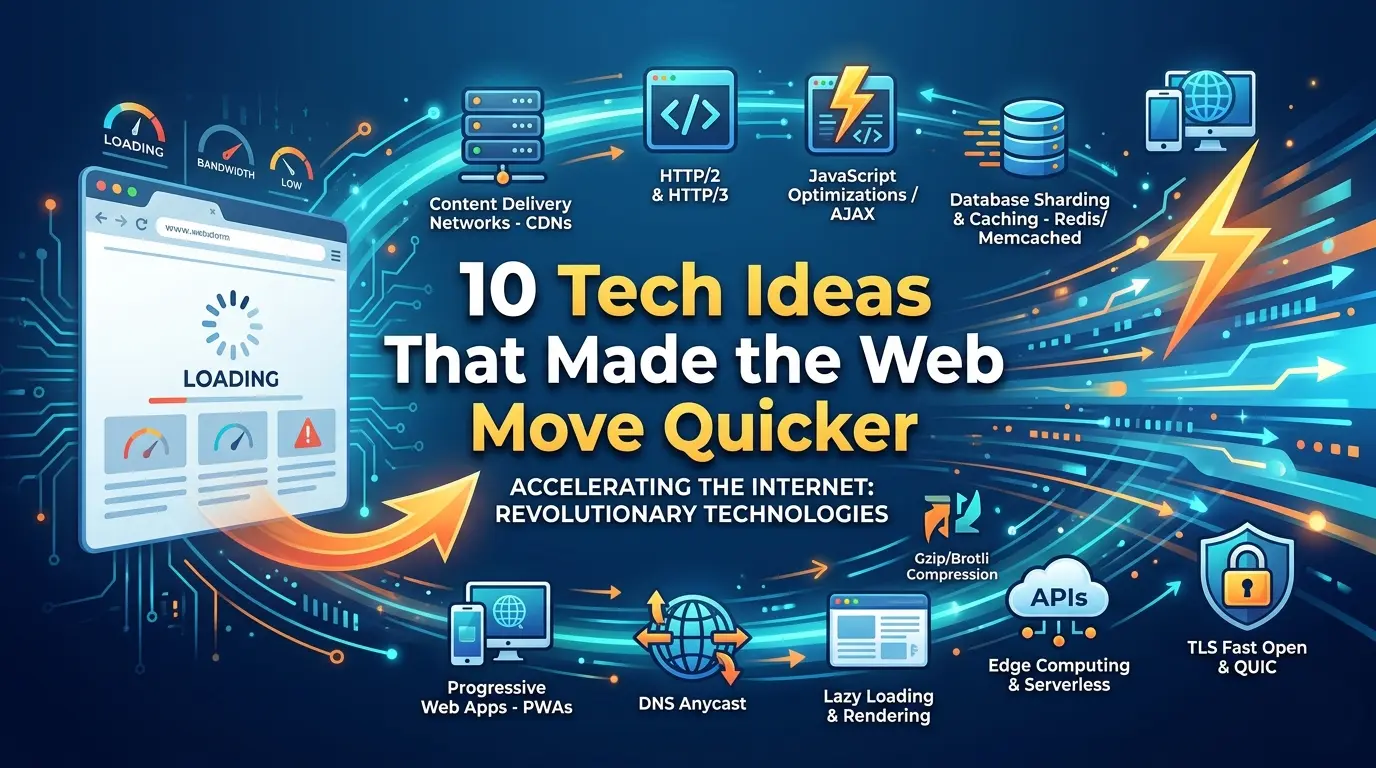

The internet has changed dramatically over the last few decades. In the early days, waiting 20 seconds for a webpage to load was normal. Today, users expect sites to appear almost instantly. Research from Akamai has long suggested that a 1-second delay in page load time can reduce conversions by around 7%, while modern websites often load in under two seconds.
So, what are the tech ideas that made the web move quicker?
The answer isn’t a single invention. Instead, it’s a combination of smarter networking protocols, better browsers, efficient image formats, global content delivery systems, and performance-focused development practices.
In this guide, you’ll discover the 10 biggest technology ideas that transformed web speed, why they matter in 2026, and how they work together to create the fast internet experience we rely on every day.
Why Web Speed Became a Priority
The web wasn’t always built for speed.
During the dial-up era, internet connections were slow and webpages were relatively simple. Broadband brought higher bandwidth, allowing richer websites with images and multimedia. Then smartphones changed everything.
The mobile-first era created new challenges:
- Smaller devices
- Variable network quality
- Global audiences
- Higher user expectations
Businesses quickly realized that speed directly affected revenue.
Amazon famously estimated that a 100-millisecond delay could cost around 1% in sales. Google reached similar conclusions regarding user engagement and advertising performance.
In 2021, Google officially introduced Core Web Vitals as a ranking signal, encouraging website owners to prioritize user experience alongside content quality.
Today, web speed affects:
- SEO rankings
- Conversion rates
- Bounce rates
- Customer satisfaction
- Mobile usability
This demand for speed sparked some of the most important innovations in web technology.
1. HTTP/2 and HTTP/3 — Smarter Protocols
The original HTTP protocol wasn’t designed for today’s internet.
HTTP/2 introduced multiplexing
Instead of opening multiple connections for different resources, browsers can download several files simultaneously over one connection.
Benefits include:
- Reduced latency
- Better bandwidth utilization
- Faster page rendering
HTTP/3 goes even further
HTTP/3 uses the QUIC transport protocol instead of TCP.
Key improvements:
- Faster connection establishment
- Built-in encryption
- 0-RTT reconnection
- Better handling of packet loss
By early 2026, industry measurements suggest roughly 30–35% of the top 10 million websites support HTTP/3.
Google, Cloudflare, and Meta have reported performance improvements often ranging between 10% and 20% under suitable network conditions.
Without modern HTTP protocols, today’s complex websites would feel much slower.
2. Content Delivery Networks (CDNs)
A Content Delivery Network stores copies of website assets across multiple global locations.
Instead of downloading data from one central server, users receive content from the nearest edge location.
How CDNs work
A CDN uses:
- Edge servers
- Geographic routing
- Anycast DNS
- Intelligent caching
Popular providers include:
- Cloudflare
- Akamai
- Fastly
Performance benefits
CDNs reduce:
- Latency
- Server load
- Congestion
Many websites experience 2–3 times faster global content delivery after implementing an effective CDN strategy.
For international audiences, CDNs are almost essential.
3. Browser Caching
Caching prevents browsers from downloading the same files repeatedly.
There are three main layers.
Browser cache
Stores CSS, JavaScript, fonts, and images locally.
Server cache
Reduces backend processing.
Edge cache
CDNs store frequently requested files close to users.
Practical cache headers
Common HTTP headers include:
Cache-Control
ETag
Expires
When configured correctly:
- First visit downloads assets.
- Return visits reuse cached files.
- Loading becomes nearly instant.
Caching dramatically improves user experience while reducing bandwidth costs.
4. Compression (Gzip, Brotli, WebP, AVIF)
Compression reduces file sizes before delivery.
Text compression
Gzip
Long-time standard.
Brotli
Offers higher compression ratios for text assets.
Commonly compresses:
- HTML
- CSS
- JavaScript
Image compression
Images often make up the largest part of webpages.
WebP
Google’s format offers approximately 25–35% smaller file sizes than JPEG while maintaining quality.
AVIF
Provides even greater compression efficiency in many scenarios.
Benefits include:
- Faster mobile loading
- Lower data usage
- Better SEO
- Improved Core Web Vitals
Modern image formats have become one of the easiest speed wins.
5. Edge Computing
CDNs evolved beyond simply storing files.
Today, they can execute code directly at edge locations.
Popular platforms include:
- Cloudflare Workers
- Vercel Edge Functions
- AWS Lambda@Edge
Also Read: Best Pet Tech Gadgets of 2026: The Ultimate Guide to Smarter, Safer, Healthier Pets
Use cases
Personalization
Customize content based on location.
Fraud detection
Analyze requests before reaching the main server.
Authentication
Verify users quickly.
Real-time applications
Reduce delays for interactive services.
Edge computing minimizes the distance data travels, improving responsiveness.
6. Smarter Loading Strategies
Loading everything immediately wastes resources.
Modern websites prioritize critical content.
Lazy loading
Images below the fold load only when needed.
Improves:
- LCP
- Bandwidth usage
- Mobile performance
Script deferral
JavaScript waits until essential content renders.
Code splitting
Applications load only required components.
Resource preloading
Important assets receive priority.
Developer tips
- Prioritize above-the-fold content.
- Minimize render-blocking scripts.
- Remove unused CSS.
- Defer non-critical resources.
Small optimizations can significantly improve performance.
7. WebAssembly (Wasm)
WebAssembly is one of the biggest advances in modern web development.
It allows languages like:
- Rust
- C++
- Go
- C
to run inside browsers at near-native speed.
Why it matters
Heavy computations no longer require slow JavaScript implementations.
Applications become:
- Faster
- More responsive
- More capable
Real-world examples
Figma
Complex design editing.
Photoshop Web
Advanced image manipulation.
AutoCAD Web
Professional CAD tools.
WebAssembly enables desktop-class applications inside browsers.
8. Modern Browsers (V8 Engine, GPU Acceleration)
Browsers have become highly optimized software platforms.
JavaScript engines
Chrome’s V8 engine introduced:
- Just-in-time compilation
- Optimized execution
- Memory improvements
Modern engines process JavaScript dramatically faster than early browsers.
Parallel rendering
Multiple tasks run simultaneously.
GPU acceleration
Graphics hardware handles:
- Animations
- Video
- Visual effects
This reduces CPU workload and improves smoothness.
Modern browsers transformed what websites can achieve.
9. 5G and Faster Mobile Networks
Network technology evolved rapidly.
3G
Basic mobile browsing.
4G LTE
Streaming and richer applications.
5G
Potential speeds approaching 1 Gbps or more under ideal conditions, with significantly lower latency.
Benefits include:
- Faster downloads
- Reduced buffering
- Better cloud applications
- Improved gaming
- Enhanced video calls
Since mobile traffic dominates web usage, modern websites increasingly adopt mobile-first design principles.
Fast networks and optimized websites complement each other.
10. Core Web Vitals & Performance Measurement Culture
You can’t improve what you don’t measure.
Google introduced Core Web Vitals to standardize user experience metrics.
Largest Contentful Paint (LCP)
Measures loading performance.
Goal:
Under 2.5 seconds.
Interaction to Next Paint (INP)
Measures responsiveness.
Lower is better.
Cumulative Layout Shift (CLS)
Measures visual stability.
Unexpected layout movement creates poor experiences.
Popular tools
- Google PageSpeed Insights
- Lighthouse
- WebPageTest
- Chrome DevTools
Measurement created accountability, encouraging developers to optimize continuously.
Also Read: 20 Tech Activities Outdoor for Kids That Actually Stick
How These 10 Ideas Work Together
No single innovation made the web fast.
Modern performance relies on layered optimization.
Here’s how the stack works:
| Old Web | Modern Web |
|---|---|
| HTTP/1 | HTTP/3 |
| Single server | Global CDN |
| Large JPEG images | WebP and AVIF |
| No caching | Multi-layer caching |
| Server-only processing | Edge computing |
| Full-page loading | Lazy loading |
| JavaScript only | WebAssembly |
| Slow browsers | V8 and GPU acceleration |
| 3G networks | 5G connectivity |
| Limited metrics | Core Web Vitals |
Together, these technologies create a layered speed architecture where every component reduces latency and improves user experience.
Conclusion
The 10 tech ideas that made the web move quicker didn’t emerge overnight. Faster protocols like HTTP/3, global CDNs, browser caching, compression, edge computing, smarter loading strategies, WebAssembly, powerful browser engines, 5G networks, and Core Web Vitals collectively transformed how websites perform.
In 2026, speed remains a competitive advantage for businesses, developers, and content creators. Understanding these technologies helps explain why today’s web feels dramatically faster than it did a decade ago—and where future improvements may come from.
For more technology explainers, performance guides, and industry trends, explore related articles on TonicofTech.com.
FAQ
What are the tech ideas that made the web move quicker?
The biggest innovations include HTTP/2 and HTTP/3, CDNs, browser caching, compression technologies, edge computing, smarter loading strategies, WebAssembly, modern browser engines, 5G networks, and Core Web Vitals. Together, they reduce latency, optimize content delivery, and improve user experience.
How did HTTP/3 improve web speed?
HTTP/3 uses the QUIC protocol, reducing connection setup times and handling packet loss more efficiently. Features like multiplexing and 0-RTT reconnection help websites load faster, especially on unstable mobile networks.
Does a CDN always make a website faster?
In most cases, yes. A CDN serves content from edge servers closer to users, reducing latency and improving load times. However, poor CDN configuration can reduce potential performance gains.
What is WebAssembly and why does it matter for web speed?
WebAssembly is a browser technology that allows languages like Rust and C++ to run at near-native speed. It enables complex applications such as Figma and Photoshop Web to perform intensive tasks efficiently.
How is web performance measured in 2026?
Web performance is commonly measured using Core Web Vitals, including Largest Contentful Paint (LCP), Interaction to Next Paint (INP), and Cumulative Layout Shift (CLS). Tools like Lighthouse and PageSpeed Insights help developers monitor these metrics.
Why are some modern websites still slow?
Modern websites can be slow due to oversized images, excessive JavaScript, poor hosting, too many third-party scripts, weak caching strategies, and unoptimized code despite advances in web technology.
What is the biggest factor in web page load time?
There is no single factor. Server response times, image optimization, network quality, browser caching, JavaScript efficiency, and CDN usage all contribute significantly to overall page speed.