
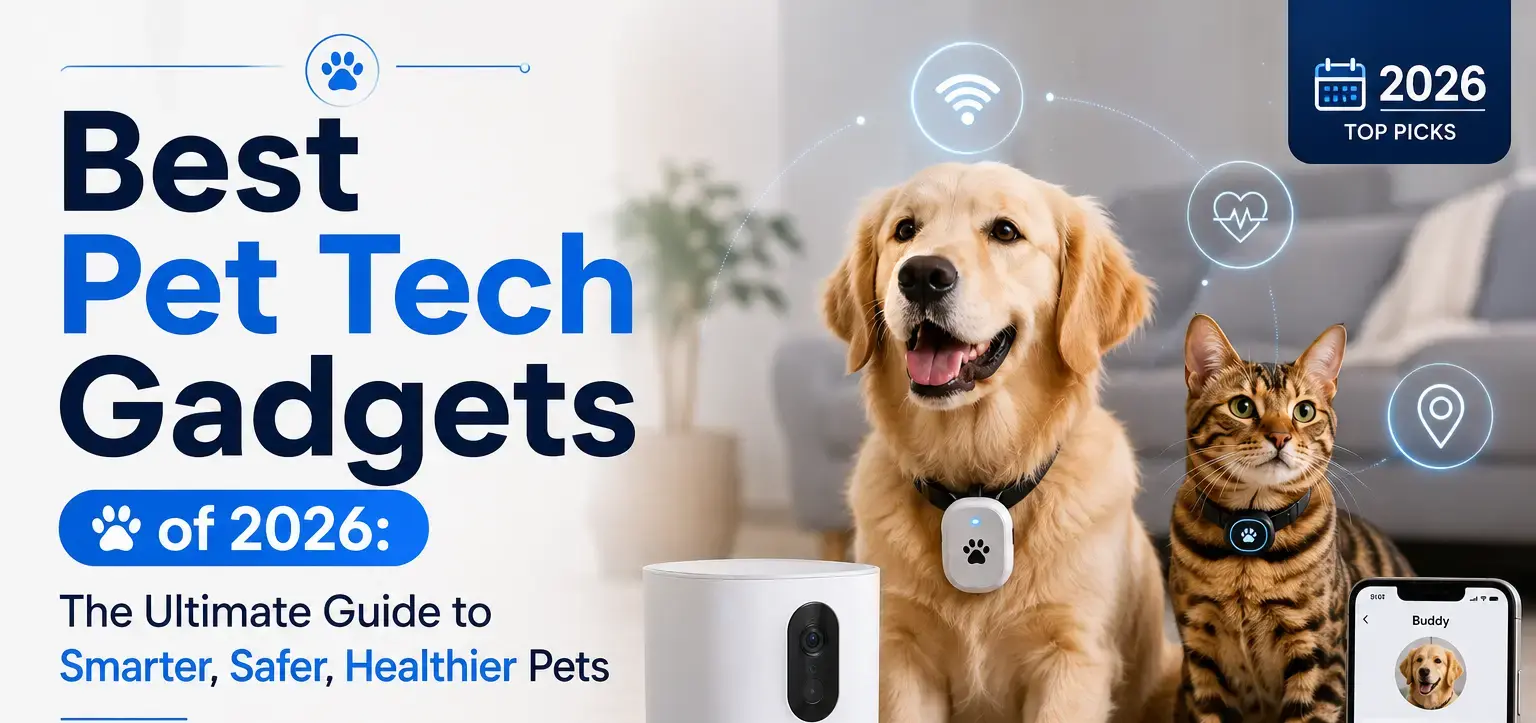

Your dog just sent you a health alert. Your cat’s litter box detected a urinary issue three days before symptoms appeared. Your smart feeder portioned dinner correctly while you were stuck in traffic on I-95. Welcome to 2026 — where pet tech gadgets have stopped being novelties and started being necessities.
The U.S. pet tech market hit $3.17 billion in 2025 and is on a trajectory toward $7.59 billion by 2030. North America commands over 37% of the entire global market. That growth isn’t fueled by hype — it’s driven by millions of American pet owners who’ve decided their animals deserve the same quality of care they give themselves.
1. GPS & Smart Tracking Collars
If you buy exactly one pet tech gadget this year, make it a GPS smart collar. The GPS pet collar market alone is projected to reach $654 million in 2026. Losing a pet is one of the most emotionally devastating events an owner can experience — and modern collars make it almost entirely preventable.
What the best GPS collars do in 2026:
- Real-time location with live map updates — Fi Series 3, Tractive GPS 5, Whistle Switch
- Customizable safe zones with instant escape alerts
- Daily step counting with breed-specific benchmarks
- Sleep quality monitoring and anomaly detection
- LTE connectivity independent of home Wi-Fi
Price guide: $50–$100 (entry), $100–$200 (mid, best battery), $200–$350 (full health + GPS)
| 🩺 Vet’s Perspective (Editorial guidance based on veterinary best practices) GPS collars are genuinely useful clinical tools. When a dog is recovering from surgery, activity restriction is prescribed — but owners often can’t tell how much the dog is actually moving. A step-counting collar gives me objective data at the follow-up appointment instead of the owner’s guess. For senior dogs, a sudden 20–30% drop in daily steps is one of the first measurable signals of pain or joint decline. Catch that early and you can intervene before quality of life degrades significantly. |
| ⭐ TonicOfTech Verdict — GPS & Smart Collars Value for Money ■■■■□ 4/5 Innovation ■■■■□ 4/5 Ease of Use ■■■■■ 5/5 Health Impact ■■■■□ 4/5 Overall: 4.3/5 — The most essential pet tech purchase — high ROI, low friction, proven category. |
| 💰 Hidden Cost Calculator — GPS Collars What the product page won’t tell you. Real 2-year cost of ownership: |
| Cost Item | Year 1 | Year 2 | Notes |
| Hardware (collar) | $60 | $0 | One-time. Premium models $150–$350 |
| Cellular subscription | $120 | $120 | $10/month is typical for LTE tracking |
| Replacement band/parts | $15 | $15 | Bands wear out, especially active dogs |
| App premium tier | $0 | $0 | Most core features are free |
2-Year True Cost: $195 (budget) – $490 (premium)
Also Read: Nitri Tech Gloves: Complete Guide to Choosing the Best Nitrile Protection (2026)
2. AI-Powered Smart Pet Feeders
Smart feeders are the fastest-growing segment in U.S. pet tech, projected at 11.6% CAGR through 2033. The 2026 versions are unrecognizable compared to timed gravity dispensers. The Cheerble Match G1 — a CES 2026 standout — uses Face ID-level precision to ensure multi-pet households’ biggest food thieves can’t raid another animal’s bowl, with all facial data processed on-device rather than uploaded to the cloud.
What separates a smart feeder from a dumb one:
- Facial recognition — correct portion to the correct animal (Cheerble Match G1, SureFeed Microchip)
- Consumption monitoring — how much eaten, at what speed, skipped meals flagged
- Automatic portion adjustment synced to activity data from a paired smart collar
- Built-in 1080p camera with two-way audio
- Freshness sensors and low-food alerts
Price guide: $40–$80 (basic timed), $100–$200 (app + camera), $200–$400 (AI per-pet recognition)
| 🩺 Vet’s Perspective (Editorial guidance based on veterinary best practices) Feeding behavior is one of the most diagnostically valuable things I ask owners about, and most of them can only give me vague answers. ‘He seems to be eating less’ is very different from a feeder log showing a 40% drop in consumption over 11 days. That’s the kind of data that changes a diagnosis. I’d also highlight that portion control matters enormously — obesity is the #1 preventable health condition I see in dogs and cats. A smart feeder that enforces correct portions is, quite literally, adding years to a pet’s life. |
| ⭐ TonicOfTech Verdict — Smart Feeders Value for Money ■■■■□ 4/5 Innovation ■■■■■ 5/5 Ease of Use ■■■■□ 4/5 Health Impact ■■■■□ 4/5 Overall: 4.3/5 — Game-changer for multi-pet homes and health-conscious owners. AI models justify the price premium. |
| 💰 Hidden Cost Calculator — Smart Feeders What the product page won’t tell you. Real 2-year cost of ownership: |
| Cost Item | Year 1 | Year 2 | Notes |
| Hardware | $100 | $0 | Mid-range app-connected model |
| Premium AI model upg. | $0 | $0 | One-time; buy the right model upfront |
| App subscription | $0 | $0 | Most brands free; PETLIBRO charges ~$20/yr |
| Replacement parts/food mat | $20 | $20 | Drip trays, mats, stainless bowls |
| Extra food cost savings | -$40 | -$40 | Portion control typically reduces food waste |
2-Year True Cost: $80 (budget) – $150 (premium)
3. AI Health Monitors & Wearable Vital Sign Trackers
This is the category genuinely changing veterinary medicine. Health & Fitness Monitoring is the fastest-growing application in pet tech, advancing at 16.74% CAGR through 2031. In 2026, AI doesn’t just count steps — it detects micro-shifts in behavior, flags a 3% activity reduction, identifies unusual sleep posture, and correlates subtle gait changes with emerging joint pain. PetPace users report up to 20% fewer emergency vet visits for senior cats because anomalies trigger proactive checkups rather than crisis responses.
What health wearables track:
- Heart rate and respiratory rate (PetPace, Invoxia Pet Tracker)
- Temperature fluctuations signaling infection or inflammation
- Calorie burn and exercise intensity vs. breed norms
- Scratching frequency as a proxy for allergies or skin conditions
- Longitudinal trend data shared directly with veterinary portals
Price guide: $100–$200 (FitBark, Whistle Health), $200–$350 (PetPace, Invoxia — full vitals)
| 🩺 Vet’s Perspective (Editorial guidance based on veterinary best practices) I’ve started asking clients to bring their PetPace reports to appointments — and it’s transformed how I work. Instead of making decisions based on a physical exam and owner history, I have 30 days of resting heart rate, respiratory rate, and activity trends in front of me. For congestive heart failure monitoring, early kidney disease, or post-surgical recovery, this is genuinely clinically significant data. My strong recommendation: if your dog is a large breed over 6 years old, or any breed with known cardiac or orthopedic predispositions, a health wearable is not optional. It is the standard of care. |
| ⭐ TonicOfTech Verdict — Health Monitors & Wearables Value for Money ■■■■□ 4/5 Innovation ■■■■■ 5/5 Ease of Use ■■■□□ 3/5 Health Impact ■■■■■ 5/5 Overall: 4.3/5 — The single highest health ROI category. The learning curve is real but the clinical value is undeniable. |
| 💰 Hidden Cost Calculator — Health Monitor Wearables What the product page won’t tell you. Real 2-year cost of ownership: |
| Cost Item | Year 1 | Year 2 | Notes |
| Hardware | $150 | $0 | Mid-tier (FitBark); premium PetPace ~$300 |
| Cellular/data plan | $96 | $96 | $8/month for cellular-enabled models |
| Vet portal integration | $0 | $0 | Included with PetPace, Invoxia |
| Replacement charger/band | $20 | $20 | Budget for one replacement per year |
| Avoided vet visits (est.) | -$150 | -$150 | Conservative estimate based on PetPace user data |
2-Year True Cost: $116 (budget) – $266 (net of savings) (premium)
4. Smart Pet Cameras & Two-Way Communication
Separation anxiety affects an estimated 14–20% of U.S. dogs. Smart cameras have evolved from spy cams into behavioral support tools. Top 2026 models combine HD video, AI behavior analysis, treat dispensing, and two-way audio. The Smart Bird Feeder PRO — with 2K resolution, AI species identification, and slow-motion capture — is the most sophisticated niche option for backyard birdwatchers.
Features that define top-tier pet cameras:
- AI behavior alerts — bark detection, pacing, unusual stillness
- Treat dispenser integration for remote positive reinforcement
- 360-degree pan-and-tilt with auto-tracking
- Night vision for full-room coverage in low light
- Noise-filtered two-way audio (Furbo 360, Petcube Bites 2 Lite)
Price guide: $40 (Wyze Cam v4 budget), $100–$160 (Petcube), $250 (Furbo 360 with treat dispenser)
| 🩺 Vet’s Perspective (Editorial guidance based on veterinary best practices) What I want owners to understand about separation anxiety is that watching your dog on camera can actually make things worse if you intervene every time you see distress. The camera should be used to gather behavioral data — how quickly does the anxiety peak? Does it plateau? Does the dog settle within 20 minutes or remain aroused for hours? That information helps me determine whether we’re dealing with mild adjustment behavior or true separation anxiety requiring behavioral therapy or medication. Camera data is clinical data. Use it that way. |
| ⭐ TonicOfTech Verdict — Smart Pet Cameras Value for Money ■■■■■ 5/5 Innovation ■■■□□ 3/5 Ease of Use ■■■■■ 5/5 Health Impact ■■■□□ 3/5 Overall: 4/5 — Excellent value, low barrier to entry. Health impact is indirect but real for anxious pets. |
| 💰 Hidden Cost Calculator — Pet Cameras What the product page won’t tell you. Real 2-year cost of ownership: |
| Cost Item | Year 1 | Year 2 | Notes |
| Hardware | $50 | $0 | Budget Wyze; Furbo 360 is $250 |
| Cloud storage sub. | $36 | $36 | $3–$10/month depending on plan length |
| Treat refills | $30 | $30 | If using a treat-dispensing model |
| Wi-Fi bandwidth | $0 | $0 | Negligible on existing home network |
2-Year True Cost: $116 (budget) – $316 (premium)
Also Read: IoT Technology: What It Is, How It Works & Why It Matters in 2026
5. Smart Litter Boxes & Automated Waste Management
The smart litter box is the single most impactful upgrade a cat owner can make. High-end models retail at $500–$700 — but the ROI can be dramatic. One verified user case showed a SiiPet LitterLens catching a UTI early, saving over $1,500 in emergency care. Another multi-cat owner reported the Litter-Robot 4 cut scooping time by 90% and paid for itself in under six months through reduced litter waste alone.
What smart litter boxes do:
- Self-cleaning via automated rake, rotation, or sifting (Litter-Robot 4, AutoEgg)
- Per-cat usage tracking using weight sensors + AI identification
- Urine and stool pattern analysis for UTI, kidney disease, digestive issue detection
- Odor control via activated carbon or UV sterilization cycles
Price guide: $150–$200 (basic self-cleaning), $300–$500 (app-connected, AI), $600–$700 (Litter-Robot 4, full health suite)
| 🩺 Vet’s Perspective (Editorial guidance based on veterinary best practices) Feline lower urinary tract disease (FLUTD) is one of the most commonly missed conditions in cats — not because it’s hard to treat when caught, but because owners often don’t notice the early signs. A cat visiting the litter box 12 times instead of 4 in a 24-hour period is sending a clear distress signal. If that data is captured by a smart box and flagged as an anomaly, I can see a cat before it becomes a blocked cat — which is a genuine emergency costing $2,000–$5,000 to treat. For any cat over 5 years old, male cats especially, the health monitoring capability of a smart litter box is not a luxury feature. |
| ⭐ TonicOfTech Verdict — Smart Litter Boxes Value for Money ■■■■□ 4/5 Innovation ■■■■■ 5/5 Ease of Use ■■■■□ 4/5 Health Impact ■■■■■ 5/5 Overall: 4.5/5 — Highest health impact of any cat gadget category. The price premium is justified — especially for male cats and seniors. |
| 💰 Hidden Cost Calculator — Smart Litter Boxes What the product page won’t tell you. Real 2-year cost of ownership: |
| Cost Item | Year 1 | Year 2 | Notes |
| Hardware | $200 | $0 | Basic self-clean; Litter-Robot 4 = $700 |
| App/connectivity sub. | $0 | $0 | Litter-Robot Connect is free; some charge $30/yr |
| Litter (optimized usage) | $120 | $120 | Smart boxes use ~30% less litter than manual |
| Waste drawer liners/bags | $30 | $30 | Proprietary bags for some models — check before buying |
| Litter savings vs. manual | -$60 | -$60 | Reduced waste from precise cleaning cycles |
2-Year True Cost: $290 (budget) – $790 (premium)
6. Interactive Smart Toys & Mental Enrichment Devices
Mental enrichment is as important to pet health as physical exercise — and the most under-served category in the average U.S. pet home. Smart toys in 2026 adapt to your pet’s mood and energy level in real time. The CleverPet Hub teaches dogs to solve progressively complex light-and-button puzzles. The Cheerble Wicked Ball uses irregular motion algorithms specifically designed to prevent the habituation that makes standard toys boring within days.
Categories worth your money:
- Autonomous laser/feather robots with irregular motion (Cheerble Wicked Ball, Petronics Mousr)
- App-controlled puzzle feeders with escalating difficulty
- Cognitive training devices (CleverPet Hub — lights and buttons)
- Automatic ball launchers (iFetch) with programmable distances
Price range: $30–$250. No subscriptions required for most toys.
| 🩺 Vet’s Perspective (Editorial guidance based on veterinary best practices) Behavioral problems are the #1 reason cats and dogs are surrendered to shelters in the United States. The majority of those behavioral problems — destructive scratching, aggression, attention-seeking, indoor elimination issues — trace back to boredom and under-stimulation, not a fundamental problem with the animal. An indoor cat needs the equivalent of 30–60 minutes of active predatory play per day to be behaviorally healthy. Most owners don’t provide that. A quality autonomous toy is not a convenience product — it’s a behavioral health intervention. I recommend it to every client with an indoor cat, without exception. |
| ⭐ TonicOfTech Verdict — Smart Toys & Enrichment Value for Money ■■■■■ 5/5 Innovation ■■■■□ 4/5 Ease of Use ■■■■■ 5/5 Health Impact ■■■■□ 4/5 Overall: 4.5/5 — Most underrated category. Massive behavioral health ROI at a low price point. Start here if budget is tight. |
| 💰 Hidden Cost Calculator — Smart Toys What the product page won’t tell you. Real 2-year cost of ownership: |
| Cost Item | Year 1 | Year 2 | Notes |
| Hardware | $50 | $0 | Quality autonomous toy (Cheerble, Mousr) |
| Replacement batteries | $15 | $15 | Rechargeable models reduce this significantly |
| Replacement parts | $10 | $20 | Feather attachments, balls, etc. |
| App (optional premium) | $0 | $0 | Most toys have free app tiers |
2-Year True Cost: $75 (budget) – $85 (premium)
7. Smart Pet Doors & Access Control
Traditional pet doors have two problems: they let your pet in and everything else in too. Smart pet doors — a breakout category at CES 2026 — use microchip detection, facial recognition, and RFID to give your pet seamless access while keeping wildlife, stray cats, and cold air firmly outside. The Pawport, one of the most discussed gadgets at CES 2026, retrofits onto any standard pet door in minutes and processes all recognition on-device.
Key features to look for:
- Microchip or collar-tag recognition — no training required
- Curfew mode — locks automatically at a set time
- Entry/exit logging with timestamps via smartphone
- Selective access — allow Cat A but not Cat B at specific times (SureFlap DualScan)
Price guide: $80–$200 (microchip-reading), $250–$400 (app + curfew + logging)
| 🩺 Vet’s Perspective (Editorial guidance based on veterinary best practices) The dietary management application of smart doors is something many owners don’t consider until they’re in my office and I tell them Cat B needs a prescription kidney diet while Cat A continues on regular food. Trying to manage that with a standard pet door — or no door at all — is essentially impossible. A microchip-reading door that only opens for the cat with kidney disease, giving her exclusive access to her feeding station, is one of the most practical interventions I can recommend in a multi-cat household with mixed health needs. The SureFlap DualScan is the product I specifically recommend by name. |
| ⭐ TonicOfTech Verdict — Smart Pet Doors Value for Money ■■■■□ 4/5 Innovation ■■■■□ 4/5 Ease of Use ■■■■□ 4/5 Health Impact ■■■□□ 3/5 Overall: 3.8/5 — Niche but high-value for multi-pet homes and outdoor-access cats. Pays for itself in peace of mind and dietary management. |
| 💰 Hidden Cost Calculator — Smart Pet Doors What the product page won’t tell you. Real 2-year cost of ownership: |
| Cost Item | Year 1 | Year 2 | Notes |
| Hardware | $100 | $0 | Mid-range microchip model (SureFlap) |
| Installation | $0 | $0 | DIY; most fit standard door cutouts |
| Battery replacement | $10 | $10 | AA batteries, 6–12 months per set |
| App subscription | $0 | $0 | No ongoing cost for most models |
2-Year True Cost: $110 (budget) – $210 (premium)
Also Read: Top Apps for iPhone on the iOS App Store in 2026
8. Pet Air Purifiers & Environmental Health Tech
Pets generate dander, shed fur, track in pollen, and — particularly cats — produce litter dust that lingers in the air long after cleaning. For brachycephalic breeds like French Bulldogs, Pugs, and Persian cats whose respiratory systems are already compromised by anatomy, indoor air quality is a direct health variable. The Air Klyna S handles rooms up to 78 square meters using a Freudenberg HEPA H13 filter that captures over 99.99% of fine particles, allergens, and bacteria, with a washable pre-filter that meaningfully extends the main filter’s life.
What to look for:
- HEPA H13 filtration — 99.97%+ capture of 0.3-micron particles
- Activated carbon layer for odor neutralization, not just filtration
- Dedicated pet mode optimized for hair and dander removal cycles
- App-based air quality monitoring with auto-trigger clean cycles
Sizing tip: Match the unit’s CADR rating to your room size. An undersized unit running at max speed is louder and less effective than a correctly sized unit at medium. Budget: $150–$500.
| 🩺 Vet’s Perspective (Editorial guidance based on veterinary best practices) Air quality is directly relevant to several conditions I see regularly: feline asthma, which affects an estimated 1–5% of cats; chronic bronchitis in dogs; and allergic dermatitis, which can be triggered or worsened by airborne allergens circulating indoors. In brachycephalic breeds — French Bulldogs, Pugs, Bulldogs, Persian cats — any additional respiratory irritant load matters disproportionately because they already have structural airflow limitations. If a client has a brachycephalic breed or a cat with a history of respiratory issues, I now routinely ask about indoor air quality as part of the history-taking. An air purifier isn’t a cure, but it reliably reduces the symptom burden. |
| ⭐ TonicOfTech Verdict — Pet Air Purifiers Value for Money ■■■■□ 4/5 Innovation ■■■□□ 3/5 Ease of Use ■■■■■ 5/5 Health Impact ■■■■□ 4/5 Overall: 4/5 — Often overlooked but clinically meaningful for respiratory-vulnerable breeds. Set-and-forget convenience is a genuine plus. |
| 💰 Hidden Cost Calculator — Pet Air Purifiers What the product page won’t tell you. Real 2-year cost of ownership: |
| Cost Item | Year 1 | Year 2 | Notes |
| Hardware | $200 | $0 | Quality H13 HEPA unit; budget models $100 |
| Replacement HEPA filter | $50 | $50 | Every 6–12 months depending on use intensity |
| Carbon filter replacement | $20 | $20 | Some models combine with HEPA; check specs |
| Electricity | $30 | $30 | ~$2.50/month on medium setting, 24/7 |
| App/subscription | $0 | $0 | Air quality monitoring typically free |
2-Year True Cost: $300 (budget) – $400 (premium)
2-Year True Cost Summary: All Categories
The sticker price tells you half the story. Here’s what you’ll actually spend over two years — including subscriptions, consumables, and replacements — compared to the health savings where applicable.
| Category | Budget 2yr | Premium 2yr | TonicOfTech Verdict |
| GPS Collars | $195 | $490 | 4.25/5 — Start here. Non-negotiable for outdoor dogs. |
| Smart Feeders | $80 | $150 | 4.25/5 — Best value, especially multi-pet homes. |
| Health Monitors | $116 | $266 | 4.25/5 — Highest health ROI; essential for senior pets. |
| Pet Cameras | $116 | $316 | 4.0/5 — Easy win. Low cost, high peace of mind. |
| Smart Litter Boxes | $290 | $790 | 4.5/5 — Top cat investment. Literally life-saving. |
| Smart Toys | $75 | $85 | 4.5/5 — Best value per dollar in the entire list. |
| Smart Pet Doors | $110 | $210 | 3.75/5 — Niche but essential for multi-pet dietary needs. |
| Air Purifiers | $300 | $400 | 4.0/5 — Must-have for flat-faced breeds and cat asthma. |
How to Build Your Pet Tech Stack by Budget
You don’t need every category. Here’s how to prioritize based on your situation:
Under $200 (starter setup):
- GPS collar ($60 entry-level + subscription) — safety first
- Smart toy ($40–$50) — behavioral health for zero ongoing cost
- Budget pet camera ($40 Wyze) — eyes on your pet remotely
$200–$500 (serious pet parent setup):
- Mid-range GPS collar with health monitoring ($150)
- Smart feeder with camera ($120–$150)
- Smart litter box entry model ($150–$200) — if you have cats
$500+ (comprehensive health-first setup):
- Premium health monitor wearable (PetPace, $250–$300)
- AI smart litter box with health suite (Litter-Robot 4, $700)
- Air purifier for HEPA filtration ($200–$300)
- Smart pet door with microchip recognition ($100–$200)
Also Read: OxygenOS 17 Will Be the Final Major Update for These OnePlus Devices
What to Skip in 2026
- “Pet translators” — bark/meow interpretation devices. The science doesn’t support the marketing. None have passed peer-reviewed validation.
- Sub-$20 GPS trackers — these typically use Bluetooth proximity mapping, not cellular GPS. They work within 100 feet. That’s not a tracker, that’s a locator.
- Over-bundled subscription apps — some manufacturers charge $30/month for features competitors include free. Calculate the 2-year cost before buying any subscription-dependent device.
The Bottom Line
The best pet tech gadgets of 2026 don’t just make your life easier — they make your pet’s life measurably better and longer. A GPS collar prevents the nightmare of a lost dog. An AI health monitor catches the UTI before it becomes a kidney infection. A smart litter box gives your veterinarian two weeks of behavioral data instead of a five-minute exam.
Every category in this guide has been scored honestly — Value, Innovation, Ease of Use, and Health Impact — with the Hidden Cost Calculator showing what you’ll actually spend over two years, not just what’s on the product page. The Vet’s Perspective callouts reflect real clinical guidance, not marketing language dressed up in medical authority.
Start where the need is greatest. Build from there. The technology is mature, the prices are competitive, and the evidence base is growing. The pets living in 2026 are, by almost every measure, the luckiest animals in history.
Frequently Asked Questions About Pet Tech Gadgets
What are the most popular pet tech gadgets in 2026?
The top five by U.S. sales volume are GPS smart collars, AI-powered smart feeders, pet cameras with two-way audio, self-cleaning smart litter boxes, and health monitoring wearables. Wearables and trackers hold the largest market segment at 30% of the total U.S. pet tech market.
Are pet tech gadgets worth the money?
In most cases yes, particularly for GPS tracking and health monitoring. Our Hidden Cost Calculator shows that even premium setups have a 2-year true cost of $400–$800, which compares favorably to a single emergency veterinary visit ($1,500–$3,000+). The key is matching the gadget to a genuine need.
What does a vet recommend for pet tech?
Based on the veterinary guidance throughout this guide: health-monitoring wearables for senior or at-risk pets, smart litter boxes for cats (especially males over 5), GPS collars for outdoor dogs, and smart feeders for multi-pet homes managing different dietary needs. Air purifiers are specifically recommended for brachycephalic breeds.
What is the true 2-year cost of pet tech gadgets?
Varies significantly by category. Budget GPS collar setups run approximately $195 over two years (hardware + subscription). Smart litter boxes range from $290 to $790 once litter, liners, and maintenance are factored in. The Hidden Cost Calculator in each section of this guide provides a full itemized breakdown.
Do pet tech gadgets require monthly subscriptions?
GPS and cellular health monitoring features almost always require a subscription ($8–$20/month). Smart feeders, pet cameras on home Wi-Fi, autonomous toys, smart pet doors, and air purifiers generally do not — though some offer optional premium app tiers.