
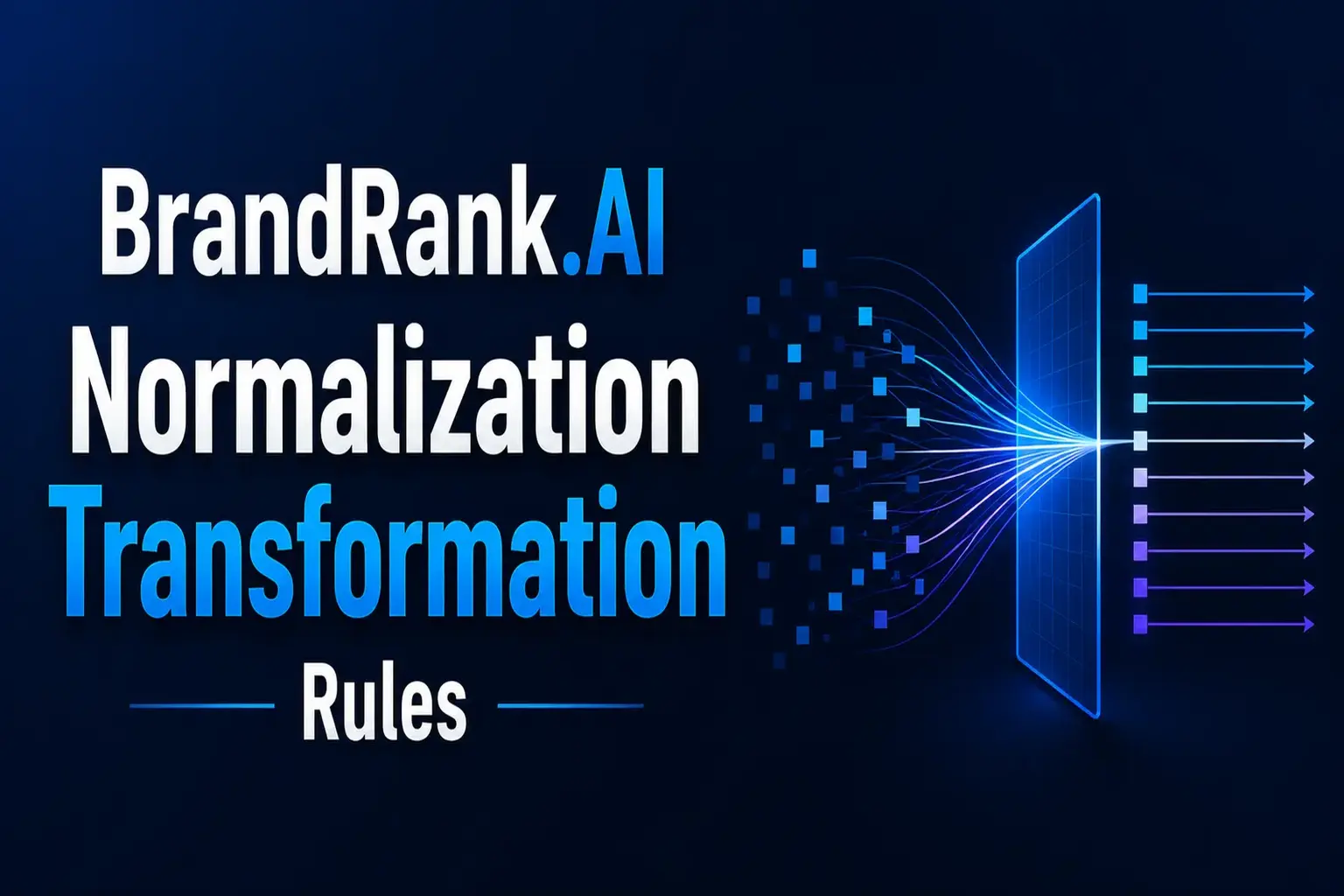

Quick Answer: BrandRank.AI normalization transformation rules are the practical methods used to clean, standardize, match, and structure brand information — names, URLs, products, locations, sentiment, and citations — before measuring how a brand appears across AI-generated answers. Normalization decides which representation of a brand is canonical. Transformation converts raw text and answers into structured fields a team can measure, compare, and act on.
Independent Guide Disclosure: This article is an independent educational resource. It is not affiliated with, endorsed by, or based on private technical documentation from BrandRank.AI. BrandRank.AI publicly describes an AI search visibility platform that tests priority prompts, analyzes AI-generated answers, reviews cited sources, and evaluates brand visibility, vulnerability, and content readiness. Its public materials do not currently publish a technical specification under the exact title “Normalization Transformation Rules.” This guide treats the phrase as a practical industry framework, not a disclosed proprietary algorithm.
What Are BrandRank.AI Normalization Transformation Rules?
A brand rarely appears the same way twice online. The same company might show up as:
- BrandRank
- BrandRank AI
- BrandRank.AI
- brandrank.ai
- BRANDRANK.AI
- Brand Rank AI
A person can tell these refer to one entity almost instantly. A data system cannot — unless it’s told how.
Normalization is the process of establishing which representation is canonical and mapping every legitimate variation to it. Transformation is the process of converting inconsistent or unstructured data — including full paragraphs from AI-generated answers — into structured fields that can be measured, compared, and tracked over time.
Put together, the workflow looks like this:
Raw data → Identify variations → Normalize → Resolve entities → Transform → Validate → Monitor
For example, an AI platform might generate this answer:
“BrandRank.AI helps companies understand how their brand appears in AI-generated search results.”
A transformation rule converts that sentence into structured data:
| Field | Value |
|---|---|
| Canonical brand | BrandRank.AI |
| Brand mentioned | Yes |
| Citation found | No |
| Sentiment | Positive |
| Topic | AI search visibility |
| Product category | Brand monitoring software |
That structured record can be compared across platforms, tracked over time, and rolled up into a report — something a paragraph of text can’t do on its own.
Also Read: AI Transformation Is a Problem of Governance: The 2026 Maturity Framework
What Does BrandRank.AI Actually Do?
According to BrandRank.AI’s public FAQ, its Brand Health and Trust framework centers on three metrics:
- Visibility — how often a brand is cited across AI platforms
- Vulnerability — risk from misinformation, omissions, or competitor encroachment
- Content Readiness — whether content is structured and supported well enough to be trusted and cited
BrandRank.AI states that its platform runs daily testing across prioritized queries and AI engines, captures full generated responses, identifies cited sources, extracts key claims, and evaluates citation strength and structure.
Normalization isn’t presented as a separate, publicly scored module. It’s better understood as the underlying data-quality layer that makes the rest of that analysis reliable — because a visibility score is only as good as the entity matching behind it.
Normalization vs. Transformation vs. Related Concepts
| Concept | What it means | Simple example |
|---|---|---|
| Normalization | Establishing one canonical representation | “Brand Rank AI” → “BrandRank.AI” |
| Transformation | Converting data into a different, more useful format | A paragraph → a sentiment label |
| Entity resolution | Deciding whether two records describe the same real-world thing | “BrandRank AI” and “BrandRank.AI” → same entity |
| Deduplication | Removing repeated records | The same citation counted once, not three times |
| Validation | Checking the final data is accurate | Confirming a canonical URL still resolves |
| Enrichment | Adding useful context to a record | Marking a domain as a “news source” |
Simple rule of thumb: normalization decides what “consistent” should look like; transformation is how you get the data there; entity resolution is how you decide two things are actually the same thing in the first place.
Why Brand Data Consistency Matters for AI Search
Customers increasingly ask ChatGPT, Gemini, Claude, Perplexity, and Copilot to compare products, recommend services, and explain pricing — instead of clicking through ten blue links themselves. These tools form answers from public information across a brand’s website, directories, reviews, news coverage, and social profiles.
When those sources disagree — an old company name here, a discontinued product there, a stale address somewhere else — the AI-generated answer inherits that inconsistency. A brand might:
- Appear in one platform’s answer but not another’s
- Show up under a former name
- Get attributed an outdated price or feature
- Get confused with an unrelated company using a similar name
Clean, normalized brand data doesn’t force an AI tool to recommend a company. What it does is make the brand’s identity unambiguous enough to be represented accurately when it is referenced — and makes it possible to actually measure what’s happening across platforms instead of guessing.
10 Core Normalization Rule Categories
- Brand Name Normalization — Map every verified variation (capitalization, spacing, punctuation, trademark symbols) to one canonical brand name, while preserving the legal name separately where it’s legitimately needed (contracts, schema, disclosures).
- Website and URL Normalization — Standardize on HTTPS, strip tracking parameters (
utm_source, etc.), lowercase the hostname, remove unnecessary trailing slashes, and follow redirects to their final destination — so one page isn’t counted as three different sources. - Product and Service Name Normalization — Maintain a naming record for each product: official name, approved abbreviation, former name, parent brand, category, and official URL. This prevents a rebranded product from fragmenting into multiple “different” entities across old content.
- Category and Taxonomy Normalization — Define one primary category and a small set of secondary categories rather than letting a brand be tagged inconsistently as “project management platform,” “productivity software,” and “collaboration tool” with no hierarchy connecting them.
- Location and Address Normalization — Standardize address formatting and distinguish headquarters from regional offices, franchises, or former locations. Each physical location should have its own canonical record connected to the parent brand.
- Source and Citation Normalization — Connect a source’s publication name, domain, and any short-form labels (e.g., “Search Central” vs. “developers.google.com“) to one source record, while still preserving the exact cited URL for accuracy.
- Social Profile Verification — Confirm official profiles using cross-checks: linked from the official site, links back to the main domain, matching brand name and current logo, active status. A false profile match contaminates every downstream report.
- Historical Brand Name Management — When a company rebrands, preserve the relationship — “Nexus Platform, formerly Acme Software” — rather than either erasing the old name or letting it be mistaken for an unrelated current entity.
- Cross-Language and Regional Normalization — For international brands, preserve parent-subsidiary relationships, language, legal identity, and regional domains instead of collapsing every translated or localized name into a single string.
- Duplicate Record Removal — Compare test date, platform, model, prompt, and response identifiers before merging records. Under-deduplication inflates reports; over-deduplication erases valid data. Both need testing.
Also Read: AI Bola Review 2026: What It Is, How It Works, and Alternatives
10 Transformation Rules for AI-Generated Answers
Once brand entities are normalized, raw AI answers can be converted into measurable fields.
| # | Transformation | What it captures |
|---|---|---|
| 1 | Mention detection | Whether the canonical brand or an approved alias appears at all |
| 2 | Citation detection | Whether the brand is linked or sourced — not just named — since a mention and a citation are not the same thing |
| 3 | Sentiment classification | Positive, neutral, negative, or mixed — a single answer can praise and criticize in the same breath |
| 4 | Recommendation strength | “Best option” vs. “one option to consider” vs. a bare mention vs. an outright warning |
| 5 | Prompt intent classification | Informational, commercial, comparison, navigational, or transactional |
| 6 | Topic classification | Pricing, features, security, support, reliability, and other topic buckets, to spot content gaps |
| 7 | Competitor detection | Which competitors appear alongside the brand, in what position, and how often |
| 8 | Claim extraction | Individual factual claims pulled from the answer, each tagged for accuracy and risk |
| 9 | Source classification | Official, independent, news, review, forum, directory, or competitor source |
| 10 | Risk and opportunity tagging | Converts findings into an action list — e.g., “old company name still visible” → “update directory listing” |
The distinction between mention and citation (#1 vs. #2) is one of the most commonly missed rules — treating every mention as a citation significantly overstates a brand’s real AI visibility.
Worked Example: A Fictional Brand Walkthrough
Consider a fictional company, Northstar Review, appearing online under several forms:
- Northstar Review
- NorthStarReview
- North Star Reviews
- northstarreview.com
- Northstar Reputation Tool (a former product name)
An AI platform generates this answer:
“North Star Reviews is a review management tool for local companies. It offers customer feedback features, but some sources still reference its former product name.”
Applying normalization and transformation rules produces:
| Field | Result |
|---|---|
| Canonical brand | Northstar Review |
| Detected alias | North Star Reviews |
| Canonical domain | northstarreview.com |
| Mention found | Yes |
| Citation found | No |
| Sentiment | Mixed |
| Topic | Review management |
| Risk flagged | Former product name still visible in third-party sources |
| Suggested action | Update high-authority directory listings and refresh outdated third-party mentions |
Without entity resolution, “North Star Reviews” could easily be logged as a different company. Without transformation, the team is left with a paragraph and no actionable next step. With both applied, the team gets a clear, prioritized fix.
The 7-Step Implementation Plan
Step 1 — Build the canonical brand record. Official name, legal name, canonical domain, logo, short and full descriptions, product names, former names, and official profiles — each dated so staleness is visible.
Step 2 — Build an alias list. Document every known variation and tag it: approved, historical, regional, unverified, or rejected. Never merge two similarly named entities without domain, product, or location evidence.
Step 3 — Audit the official website. Homepage, about page, pricing, product pages, and legal pages should all agree on names, prices, and claims.
Step 4 — Audit third-party sources. Prioritize high-traffic, high-authority, and frequently AI-cited pages first — you can’t fix everything, so fix what matters most.
Step 5 — Add accurate structured data. Organization, Product, and FAQPage schema should mirror the visible page exactly — never add claims schema can’t support.
Step 6 — Test real customer prompts across multiple AI platforms. Store the prompt, platform, date, full response, brand position, citations, sentiment, and competitors for every test — a single run tells you almost nothing on its own.
Step 7 — Review, fix, and repeat. Turn every finding into a specific task (update a directory, publish a missing FAQ, correct a stale price) and re-audit quarterly, or monthly for fast-moving brands.
Structured Data and Schema Alignment
Schema.org markup gives machine-readable structure to a brand’s identity — but it only helps if it matches what’s visibly on the page. Useful properties for an Organization include:
nameandlegalNameurlandlogodescriptionsameAs(linking to genuinely official profiles only)addresscontactPointfoundingDate
Important: structured data is a clarity signal, not a guarantee. It does not guarantee a ranking, an AI citation, a rich result, or a recommendation. If your visible homepage says “TechCorp” but your Organization schema says “TechCorp International Holdings Inc.” with no explanation, that’s a credibility gap — not a clever optimization.
Metrics: How to Measure the Results
| Metric | What it measures |
|---|---|
| Brand mention rate | How often the brand appears across tested prompts |
| Citation rate | How often an answer links to a source tied to the brand |
| Share of AI voice | Brand presence relative to named competitors |
| Average answer position | Where the brand appears within a list-style answer |
| Recommendation rate | How often the mention is a genuine recommendation, not a passing reference |
| Claim accuracy rate | Percentage of extracted claims verified as correct |
| Source diversity | Number of distinct sources supporting the brand |
| Prompt coverage | Percentage of target prompts that surface the brand at all |
| Misinformation rate | How often generated answers contain incorrect facts |
| Entity confusion rate | How often the brand is conflated with an unrelated entity |
Don’t judge performance from a single prompt or platform. Answers shift with wording, model version, test date, and even the tester’s region — track trends across repeated tests, not one-off snapshots.
Common Mistakes to Avoid
- Presenting this phrase as a leaked proprietary algorithm. It’s an educational framework unless a company officially documents otherwise.
- Merging similar brand names without evidence. “Apple” and “Meta” both illustrate why context — domain, industry, products — matters more than string similarity.
- Treating every mention as a citation. They measure different things and should never share one metric.
- Mixing a company with its product. A parent brand and a product are related but distinct entities.
- Ignoring mixed sentiment. Force-fitting a nuanced answer into “positive” or “negative” loses real signal.
- Hiding uncertainty. Use confidence levels and flag unclear entity matches for human review instead of guessing.
- Adding schema that doesn’t match the visible page. This creates more inconsistency, not less.
- Testing only one AI platform. Different engines cite different sources and reach different conclusions for the same prompt.
- Discarding original AI answers after labeling them. Keep the source text — it’s the audit trail when a label needs correcting.
- Expecting instant results. Better data improves clarity and measurement. It does not force a citation or a recommendation.
Full Audit Checklist
Brand Identity
- Canonical brand name is documented and consistent
- Legal name is distinguished from the display name
- Known aliases and misspellings are logged with a status
- Former names include the date of change
- Products are correctly linked to the parent brand
Website
- Canonical domain uses HTTPS
- Old URLs redirect correctly
- About, pricing, and product pages agree with each other
- Addresses and contact details are current
Structured Data
- Organization schema matches visible content
- sameAs links only genuine official profiles
- Product schema reflects current names, not former ones
- No unsupported claims are present in markup
AI Visibility Tracking
- Priority prompts are documented and reused across tests
- Mentions and citations are tracked as separate metrics
- Sentiment allows for a “mixed” label
- Competitor aliases are normalized the same way as your own brand
- Original AI responses are archived, not discarded
- Duplicate records are reviewed manually before removal
Also Read: Meigen AI: What It Is, How It Works, Pricing, Features & Best Prompts (2026)
Final Takeaway
BrandRank.AI normalization transformation rules are best treated as a practical, well-established data discipline — not a mysterious formula. The process is consistent: identify variations, establish canonical records, resolve entities, transform raw answers into structured data, validate, and monitor.
Accuracy matters more than uniformity for its own sake. A legal name can legitimately differ from a public brand name. A regional subsidiary can differ from its parent. A former brand name may need to stay visible for historical context. The strongest approach doesn’t force every reference into one identical string — it makes the relationships between names, products, locations, and sources clear, accurate, and easy for both people and AI systems to verify.
Frequently Asked Questions
What are BrandRank.AI normalization transformation rules?
A practical framework for standardizing brand and entity information — names, URLs, products, locations, and citations — before or during AI-visibility analysis. It is not a publicly documented BrandRank.AI algorithm.
Is this an official BrandRank.AI framework?
No confirmed public specification exists under this exact title. BrandRank.AI publicly discusses Visibility, Vulnerability, and Content Readiness as part of its Brand Health and Trust framework.
What’s the difference between normalization and transformation?
Normalization establishes a single canonical representation of a fact. Transformation converts raw or inconsistent data — including AI-generated text — into structured, measurable fields.
What’s the difference between a mention and a citation?
A mention is any reference to the brand by name. A citation specifically links to or sources content tied to the brand. Conflating the two inflates visibility reporting.
Can normalization improve AI visibility?
It can improve measurement accuracy and reduce entity confusion. It is not a guaranteed ranking or citation factor.
Does schema markup guarantee an AI citation?
No. Accurate schema is a clarity signal that supports correct interpretation — not a guarantee of citation, ranking, or recommendation.
How often should normalization be reviewed?
Quarterly is a reasonable baseline; monthly for brands with frequent rebrands, product launches, or pricing changes.
Is this the same as Answer Engine Optimization (AEO)?
No. AEO is the broader practice of improving how a brand appears in AI-generated answers. Normalization and transformation are the data-quality layer that supports accurate AEO measurement.
Can a small business apply these rules without dedicated tooling?
Yes. A spreadsheet with a canonical brand record, an alias list, and a log of tested prompts and results is a functional starting point.













[…] Also Read: BrandRank.AI Normalization Transformation Rules: The Complete 2026 Guide to Winning AI Visibility […]
[…] Also Read: BrandRank.AI Normalization Transformation Rules: The Complete 2026 Guide to Winning AI Visibility […]
[…] Also Read: BrandRank.AI Normalization Transformation Rules: The Complete 2026 Guide […]
[…] Also Read: BrandRank.AI Normalization Transformation Rules: The Complete 2026 Guide […]