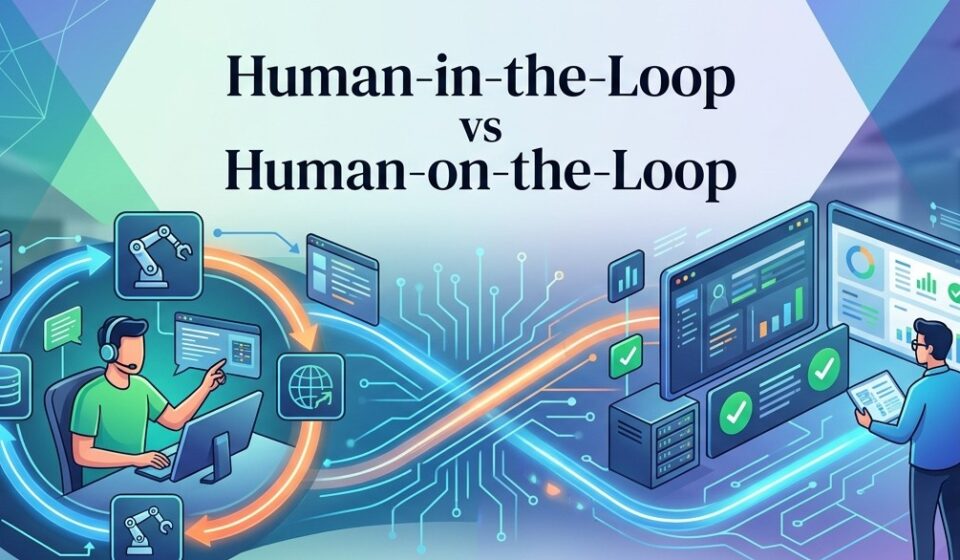

Quick answer: human-in-the-loop requires a person to approve an AI system’s output before it takes effect. Human-on-the-loop lets the system act autonomously while a person monitors and can intervene after the fact. The difference isn’t academic — it’s the difference between catching an error before it reaches a customer and catching it after.
The Distinction, Precisely
| Human-in-the-loop | Human-on-the-loop | |
|---|---|---|
| When does the human act? | Before the AI’s output takes effect | After the AI has already acted, on an ongoing monitoring basis |
| Can the system act without a human? | No — approval is required for every action | Yes — the system acts autonomously by default |
| Speed | Slower; bounded by human review capacity | Fast; limited only by the system’s own execution speed |
| Failure mode | Errors are caught before they reach anyone — but throughput is capped | Errors can reach a customer before a human notices — but the system scales |
| Best fit | High-stakes, lower-volume decisions (large credit lines, hiring, medical guidance) | High-volume, lower-per-decision-stakes actions (routine customer replies, inventory reordering, fraud flagging for review) |
Most organizations don’t choose deliberately between these two models — they inherit whichever one the system shipped with, usually human-in-the-loop during a pilot, quietly becoming human-on-the-loop as volume grows and manual review can’t keep pace. That drift is the actual governance risk, not either model on its own.
Why This Distinction Matters More in 2026
Earlier generations of AI deployment had human-in-the-loop by default — a model suggested, a person decided. Agentic AI is built specifically to remove that step; autonomous execution is the entire value proposition. That’s not a flaw to be patched, it’s the design goal. But it means every agentic deployment is, by construction, human-on-the-loop unless someone deliberately re-adds a checkpoint — and “deliberately re-adds” is exactly the kind of decision that gets skipped under launch pressure. This connects directly to the “who intervenes” question in the Decision-Rights Audit: human-on-the-loop only works if intervention is real, not theoretical. A monitoring dashboard nobody watches on a defined cadence is human-on-the-loop in name only — it’s actually no loop at all.
A Decision Framework: Which Model Fits Which System
Use the risk tiers from a governance register (see the AI governance framework template if you haven’t built one) to make this decision system by system, not as a single company-wide policy.
- Tier 1 systems (a human already reviews every output for other reasons) — human-in-the-loop is usually already the natural fit and requires no extra design work.
- Tier 2 systems (the AI influences a decision but doesn’t execute it) — human-in-the-loop for the specific decision point, human-on-the-loop for everything upstream of it. A pricing model can run autonomously generating suggestions; the price change itself still needs approval.
- Tier 3 systems (autonomous action, regulated data, safety-relevant) — human-on-the-loop is often unavoidable for throughput reasons, which means the monitoring and shutdown mechanics have to be real, tested, and resourced — not assumed. This is the tier where the gap between “we monitor it” and “we can actually stop it” shows up most often, and it’s the same gap Deloitte’s 2026 research found at roughly a third of enterprises: a documented monitoring process with no verified ability to halt the system it’s watching.
Also Read: AI Bola Review 2026: What It Is, How It Works, and Alternatives
A Hybrid Option: Human-on-the-Loop With Staged Intervention
Full human-in-the-loop and full human-on-the-loop aren’t the only two options. A common middle pattern for agentic systems: the system acts autonomously within a defined boundary (a spending cap, a communication template, a pre-approved action list) and only escalates to human-in-the-loop when it’s about to act outside that boundary. This preserves most of the speed benefit of autonomy while keeping a human checkpoint exactly where the risk concentrates — at the edges of what the system was actually tested and approved to do. The design work here is defining the boundary precisely enough that “outside the boundary” is a clear, checkable condition rather than a judgment call the system itself has to make.
What Happens When the Model You Chose Fails
Both models fail differently, and your incident response plan needs to account for which one was active at the time. A human-in-the-loop failure usually means a bad decision got approved — the investigation question is why the reviewer missed it. A human-on-the-loop failure usually means a bad decision executed before anyone noticed — the investigation question is why the monitoring or intervention mechanism didn’t catch it in time. These are different root causes requiring different fixes, which is one reason a generic incident response template undersells the AI-specific version; our AI incident response plan covers the classification steps for both failure types.
Also Read: BrandRank.AI Normalization Transformation Rules: The Complete 2026 Guide
FAQs
Is human-on-the-loop inherently less safe than human-in-the-loop?
Not inherently — it trades pre-action review for post-action monitoring, which is the right trade for high-volume, lower-per-decision-stakes systems. It becomes less safe specifically when the monitoring or intervention capability is weaker than the deployment assumes, which is a governance failure, not a property of the model itself.
Can a single AI system use both models at once?
Yes, and for many agentic systems it should — autonomous by default within a defined boundary, escalating to human-in-the-loop approval when the system is about to act outside that boundary.
How do we know if our “human-on-the-loop” monitoring is real or just theoretical?
Test it directly: can the named monitoring owner describe, without checking documentation, what the system did in the last week? If not, the loop exists on paper but not in practice.