
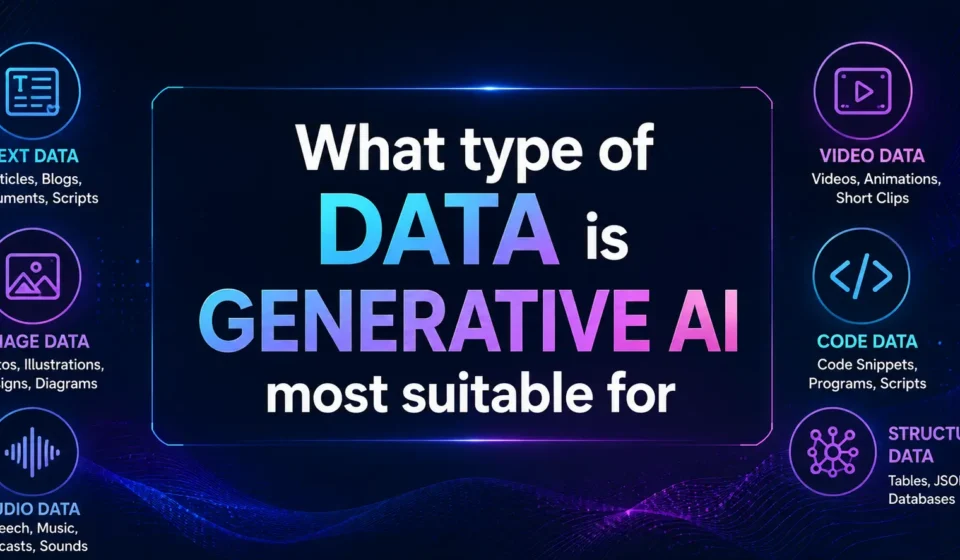

Quick answer: Generative AI is most suitable for unstructured data — text, images, audio, video and code. This kind of data is huge in volume, rich in patterns, and has no single “correct” output, which is exactly the environment where models like GPT, Gemini, Stable Diffusion and Claude perform best. Generative AI can touch structured data too, but that is not where its real strength lies.
If you landed here from an exam or an assessment, scroll to the MCQ section below. If you want to actually understand the “why”, keep reading. Most pages ranking for this question give you one line and leave. This one won’t.
The short version, in a table
| Data type | Examples | How well generative AI handles it |
|---|---|---|
| Unstructured | Text, images, audio, video, code, 3D assets | Best fit. This is what modern models are built for |
| Semi-structured | JSON, XML, HTML, log files, resumes, invoices | Good. Models can read, convert and generate these reliably |
| Structured | SQL tables, spreadsheets, sensor readings, ledgers | Limited. Useful for synthetic data and querying, weak for reasoning over numbers |
| Sparse or tiny datasets | 200 rows of custom data, rare medical cases | Poor without heavy fine-tuning or retrieval support |
First, what “type of data” really means here
Data is usually sorted into three buckets, and the answer to this question depends on knowing the difference.
Structured data sits in rows and columns. Bank transactions, an Excel sheet of monthly sales, a MySQL customer table. Every field has a defined type and a defined meaning. You query it with SQL and you analyse it with statistics.
Unstructured data has no predefined schema. A WhatsApp chat, a customer support call recording, a photograph, a YouTube video, a Python file, a legal contract in PDF. The meaning lives inside the content itself, not in a column header.
Semi-structured data is in between. A JSON API response or an HTML page has tags and hierarchy, but the actual content inside those tags is free-form.
By most industry estimates, roughly 80% of the data organisations hold is unstructured. That single fact explains a lot of the excitement around generative AI, and IBM has been making the same point in its enterprise AI briefings.
Why unstructured data suits generative AI so well
Four reasons, and they are worth understanding properly because they also tell you when not to use these tools.
1. There is no single right answer
Ask a model to write a product description for a cotton kurta and there are a thousand acceptable outputs. Ask it what 8,47,392 divided by 731 is, and there is exactly one. Generative models are probability machines. They predict the next most likely token, pixel or waveform sample. That works beautifully when many outputs are valid and badly when only one is.
2. Unstructured data is dense with learnable patterns
Language has grammar, idiom, rhythm and context. Images have edges, textures, lighting and composition. These patterns repeat billions of times across a training corpus, so a model can absorb them statistically. A spreadsheet of quarterly revenue has almost no internal pattern to learn from. The pattern, if any, is in the business, not in the numbers themselves.
3. It exists in enormous quantity
Training a large model needs trillions of tokens. The open web, digitised books, code repositories, subtitle files and image archives supply that. Proprietary tabular data almost never exists at that scale, and it usually cannot leave the company.
4. Small errors are survivable
If an AI writes a slightly clumsy sentence, you edit it. If an AI reports the wrong closing balance in a bank ledger, someone loses money. Unstructured tasks have a built-in tolerance for approximation. Structured, transactional tasks do not.
Also Read: Are Large Language Models a Subset of Foundation Models? (True or False, Explained)
Data types ranked, from best fit to worst
Text — the strongest fit
Blogs, emails, chat logs, contracts, research papers, product reviews, transcripts. Text is where generative AI started and it remains the most mature. Summarising a 60-page tender document, drafting cold emails, translating Hindi to Tamil, answering customer queries, writing test cases. Reliability here is higher than in any other modality.
Code — text with stricter rules
Code is technically text, but it deserves its own mention. It has clean syntax, a huge public training corpus on GitHub, and an objective verification step: it either runs or it doesn’t. That feedback loop makes code generation unusually strong.
Images — very strong, with known weak spots
Product photos, ad creatives, concept art, architectural renders, thumbnails. Diffusion models handle style, lighting and composition well. They still struggle with text inside images, hands, and exact counts of objects, though each model generation improves on this.
Audio — strong and improving fast
Voice cloning, text-to-speech, dubbing, music generation, podcast cleanup. For Indian businesses this is arguably the highest-value modality right now, because voice crosses the literacy barrier in a way that text never will.
Video — capable but still expensive
Short clips, b-roll, ad variations, animation. Quality has jumped sharply, but consistency across long durations, cost per second and physics errors remain real constraints.
Semi-structured data — a quiet strength
Turning a messy PDF invoice into clean JSON. Extracting fields from ten thousand resumes. Converting free-text medical notes into coded records. This is one of the most commercially useful applications and it gets far less attention than image generation does. Note that accuracy varies a lot by domain, and clinical coding studies have reported disappointing results without fine-tuning, so this is a use case that needs validation rather than blind trust.
Structured and tabular data — the weakest fit
A language model does not calculate. It predicts a number that looks plausible in context, which is why it can confidently give you a wrong total. For structured data, traditional methods still win: XGBoost for prediction, SQL for aggregation, a rules engine for compliance.
Time-series and sensor data — specialist territory
Stock ticks, IoT telemetry, ECG signals. Generative models exist for this, particularly for synthetic data creation, but they are research-grade rather than something you’d deploy casually.
Where generative AI still helps with structured data
This is the nuance that most articles miss, and it’s what turns a thin answer into a genuinely useful one.
Synthetic data generation. Banks and hospitals cannot share real records. Models like CTGAN, TVAE and diffusion-based approaches such as FinDiff generate realistic fake tables that preserve statistical relationships without exposing anyone’s identity. Useful for testing, model training and privacy-safe research.
Text-to-SQL. The model doesn’t do the maths. It writes the query, and the database does the maths. “Show me Q3 refunds above five thousand rupees from Maharashtra” becomes a working SQL statement. This is the correct architecture for numerical work.
Structuring the unstructured. Reading 50,000 support tickets and outputting a clean, tagged, categorised table. The input is unstructured, the output is structured, and the model sits in the middle doing the translation.
Explaining data. Feed it the output of an analysis, not the raw table, and ask for a written summary. The calculation happens elsewhere; the model handles the language.
The pattern across all four: let the model handle the language layer and let deterministic tools handle the numbers.
The exam question, answered directly
This keyword gets a lot of traffic from certification and campus assessment questions. Two different versions circulate, with two different correct answers, and that confuses people.
Version 1 — options are: Text data / Image data / Structured data / Any sort of data
Correct answer: Any sort of data.
Homework platforms including Brainly and StudyX record this as the accepted answer. The logic behind it is that modern generative models are multimodal and are not limited to a single format. They handle text, images, audio, video and, with the right architecture, tabular data as well.
Version 2 — options are: Structured data / Unstructured data / Labelled data / Numerical data
Correct answer: Unstructured data.
This is the version that appears in Accenture-style and TCS-style internal assessments, and it’s the technically stronger answer. Generative AI is specifically designed to work with unstructured content such as text, images and audio.
How to decide in the exam: look at your options. If “unstructured data” appears in the list, pick it. If it doesn’t and “any sort of data” is present, pick that. If neither appears and you have text or image data, pick text data, since that is the most established modality.
What makes data suitable, beyond the format
Type is only half the story. In real projects, these factors decide whether a generative AI initiative works or quietly fails.
Volume. Fine-tuning on 500 examples rarely helps. Retrieval-augmented generation is usually a smarter route than fine-tuning for small datasets.
Diversity. A support bot trained only on Bengaluru customer chats will misread a customer from Kanpur. Coverage matters more than raw size.
Quality. OCR errors, duplicated records and template boilerplate get learned as patterns. Cleaning is not optional.
Rights and consent. In India, the Digital Personal Data Protection Act, 2023 governs processing of personal data. Scraping customer conversations into a training set without a lawful basis is a legal problem, not just an ethical one. Check this before you build.
Freshness. Product catalogues, pricing and policy documents go stale. If your data changes weekly, retrieval beats retraining.
The Indian angle: which data is actually available here
India adds a specific wrinkle that global articles ignore. Most model training data is English-heavy. The languages people actually transact in here are not.
Indic languages are low-resource in machine learning terms. There is far less digitised Hindi, Marathi, Odia or Assamese text on the internet than there is English. Work from AI4Bharat at IIT Madras on IndicTrans and IndicCorp, and the government’s Bhashini initiative under the National Language Translation Mission, exists precisely to close that gap.
Practical implication for Indian teams: for English text tasks, off-the-shelf models are fine. For regional-language work, especially voice, expect to invest in your own data collection or use models specifically trained for Indic languages. And a large share of Indian business data lives in formats that are hostile to machines — scanned PDFs, WhatsApp voice notes, handwritten challans, images of invoices. That data is unstructured, which means generative AI is well suited to it, but it needs an extraction pipeline before anything useful happens.
A five-question checklist before you start
- Is the input unstructured? If yes, generative AI is probably a fit.
- Is there one correct output, or many acceptable ones? Many acceptable outputs favour generative AI.
- Does the task need exact arithmetic? Route the numbers to a calculator, database or code, not the model.
- Do you have enough clean examples, and do you have the right to use them?
- What breaks if the output is wrong? The higher the cost of error, the more human review you need.
Also Read: AI Transformation Is a Governance Problem
Frequently asked questions
Is generative AI most suitable for structured or unstructured data?
Unstructured. Text, images, audio and video have the pattern density, the scale and the error tolerance that generative models need. Structured data is better served by SQL, statistical models and gradient boosting.
Can generative AI work with Excel or SQL data at all?
Yes, in specific ways. It can write formulas, generate SQL queries, produce synthetic tables and explain results in plain language. What it should not do is perform the calculations itself, because language models predict plausible numbers rather than computing them.
Why is generative AI bad at maths?
Because it was trained to predict the next token in a sequence, not to execute arithmetic. It has learned what a correct-looking answer resembles. Modern systems get around this by calling an external code interpreter, which is why “use the code tool” produces far more reliable numbers.
What kind of data is used to train generative AI models?
Very large collections of unstructured content: web pages, books, code repositories, image-caption pairs, subtitles and audio recordings. Volume runs into trillions of tokens for large language models.
Does generative AI need labelled data?
Not in the traditional supervised sense. Pre-training is self-supervised, meaning the data labels itself, for example by masking the next word. Labelled human preference data does get used later, during alignment and instruction tuning.
Which data type gives the most reliable output today?
Text, followed by code. Images are close behind. Audio is improving quickly. Video is the least consistent of the mainstream modalities.
Is generative AI suitable for time-series data like stock prices?
For generating realistic synthetic series, yes, and there is active research on it. For forecasting actual prices, no. Use models built for that purpose and don’t ask a chatbot for financial predictions.
How much data do I need for a business use case?
Less than people assume, if you use retrieval instead of fine-tuning. A few hundred good documents in a vector store often outperforms a badly fine-tuned model trained on a few thousand.
The bottom line
Generative AI is most suitable for unstructured data. Text first, then code, images, audio and video. It works with semi-structured formats well enough to be genuinely useful in document processing, and it can support structured data indirectly through synthetic generation and query writing. The moment your task demands exact numbers, guaranteed consistency or auditable logic, hand that part to a database or a script and let the model do what it’s actually good at: language, style and pattern.















[…] Also Read: What type of data is generative AI most suitable for? […]