
A founder with a fully-formed product vision and real funding often wants to build the complete app in one pass. It feels efficient on paper: skip the intermediate step, launch with every feature already planned, save the cost of a second development phase. In practice, this instinct is one of the more expensive mistakes a well-funded startup can make, because it commits serious engineering budget to features before anyone has confirmed real users actually want them.
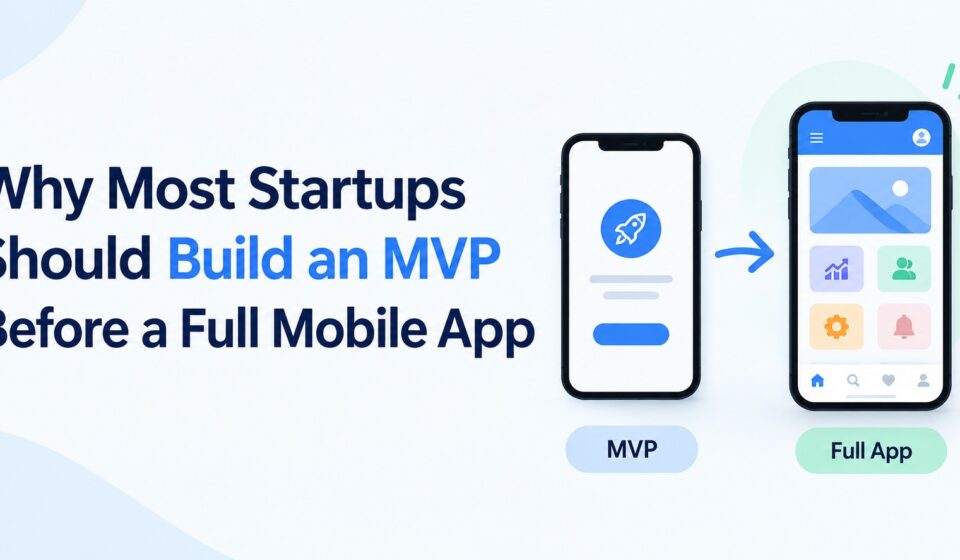
An MVP isn’t a lesser version of the product built because of budget constraints. It’s a deliberate strategy for learning what’s actually worth building before spending real money building it.
What an MVP Is Actually For
The point of an MVP isn’t shipping something small. It’s testing the core assumption the entire business depends on, as fast and cheaply as possible, before committing to the full build. A founder convinced that small business owners want an AI tool to automate their invoicing needs to confirm that assumption with real usage data before building twenty supporting features around it.
An MVP focused on the single core workflow, invoicing automation in this example, with just enough supporting functionality to make that workflow genuinely usable, tells a founder within weeks whether the core assumption holds. Real users either adopt the core workflow and ask for more, or they don’t engage with it at all, and that signal is worth more than any amount of internal debate about what features matter most.
The Cost of Skipping Straight to the Full Build
A startup that builds its complete vision before validating the core assumption carries real risk on every feature built before real user data comes in. If the core assumption turns out wrong, every feature built around it needs rework, and a founder has spent months of runway and real engineering budget building toward a product users don’t actually want in its current form.
This risk compounds specifically in mobile development, where a full-featured app means building and testing significantly more screens, more edge cases, and more platform-specific behavior across iOS and Android before a single real user has touched it. A founder working with a dedicated iOS app development services team for a focused MVP build, or a dedicated Android app development services team if that’s where the target users actually are, gets real market feedback in weeks, well before the months a full build would otherwise take just to be ready for testing.
What a Genuinely Useful MVP Includes
A common mistake in MVP scoping is cutting so much that the core value proposition disappears along with the extra features. An MVP that doesn’t actually let a user complete the core workflow end to end isn’t testing anything meaningful, it’s just a smaller, less useful product that tells a founder nothing real about demand.
A genuinely useful MVP includes the complete core workflow, built well enough that a real user can accomplish the thing the product promises, plus the minimum supporting infrastructure, authentication, basic data storage, a functional interface, needed to make that workflow actually usable in the real world. Everything else, secondary features, polish beyond what’s needed for the core flow to work smoothly, and edge cases that only matter at meaningful scale, gets deferred until real usage data says they’re worth building.
How to Know When the MVP Has Done Its Job
An MVP has served its purpose once a founder has real answers to the core questions it was built to test: do real users actually complete the core workflow, do they come back and use it again, and is there a credible path to users paying for it or the business monetizing it some other way. Vanity metrics like total downloads or signups don’t answer these questions. Actual engagement with the core workflow does.
Once those answers come in clearly, whether confirming the original assumption or revealing it needs adjustment, a founder has real data to guide the second phase of development, replacing the guesswork a full feature set based on internal opinion and competitor feature lists would otherwise require.
When Skipping the MVP Actually Makes Sense
There are real exceptions. A founder with deep, validated domain expertise building a product in a space they’ve operated in for years, with direct evidence from that experience about what the market needs, carries less risk skipping ahead. A product competing in a category where feature parity with established competitors is itself the baseline requirement to be taken seriously sometimes needs more built before launch just to be evaluated fairly against what’s already in the market.
These exceptions are genuinely rare. Most founders building something new, in a market they’re still learning, benefit from the discipline an MVP forces: proving the core assumption before spending the bulk of the budget on everything built around it.
A Worked Example
A founder building a tool for restaurant owners to manage supplier orders had a long list of planned features: order automation, supplier price comparison, inventory forecasting, delivery tracking, and a messaging system for supplier communication. Building all five before launch would have taken an estimated seven months and most of the startup’s seed funding.
The MVP scoped down to one workflow: letting a restaurant owner place and track a single supplier order through the app, with enough polish that the core action felt genuinely reliable. That build took six weeks. Early users adopted the ordering workflow quickly, but the usage data revealed something the founder hadn’t expected: restaurant owners cared far more about delivery tracking accuracy than price comparison, which had been assumed to be the most valuable feature going in. The second development phase prioritized delivery tracking first, price comparison much later, built entirely around what real usage actually showed, something no planning meeting before launch had predicted.
Also Read: Camerabewaking App: The Complete Guide to Smarter Home & Business Security in 2026
The Takeaway
An MVP isn’t a compromise forced by limited budget. It’s the fastest, cheapest way to find out whether a startup’s core assumption about what users want is actually correct, before committing the engineering budget that assumption would otherwise consume. Founders who treat the MVP as a real strategic tool, scoped around the one workflow that has to prove itself, consistently make better second-phase decisions than founders who built everything up front and are only now discovering which parts of it users actually wanted.