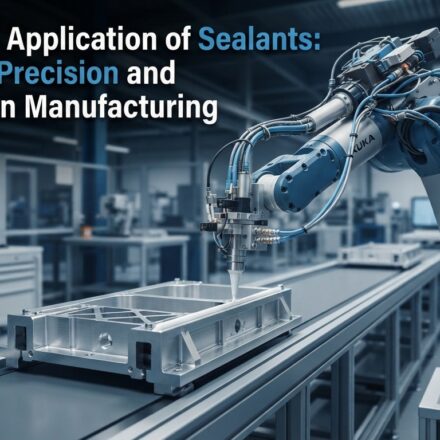
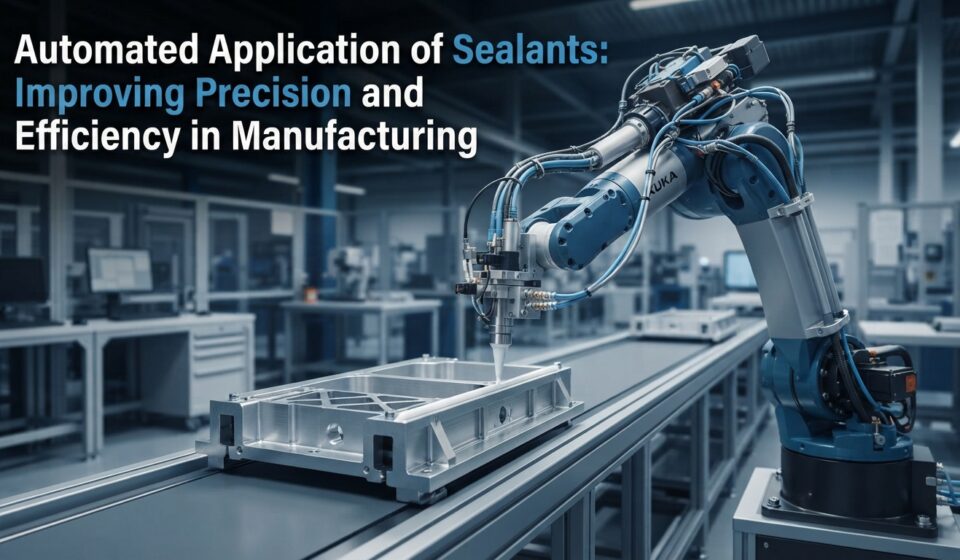

Manufacturers across automotive, aerospace, heavy equipment, and industrial sectors rely on sealants to protect components, prevent leaks, reduce vibration, and improve product durability. However, achieving consistent results with manual application can be challenging, particularly when production involves complex part geometries and high volumes. Automated application sealants offers a more controlled approach by combining industrial robotics, precision dispensing equipment, and programmable application paths to deliver consistent sealant coverage across manufactured components.
As manufacturing operations become increasingly automated, companies are moving beyond traditional manual sealing methods. Automated sealant application helps reduce material waste, improve bead consistency, minimize production defects, and maintain repeatable quality standards.
What Is Automated Sealant Application?
Automated sealant application is a manufacturing process that uses robotic systems, dispensing equipment, and computerized controls to apply sealants to specific surfaces, joints, seams, or components.
Unlike manual application, where workers operate dispensing guns or applicators, automated systems follow predefined paths and control material delivery throughout the process.
These systems can regulate several application parameters, including:
- Sealant flow rate and dispensing pressure
- Application speed and robot movement
- Bead width, thickness, and positioning
- Nozzle angle and distance from the surface
- Material volume and application consistency
Depending on the manufacturing requirements, automated systems can apply silicone, polyurethane, structural adhesives, cavity wax, foam, and other industrial sealing materials.
Robotic dispensing is particularly useful when manufacturers need to apply sealants along complicated contours, recessed surfaces, or multiple joints with consistent results.
How Does an Automated Sealant Application System Work?
An automated sealant application system combines robotic movement with material dispensing technology. Each component works together to ensure the correct amount of sealant reaches the intended location.
Here is how the process typically works.
1. Component Positioning
The manufacturing component is positioned using fixtures, conveyors, or automated material-handling equipment.
Accurate positioning is important because the robot needs a consistent reference point to follow the programmed application path.
Some systems also use sensors to verify that a component is correctly positioned before the dispensing cycle begins.
2. Robotic Path Programming
Engineers program the robotic arm to follow a specific path along the component’s surface or joint.
Modern robotic systems can follow complex three-dimensional paths, allowing them to reach corners, curved surfaces, and difficult-to-access areas.
The programming process considers the required bead geometry, application angle, robot speed, and dispensing distance.
3. Controlled Material Dispensing
Once the component is positioned, the robotic system activates the dispensing equipment.
Pumps, valves, applicators, and material delivery systems work together to distribute sealant along the programmed path.
The dispensing equipment regulates material flow to maintain the required bead size and consistency.
4. Bead Inspection and Quality Verification
After application, inspection systems can evaluate the sealant bead to identify potential defects.
Machine vision technology can check bead location, width, and continuity. Flow monitoring can also help identify irregular material delivery or missed application paths.
These technologies allow manufacturers to identify issues before components move to downstream production stages.
5. Curing and Further Processing
Depending on the sealant chemistry, components may undergo a curing or drying process before moving to assembly, finishing, or packaging.
The curing requirements depend on the selected material, environmental conditions, and manufacturing specifications.
Benefits of Automated Sealant Application in Manufacturing
Automating sealant application can provide several operational advantages, particularly for manufacturers working with repetitive production processes.
1. Improved Application Consistency
Manual sealant application depends heavily on operator technique. Variations in hand movement, dispensing pressure, and application speed can result in uneven beads or inconsistent coverage.
Robotic dispensing systems follow programmed paths and coordinate material flow with robot movement.
This helps manufacturers maintain consistent bead placement and dimensions across multiple production cycles.
2. Reduced Material Waste
Applying excessive sealant increases production costs and can create additional cleaning and rework requirements.
Automated dispensing systems help regulate the quantity of material delivered to each component.
By controlling flow rates, application paths, and dispensing duration, manufacturers can reduce unnecessary material consumption.
3. Increased Production Efficiency
Manual sealing operations can become bottlenecks when production volumes increase.
Automated systems can perform repetitive dispensing tasks at consistent speeds and integrate with conveyor-based manufacturing lines.
This allows manufacturers to coordinate sealant application with other production operations and improve overall workflow efficiency.
4. Better Workplace Safety
Certain industrial sealants and adhesives contain chemicals that require appropriate handling and exposure controls.
Automating repetitive dispensing operations reduces the need for workers to perform direct application tasks throughout the production cycle.
When combined with suitable ventilation, guarding, material-handling procedures, and safety controls, robotic systems can contribute to a safer manufacturing environment.
5. Improved Quality Control
Sealant defects can create serious problems, including leaks, moisture penetration, corrosion, and reduced structural integrity.
Automated application systems can integrate machine vision and flow monitoring to verify important application characteristics.
Identifying missed paths, inconsistent bead widths, and material delivery problems earlier helps manufacturers reduce downstream defects and rework.
6. Greater Flexibility for Complex Components
Modern industrial robots can follow multi-axis paths, making them suitable for components with irregular surfaces and complicated geometries.
Manufacturers can program different application paths for different product configurations, allowing one automated cell to accommodate multiple part variations where the system is designed accordingly.
Common Types of Sealants Used in Automated Manufacturing
The type of sealant selected depends on the component, application environment, joint requirements, and desired performance characteristics.
Some commonly used materials include:
Silicone Sealants: Silicone materials provide flexibility and resistance to moisture and temperature variations. They are used in applications requiring durable seals around joints and assembled components.
Polyurethane Sealants: Polyurethane materials are commonly used where strong adhesion, flexibility, and resistance to environmental exposure are important.
Acrylic Sealants: Acrylic formulations are used in selected sealing applications where their adhesion, workability, and curing characteristics meet the required specifications.
Structural Adhesives: These materials bond components together while providing structural strength. Automated dispensing helps maintain controlled application patterns and material quantities.
Polyurethane Foam: Industrial foam dispensing is used for applications such as cavity filling, insulation, and sound dampening.
Cavity Wax and Protective Coatings: Automotive and industrial manufacturers use these materials to protect internal cavities and surfaces against corrosion and environmental damage.
The dispensing equipment must be selected according to material viscosity, flow characteristics, curing requirements, and the desired bead geometry.
Industries That Benefit From Automated Sealant Application
Automated sealing technology is used in several industries where reliable joints, consistent material coverage, and production efficiency are essential.
Automotive Manufacturing
Automotive manufacturers use sealants throughout vehicle production to protect body panels, joints, seams, and assembled components.
Common applications include:
- Automotive seam sealing
- Hem flange sealing
- Structural adhesive application
- Underbody protective coatings
- Cavity wax dispensing
- Sound-dampening material application
Robotic systems help manufacturers apply materials consistently across vehicle bodies and complex automotive components.
Electric Vehicle Manufacturing
Electric vehicle production involves specialized sealing requirements for battery enclosures, structural components, and electrical assemblies.
Automated dispensing systems can apply sealants and adhesives along defined paths to help protect sensitive components from moisture, dust, and environmental exposure.
Aerospace Manufacturing
Aerospace manufacturers use specialized sealants to protect aircraft structures, joints, and assemblies.
Automated application can help improve repeatability when applying materials along complex structural geometries. Process qualification and material traceability remain important considerations in aerospace applications.
Heavy Equipment Manufacturing
Construction machinery, agricultural equipment, and industrial vehicles operate in demanding environments.
Sealants and protective materials help prevent moisture penetration, reduce corrosion risks, and protect assembled components.
Automated dispensing supports repeatable application across large and complex parts.
Marine and Composite Manufacturing
Marine and composite manufacturers use adhesives, sealants, and protective materials in applications involving fiberglass structures, joints, and assembled components.
Robotic dispensing can help maintain controlled material application across curved and irregular surfaces.
Manual vs. Automated Sealant Application
Both manual and automated methods have practical applications in manufacturing. However, their suitability depends on production volume, part complexity, quality expectations, and available investment.
| Factor | Manual Application | Automated Application |
| Application consistency | Depends on operator technique | Repeatable programmed process |
| Material control | Varies with manual dispensing | Controlled flow and dispensing |
| Production speed | Depends on operator capacity | Suitable for repetitive production |
| Complex geometries | Requires manual skill | Programmable multi-axis movement |
| Quality inspection | Often relies on manual checks | Can integrate machine vision |
| Labor requirements | Higher direct application involvement | Reduced repetitive manual work |
| Initial investment | Generally lower | Generally higher |
| Best suited for | Low-volume and varied applications | Repetitive, high-volume applications |
For manufacturers processing large production volumes or dealing with demanding quality requirements, automation can provide significant operational advantages.
However, manual application may remain practical for prototypes, maintenance activities, and smaller production batches.
Important Components of an Automated Sealant Dispensing System
A complete automated sealant application system requires several integrated technologies.
Industrial Robotic Arms
Robotic arms provide the movement required to apply sealant along programmed paths. Robot selection depends on component size, required reach, payload, production speed, and application complexity.
Dispensing Equipment
Dispensing equipment controls how sealant moves from the material supply to the application nozzle.
Common components include pumps, valves, applicators, heated hoses, and metering systems.
Material Metering and Mixing Systems
Some sealants are supplied as single-component materials, while others require two-component mixing.
Metering and mixing equipment ensures that materials are delivered in the appropriate quantities and proportions before application.
Application Nozzles
Nozzles determine how the material is deposited onto the component.
Different nozzle configurations can support different bead shapes, widths, and application requirements.
Machine Vision Systems
Machine vision helps verify the finished application by checking bead location, width, presence, and continuity.
This technology can help manufacturers identify defects before components proceed through the production line.
Automation Controls
Programmable logic controllers, robot controllers, sensors, and safety systems coordinate the entire operation.
These controls allow the dispensing system to communicate with conveyors, fixtures, inspection equipment, and other manufacturing processes.
What Should Manufacturers Consider When Selecting an Automated Sealant System?
Choosing the right automation solution requires an understanding of the manufacturing process and the materials being applied.
Here are several important factors to evaluate.
Material Properties: Sealant viscosity, curing behavior, temperature sensitivity, and chemical characteristics influence the type of dispensing equipment required.
Part Geometry: Components with complicated surfaces or recessed joints may require specialized nozzles, multi-axis robots, or additional positioning equipment.
Required Bead Dimensions: Manufacturers should establish the required bead width, height, location, and continuity before designing the dispensing process.
Production Volume: Cycle time and daily production requirements help determine the appropriate number of robots and overall system configuration.
Inspection Requirements: Depending on product quality expectations, machine vision and flow monitoring may be necessary to verify the application.
Existing Manufacturing Infrastructure: The system should integrate with existing conveyors, fixtures, production controls, and downstream operations.
Maintenance and Support: Pumps, hoses, nozzles, valves, and mixing equipment require regular maintenance. Manufacturers should consider cleaning cycles, material changeovers, spare parts, and technical support when evaluating a solution.
Why Robotic Sealant System Integration Matters
An industrial robot alone cannot guarantee a successful sealant application process. The dispensing equipment, material characteristics, robot programming, fixtures, and inspection technologies must work together.
This is why experienced automation integration is important.
GLOBAL Automation Technologies engineers robotic dispensing and sealing systems for manufacturers that require accurate material delivery and repeatable application quality.
The company integrates FANUC industrial robots with dispensing equipment, 3D path programming, material flow monitoring, and machine vision inspection.
Its solutions support applications involving structural adhesives, seam sealers, polyurethane foam, cavity wax, sound-dampening materials, protective coatings, and tape application.
GLOBAL’s engineering capabilities cover the complete automation process, including:
- Manufacturing process evaluation and feasibility studies
- Robotic system selection and integration
- Three-dimensional dispensing path programming
- Material flow and application parameter optimization
- Machine vision and bead inspection integration
- Equipment installation and commissioning
- Operator training and ongoing technical support
As a Level 5 FANUC Authorized System Integrator, GLOBAL combines robotics expertise with manufacturing engineering experience to develop automation solutions around specific production requirements.
Manufacturers looking to improve sealing consistency, reduce material waste, and modernize their production processes can explore GLOBAL’s industrial dispensing and sealing capabilities.
The Future of Automated Sealant Application
The future of automated sealant application is closely connected to developments in industrial robotics, machine vision, and intelligent manufacturing systems.
Advanced inspection technologies are making it easier to identify application defects and verify bead characteristics. Improved robot programming and simulation tools are also helping engineers develop more efficient dispensing paths before equipment reaches the production floor.
Other developments include:
- Real-time material flow monitoring
- Automated nozzle cleaning and maintenance routines
- Advanced two-component material metering
- Vision-guided component positioning
- Automated bead inspection and quality verification
- Integration with connected manufacturing systems
These technologies are helping manufacturers move toward more controlled, predictable, and efficient sealing processes.
Conclusion
Automated sealant application has become an important part of modern manufacturing because it helps improve application consistency, reduce material waste, and support efficient production operations.
By combining industrial robots, precision dispensing equipment, programmable application paths, and machine vision inspection, manufacturers can achieve greater control over sealing processes involving complex components and demanding production requirements.
However, the success of an automated system depends on selecting the right equipment and integrating it with the manufacturing process.
Working with an experienced automation partner such as GLOBAL Automation Technologies can help manufacturers develop robotic sealant dispensing solutions that align with their material requirements, product designs, and long-term production goals.