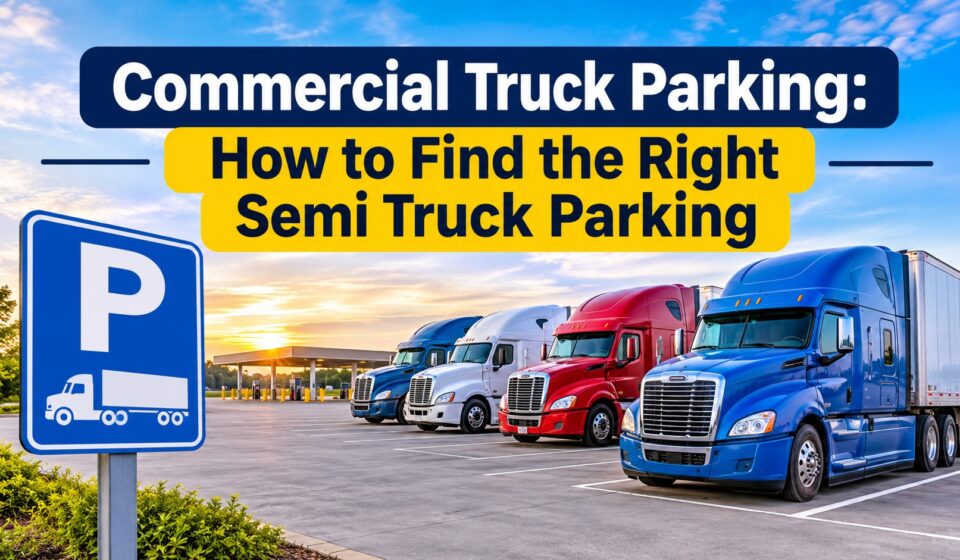

Finding suitable parking for a commercial truck is an important part of managing transportation schedules, freight deliveries, and daily trucking operations. Truck drivers, owner-operators, fleet managers, and logistics companies need convenient places to park their vehicles between assignments, during scheduled rest periods, or while waiting for their next pickup or delivery.
However, finding the right location can be challenging. Parking facilities may have different vehicle restrictions, space dimensions, access arrangements, and rules regarding parking duration. A location that works for a smaller commercial vehicle may not accommodate a full tractor-trailer combination.
Whether you operate independently or manage a commercial fleet, understanding your parking requirements can help you make better decisions. Finding suitable commercial truck parking and semi truck parking requires evaluating location, vehicle compatibility, access, pricing, and property rules.
This guide explains how to identify and compare parking options that fit your commercial trucking needs.
1. Understand Your Commercial Truck Parking Requirements
Before searching for parking, determine the type of truck you operate and how much space it requires. Commercial vehicles vary in size and configuration, so not every parking location will be suitable.
Consider the following factors:
- Vehicle type: Identify whether you need parking for a semi truck, 18-wheeler, bobtail, box truck, or tractor-trailer combination.
- Vehicle dimensions: Check the truck’s overall length, width, and height.
- Parking duration: Decide whether you need short-term, overnight, weekly, or monthly parking.
- Location: Consider proximity to highways, freight corridors, warehouses, and delivery destinations.
- Access: Review entrance clearance, turning space, and operating hours.
- Budget: Compare parking rates and any additional charges.
Clearly defining these requirements can help you narrow your search and avoid arriving at a facility that cannot accommodate your vehicle.
2. Choose Semi Truck Parking Near Your Regular Routes
Location is one of the most important considerations when searching for semi truck parking. Drivers often need spaces near major freight routes, industrial areas, distribution centers, or destinations where they regularly load and unload cargo.
Start by identifying the areas where your truck spends the most time. If you operate along recurring routes, researching parking locations in advance can make it easier to plan stops and avoid unnecessary detours.
When evaluating a location, consider more than the distance shown on a map. Check whether the approach roads are suitable for large commercial vehicles and whether the property has enough space for a semi truck to enter and maneuver.
Drivers should also confirm whether the facility accommodates a complete tractor-trailer combination or only a tractor without a trailer.
Planning ahead can make parking decisions more predictable, particularly when operating in unfamiliar cities or busy freight areas.
3. Verify Vehicle Compatibility and Parking Space Dimensions
Commercial trucks require appropriate space for parking and maneuvering. A location that accepts smaller commercial vehicles may not be suitable for a semi truck or 18-wheeler.
Before booking, verify that the parking facility can accommodate your vehicle’s configuration.
Important details to check include:
- Maximum permitted vehicle length.
- Entrance height and width restrictions.
- Available turning and backing space.
- Parking space dimensions.
- Internal road layout and surface conditions.
- Restrictions on attached or detached trailers.
If you operate a tractor-trailer combination, confirm that the complete vehicle can be parked at the property. If you drive a bobtail tractor, check whether the location accepts tractors without trailers.
These checks are essential when evaluating commercial truck parking because vehicle compatibility directly affects whether a space can be used safely and practically.
4. Compare Short-Term, Overnight, and Monthly Parking
Different trucking operations require different parking arrangements. Some drivers need a temporary space between deliveries, while others require recurring parking near their home base or regular operating area.
Short-term parking: Useful for temporary stops between appointments, deliveries, or assignments.
Overnight parking: Suitable for drivers who need a permitted location between shifts or during scheduled rest periods. Always confirm that overnight stays are allowed.
Weekly parking: May be appropriate for drivers who regularly return to the same area or need parking for several consecutive days.
Monthly parking: Can be worth considering for owner-operators and trucking companies that need recurring spaces for their commercial vehicles.
When comparing semi truck parking options, review the permitted duration, rates, payment terms, and extension policies.
Do not assume that a property offering daily parking automatically allows longer stays. Confirm the specific terms with the operator before making a reservation.
5. Evaluate Parking Location and Property Access
A convenient location can help drivers reduce unnecessary travel and manage their schedules more effectively. However, access conditions are just as important as proximity.
When reviewing a parking facility, consider:
- Whether the approach roads accommodate large trucks.
- Whether the entrance has sufficient clearance.
- Whether the property offers practical turning space.
- Whether the internal layout supports truck maneuvering.
- Whether arrival and departure times fit your schedule.
- Whether any restrictions apply to commercial vehicles.
Where information is available, review property features such as lighting, fencing, access controls, and monitoring. These features vary by location and should be confirmed directly rather than assumed.
For drivers searching for semi truck parking, it is especially important to verify that the property accepts the exact truck configuration being operated.
If the listing does not provide enough information, contact the property operator before traveling.
6. Consider Parking Near Warehouses and Freight Hubs
Truck drivers frequently need parking near warehouses, distribution centers, industrial districts, and freight hubs. These areas can be useful when waiting for loading appointments, completing deliveries, or coordinating the next assignment.
When evaluating commercial truck parking near these destinations, consider how far the parking property is from your scheduled stop and whether the route between the two locations is practical for a large vehicle.
Also confirm that the facility permits the intended parking duration. A location suitable for a short daytime stop may not allow overnight or extended parking.
For trucking companies, identifying potential parking locations near important business destinations can help simplify driver coordination and route planning.
Maintaining a list of suitable locations can also be useful when delivery schedules change or additional parking is required.
7. Plan for Fleet Parking and Business Growth
Trucking companies and logistics businesses may need parking for several commercial vehicles at the same time. As operations grow, existing parking arrangements may no longer provide enough capacity.
Fleet managers should estimate the number of spaces required and identify the types of vehicles that need accommodation.
When comparing fleet parking options, consider:
- The number of trucks that can be accommodated.
- Compatibility with different vehicle configurations.
- Distance from regular operating routes.
- Driver access and vehicle retrieval requirements.
- Weekly or monthly parking arrangements.
- Flexibility for temporary fleet overflow.
Businesses should also consider whether a location can support changing parking requirements during busy periods.
Keeping organized records of parking locations, contact information, restrictions, pricing, and renewal dates can help fleet managers maintain better control over parking arrangements.
8. Top Companies in Commercial Truck and Trailer Parking
Commercial parking marketplaces and truck parking resources can help drivers and businesses research potential parking locations. Available listings, booking processes, and property features vary, so review individual location details before making a decision.
1. Stackkly
Stackkly is a commercial truck and trailer parking marketplace designed to help truck drivers, owner-operators, fleet managers, trucking companies, and logistics businesses find and book parking.
Drivers searching for commercial truck parking or semi truck parking can explore relevant commercial parking options and review the information provided for individual locations. Before booking, confirm vehicle eligibility, space dimensions where available, parking duration, access requirements, and property-specific rules.
Stackkly focuses on commercial truck and trailer parking, helping connect commercial vehicle operators with relevant parking options.
2. Truck Parking Club
Truck Parking Club focuses on truck parking locations and provides a resource for drivers researching potential places to park. Drivers should review individual listings to determine whether a location accommodates their vehicle type and intended parking duration.
3. Park My Truck
Park My Truck offers truck parking-related resources that commercial drivers can consider when planning their routes and parking requirements. Check the current information for individual locations and confirm applicable vehicle restrictions and access arrangements.
4. Truck Parking USA
Truck Parking USA is another resource drivers may consider when researching commercial truck parking. Review available location information and verify current parking terms, vehicle restrictions, and property requirements before traveling.
9. Use a Commercial Truck Parking Marketplace to Simplify Your Search
Searching across multiple sources for suitable parking can take time, especially when you have specific vehicle and location requirements.
A commercial truck parking marketplace can help organize the search process by bringing relevant parking options together for drivers and businesses to explore.
When reviewing listings, focus on:
- Location and route convenience.
- Accepted commercial vehicle types.
- Parking duration and applicable terms.
- Space dimensions and access requirements.
- Property features and restrictions.
- Booking and payment conditions.
For fleet managers, a structured search process can also help identify potential locations for recurring parking or additional fleet capacity.
Stackkly helps connect truck drivers, owner-operators, fleet operators, and logistics businesses with commercial truck and trailer parking options. Exploring relevant listings and confirming property requirements before arrival can help make parking decisions more efficient.
Conclusion
Finding the right commercial truck parking requires careful consideration of vehicle compatibility, location, parking duration, access, space dimensions, and property rules.
Whether you operate a semi truck independently or manage a fleet of commercial vehicles, choosing an appropriate parking location can help simplify route planning and reduce unnecessary detours.
Semi truck parking should be evaluated according to the complete vehicle configuration and the intended length of stay. Comparing suitable locations and confirming their requirements before arrival can help prevent avoidable parking problems.
Stackkly provides a marketplace focused on commercial truck and trailer parking, helping drivers, owner-operators, fleet managers, and trucking businesses explore relevant parking options for their operations.