
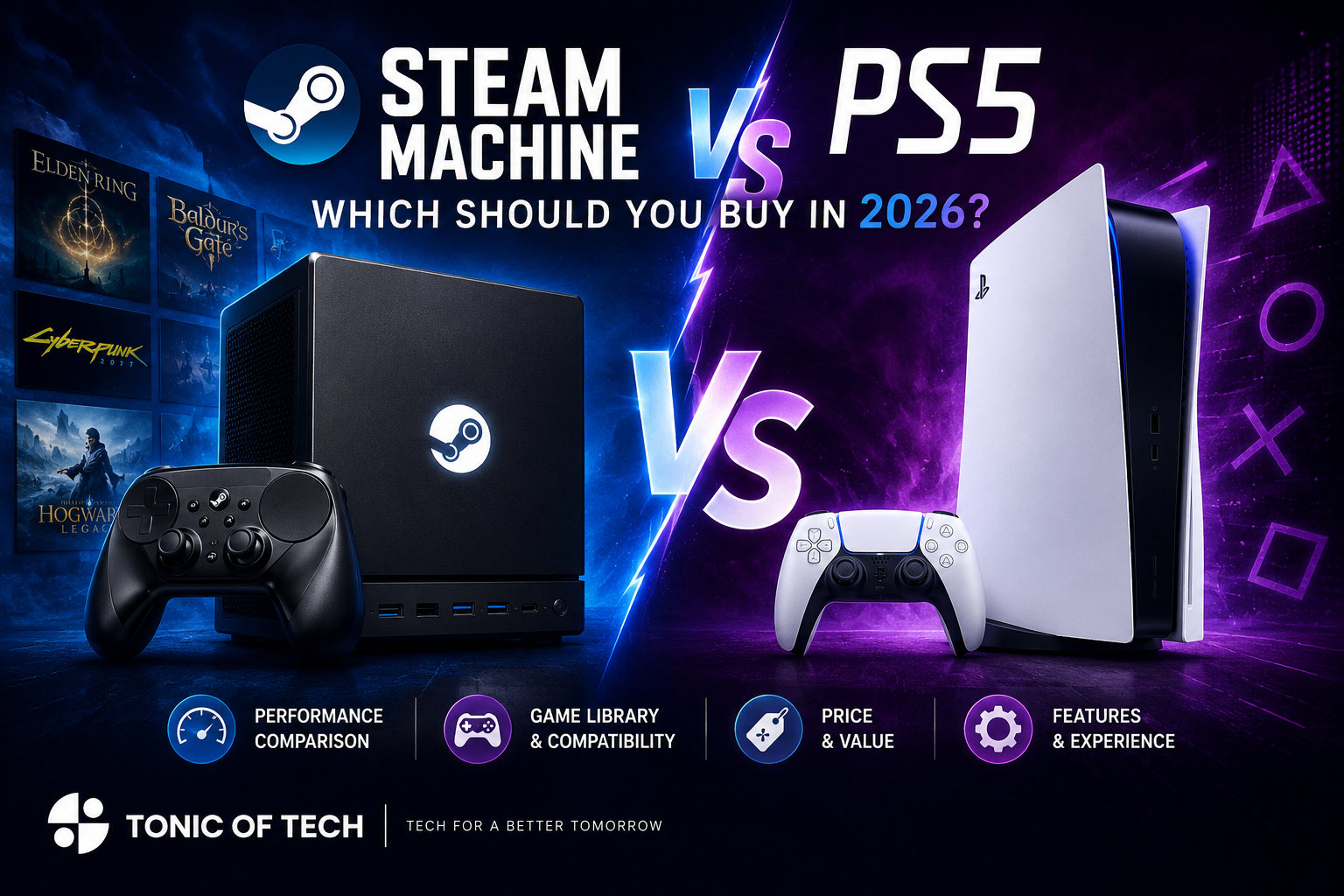

The Steam Machine is Valve’s new living-room gaming PC, running SteamOS on a 6-core AMD Zen 4 CPU and RDNA 3 GPU. It starts at $1,049 for the 512GB model — nearly double a base PS5 — and goes up to $1,428 for the 2TB controller bundle. Pre-orders open June 25, 2026, with units shipping from June 29–30, 2026. Despite stronger CPU specs, independent benchmarks show it performing roughly on par with — and sometimes slightly behind — a base PS5 in real games, mainly due to its 8GB VRAM limit.
Key Facts at a Glance
- Steam Machine 512GB price: $1,049 USD
- Steam Machine 2TB price: $1,349 USD ($1,428 with controller)
- Originally planned price: around $750, before a global RAM shortage
- CPU: AMD Zen 4, 6-core/12-thread, up to 4.8GHz, 30W TDP
- GPU: AMD RDNA 3, 28 compute units, 8GB GDDR6, 110W TDP
- RAM: 16GB DDR5 (soldered, not user-upgradeable)
- Storage: 512GB or 2TB NVMe SSD, plus microSD expansion
- Pre-orders open: June 25, 2026 (lottery-style reservation)
- Release date: June 29–30, 2026
- Performance vs PS5: roughly equal to up to 17% slower in several tested games
What Is the Steam Machine?
The Steam Machine is Valve’s new compact gaming PC, built to sit in your living room and run SteamOS instead of Windows — essentially a console-shaped desktop that plays your existing Steam library on a TV, similar in spirit to a Steam Deck but built for a screen rather than your hands.
Unlike the original 2015 Steam Machines, which let third-party manufacturers build their own boxes to a Valve-defined spec, this version is designed and built entirely in-house. It runs a custom AMD chip, ships alongside the new Steam Controller 2, and pairs with the Steam Frame VR headset over the same wireless ecosystem — all aimed at making PC gaming feel as simple as turning on a console, while keeping full access to mods and the open Steam storefront.
Steam Machine Specs: Full Hardware Breakdown
- CPU: Semi-custom AMD Zen 4, 6 cores / 12 threads, up to 4.8GHz, 30W TDP
- GPU: Semi-custom AMD RDNA 3, 28 compute units, 2.45GHz sustained clock, 110W TDP (roughly a Radeon RX 7600M)
- Memory: 16GB DDR5 system RAM + 8GB GDDR6 dedicated VRAM
- Storage: 512GB or 2TB NVMe SSD, expandable via microSD
- Output target: 4K/60fps with AMD FSR upscaling, or native 1080p/1440p without it
- OS: SteamOS 3, based on Arch Linux with KDE Plasma
- Connectivity: 6GHz wireless receiver for Steam Controller 2, DisplayPort for 4K/120Hz (no HDMI 2.1)
- Design: Roughly 156 x 152 x 162mm cube with a magnetic, swappable front panel
Valve says this delivers up to six times the performance of the original Steam Deck. The CPU is strong for the form factor, but the 8GB VRAM has become the most debated number on the spec sheet, since several AAA games can hit that ceiling at higher settings.
Steam Machine vs PS5 (and PS5 vs Steam Machine): Which One Is Actually Better?
Neither wins outright — the Steam Machine wins on flexibility, the PS5 wins on price and consistency. The Steam Machine costs $1,049 to start, roughly double a base PS5, yet independent testing shows the PS5 matching or slightly outperforming it in several real games.
| Steam Machine (512GB) | PS5 (Base) | |
|---|---|---|
| Price | $1,049 | ~$499 |
| CPU | AMD Zen 4, 6C/12T | AMD Zen 2, 8C/16T (custom) |
| GPU | RDNA 3, 8GB GDDR6 | RDNA 2, shared 16GB GDDR6 |
| OS | SteamOS (Linux) | PlayStation OS (closed) |
| Game library | Full Steam catalog + mods | PS5 exclusives + multiplatform |
| Controller included | No (extra $79) | Yes |
The Steam Machine’s CPU is more modern, but the PS5’s GPU has more total memory bandwidth since it isn’t split between system RAM and a smaller, separate VRAM pool — a big reason the PS5 holds its own despite costing far less.
The PS5 wins on price, simplicity, and a plug-and-play setup tuned for one fixed hardware target — the better choice for most households. The Steam Machine wins on openness: the full Steam library, mod support, a real Linux desktop underneath, and unlocked frame rates for high-refresh monitors. It’s built for PC-first gamers who want their library on a TV, not for someone simply picking their first console.
Steam Machine Games: What Can You Actually Play?
The Steam Machine runs your existing Steam library, with compatibility set by Valve’s Deck/Machine Verified system. Games already verified for Steam Deck are automatically verified for Steam Machine too, since both share most testing criteria, including Steam Controller input support.
Most Windows-only titles run through Proton, Valve’s Windows-to-Linux compatibility layer, which has matured significantly since 2021 — major games like Cyberpunk 2077, Baldur’s Gate 3, and Hogwarts Legacy already run without manual setup. Games are labeled Verified, Playable, or Unsupported, so you’ll know in advance what to expect. Some kernel-level anti-cheat systems still block a handful of competitive multiplayer games on Linux, though that gap keeps closing.
Steam Machine Performance: What to Expect in Real Games
In practice, the Steam Machine performs best at native 1440p/60fps with moderate settings, not the 4K/60 target Valve initially emphasized. The 8GB VRAM pool becomes a real bottleneck at higher resolutions with ray tracing enabled — Digital Foundry found Cyberpunk 2077 at 4K Ultra ray tracing with FSR Performance running at just 14fps, jumping to roughly 42fps once ray tracing was turned off. Drop to 1080p or 1440p with optimized settings, and the Steam Machine handles most modern titles comfortably, with its Zen 4 CPU shining in CPU-bound scenes like Baldur’s Gate 3’s crowded cities.
Steam Machine Benchmarks vs PS5: The Real Numbers
Across Digital Foundry’s tested lineup, the base PS5 outperformed the Steam Machine in several titles despite costing roughly half as much — about 9% faster on average in Alan Wake 2’s stress test, and roughly 17% faster in Crimson Desert. Forza Horizon 5 showed an even bigger gap, with the Steam Machine needing to drop to around 1620p just to approach the 60fps the PS5 hits at a higher resolution.
It’s not entirely one-sided: the Steam Machine’s CPU has an edge in CPU-limited scenes, and it supports uncapped frame rates and DisplayPort output for high-refresh monitors — something neither PS5 model offers. For competitive titles like CS2 or Dota 2, that flexibility matters more than the benchmark averages.
Steam Machine Pre-Order Details: How to Reserve One
Pre-orders open June 25, 2026, through a reservation system on the Steam hardware page rather than a first-come, first-served sale. Sign in with your Steam account and join the queue before 10 AM PT on launch day; you’ll then get either a purchase email or a wishlist spot, depending on demand. Valve chose this randomized model to avoid the rush that hit the Steam Controller 2 launch.
First units ship from June 29, 2026, with general availability from June 30, 2026. Controller-only stock has reportedly been pushed into 2027 for some configurations, so bundling a Steam Controller with your order is the safer bet.
Why Is the Steam Machine So Expensive?
The Steam Machine is expensive mainly because of a global memory shortage that hit right as Valve finalized pricing — not because Valve is chasing a bigger margin. Engineers have said the original target was closer to $750, based on memory and storage costs from roughly two years before launch.
Between Valve’s November 2025 announcement and the June 2026 launch, DRAM contract prices reportedly rose more than 170% year-over-year, largely because AI data center demand pulled manufacturers like Samsung and SK Hynix toward higher-margin server chips instead of consumer DDR5 and GDDR6. The Steam Machine’s 16GB DDR5 and 8GB GDDR6 made it especially exposed. Valve says its hardware business is self-sustained, not subsidized by software sales, so component-cost spikes flow straight into the retail price. It hasn’t ruled out cuts if memory prices ease, but hasn’t promised any.
Frequently Asked Questions
Q. How much does the Steam Machine cost?
Ans. $1,049 for the 512GB model and $1,349 for 2TB. Adding the Steam Controller brings those to $1,128 and $1,428.
Q. Is the Steam Machine more powerful than a PS5?
Ans. Not consistently. It has a more modern CPU, but Digital Foundry benchmarks show the base PS5 matching or beating it by up to 17% in several games, mainly due to the 8GB VRAM limit.
Q. When does the Steam Machine release?
Ans. Pre-orders open June 25, 2026; the device launches June 29–30, 2026.
Q. Why did the price jump from the original plan?
Ans. Valve targeted around $750, but a global DRAM shortage — driven partly by AI data center demand — pushed component costs up sharply.
Q. Can the Steam Machine play all Steam games?
Ans. Most run through Proton without issue, and many AAA titles are rated Verified or Playable. Some games using kernel-level anti-cheat remain unsupported.
The Takeaway
The Steam Machine is genuinely capable hardware wrapped in a price tag that arrived at the worst possible moment. Valve built a flexible PC that brings the entire Steam library — mods, indie games, and all — into the living room, but a global memory shortage turned a planned $750 device into a $1,049 one, and benchmarks show it doesn’t clearly outperform a PS5 that costs about half as much. For PC-first gamers who want their library on a TV, it’s still compelling. For anyone shopping purely on price-to-performance, the math currently favors the console.
If you’re tracking how rising component costs are reshaping gaming hardware, that’s exactly the kind of story we cover here at Tonic of Tech.