Best SAS Hard Disk Drives for Data Centres and Heavy Workloads
In the world of gaming and enterprise storage, capacity is the foremost priority. After capacity, the drive type, interface, performance, and durability are secondary options. If you need a drive with a more substantial capacity, I suggest making an informed decision. One way to do this is to compare all drives, as this will help you select the one that best matches your needs. Enterprise drives are of various types: SAS, HDD, SAS SSD, and SATA HDD.
Are you interested in gaming or seeking enterprise-level storage? Game lovers would have noticed an evolution of the conventional parallel SCSI (Small Computer System Interface). It offers faster data transfer speeds and greater reliability compared to SATA drives. Here lies the significant difference.
SATA drives are typically used in consumer PCs, whereas SAS drives offer more advanced features and capabilities. It is optimized for high-intensity workloads. Being part of SCSI, SAS drives use a serial interface rather than a parallel one. I personally use SAS hard drives for intensive storage capacity.
This blog will take you through the reasons why SAS hard disk drive (Serial Attached SCSI) are the prioritised choice for data centers and heavy workloads due to their unique qualities.
SAS (Serial-Attached SCSI ) hard disk drive:
SAS is significant because of its premium level of performance in transactional databases and virtual machines. Since then, it has been known for greater reliability and higher data transfer rates compared to SATA counterparts. I remember how it dominated the market with its improved performance. It has progressed significantly since then, and now, with the latest upgrades, it is a hard drive known in the tech world. Before delving into more details, let’s learn what this drive is.
A SAS-based SSD is a storage or caching device that uses the SAS interface to connect to the host system. It fits into the same slots as traditional SAS hard drives while offering faster performance and lower latency. It is a connection type that can be either HDDs (with spinning disks) or SSDs. Both types can fit in the same drive bay if your system supports SAS. Let’s get into the features of SAS hard disk drives.
Key Features of SAS hard disk drives?
SAS hard drives work in a diverse range of applications. Be it high-performance computing, business environment, video surveillance, or cloud computing, they are efficient for all. They don’t just act as components; instead, they are an integral part of advanced data storage and retrieval. In my own experience, SAS drives have been a go-to option when I needed a consistent performance without thinking about failure rates.
I can’t imagine my reliable storage without any SAS drives. Ever thought about what makes them highly popular in all such applications? They have peculiar features that are absent in their counterparts. Let’s look into their detail.
SAS serves in intensive workloads due to the high RPM, high MTBF, robust reliability enhancement, and multi-device support. You can analyze this by considering that a single SAS link delivers 1.2 GB/s, while SA-3 (12 Gbps) and SAS-4 (22.5 Gbps) achieve around 2.4 GB/s, accounting for protocol overhead.
In short, the SAS architecture emphasizes high availability and scalability in enterprise environments. Another distinguishing quality is that it maintains backward compatibility with SATA devices. Here is a brief overview of key features that contribute to its ability to handle intensive tasks.
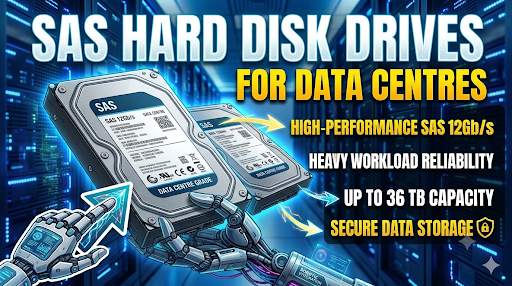
1. Interface and Speed: SAS drives use a dedicated interface that moves data really quickly. Quicker file transfer means a smooth workflow, fewer interruptions, and increased energy efficiency. That’s why a SAS interface supports 12 Gbps or 6 Gbps, enabling fast data transfers. Some systems support 24Gbps (SAS-4) for high-end applications.
2. High RPM: High RPM means faster spinning. SAS drives spin at 10,000 RPM or 15,000 RPM, which is faster than SATA drives. The speed of SATA drives is usually 5,400 RPM or 7,200 RPM. Higher RPM ensures speedier read/write speeds and lower latency.
3. Enterprise Reliability: SAS drives features with a high MTBF (Mean Time Between Failures), often ranging from 1.6 to 2 million hours. What does that mean? It means how fast it spins. The spinning determines how fast data can be read and written.
4. Dual Port Connectivity: Unlike consumer drives, SAS has dual ports. It means that they can be connected through separate paths. If one connection fails, the other will take over. The setups that demand high availability require such drives.
5. Form Factors: SAS drives are available in 2.5-inch (SFF) or 3.5-inch (LFF) sizes. 2.5” is space-sufficient, and 3.5” offers a larger capacity.
After learning about the features, the question arises about what the top SAS drives are that are compatible with intensive workloads and can handle them. Here, I have enlisted a few top hard disk drives that stand out among others.
Top SAS Hard Disk Drives for Data Centres:
Not all drives function the same. The functionality depends on several unique qualities. They include spin speed, uptime, efficiency, transfer speed, redundancy, etc. Many data centers require storage devices for various intensive tasks, including virtualization, cloud computing, and video surveillance.
For that, go for the one that meets all your demands efficiently. Here are a few widely recognised SAS drives.
1. Seagate Exos 15E900 (ST900MP0006):
Seagate hard drives are often known for their phoenix speed. Do you know why it is regarded as the world’s fastest drive? They even boast industry-leading data security features. I believe that the answer lies in its spindle speed, capacity, and interface. Seagate Exos 15E900 boasts a 900GB capacity. This provides sufficient space for storing a large amount of data. It features a 2.5-inch form factor, making it compatible with a wide range of devices.
Moreover, 15,000 RPM spindle speed and a 12Gb/s dual-port SAS interface deliver exceptional performance, low latency, and ultra-reliable operation in intensive workloads. Furthermore, it comes with TurboBoost caching technology. This technology excels in transactional workloads, such as OLTP, virtualization, and high-speed database access.
Specifications:
- Capacity: 900GB
- Average Latency (m/s): 2.0
- Interface: 12 Gb/s SAS
- Cache: 256 MB
- Spindle Speed: 15,000 RPM
- MTBF: Around 2 million hours, reflecting high durability
Where can we best utilise this drive? It is best for high-performance, mission-critical enterprise servers that require consistent availability. It is often deployed in transaction-based applications, such as OLTP databases, HPC, and Big Data analytics.
2. HPE 1.2TB 12G SAS 10K SFF (EG0600JEDHE):
HPE hard drives are renowned for their exceptional performance and reliability. They boast it as their benchmark. The HPE 1.2TB 12G SAS 10K SFF is a storage-efficient solution that performs well in data centers and supports intensive workloads. With a small form factor (2.5”) and a rapid 10,000 RPM spindle, it delivers reliable and high-performance data access over a 12 Gb/s SAS interface.
Regarding compatibility, it works well with Smart Carrier trays (SC/BC) for zero-downtime replacement. Moreover, it protects your data against any unauthorised access. The hot-swap functionality enables easy maintenance and minimizes downtime. The firmware ensures compatibility with HP ProLiant servers and secure deployments.
Specifications:
- Capacity: 1.2TB
- Interface: 12 Gb/s SAS
- Form Factor: 2.5-inch SFF
- Spindle Speed: 10K RPM
- Cache Buffer: 64MB
- Average Latency: 3.0 ms
For additional information, this drive is optimized for HPE ProLiant Gen0 and newer servers, including DL, ML, and BL families, as well as HPE storage arrays.
3. Western Digital Ultrastar DC HC530 (12TB):
Western Digital needs no introduction when it comes to hard drives. They have their mark in building high-performance and advanced hard drives for every kind of storage requirements. Likewise, the Ultrastar DC HC500-series is specifically designed for public and private cloud environments. It gives high density, reliability, and performance.
I personally used it and found it to be best suited for high-throughput environments, such as cloud infrastructure, hyperscale deployments, and large-scale backup systems. Moreover, in terms of technology, it is powered by HelioSeal technology. The benefit is that it uses helium instead of air, thereby reducing friction, vibration, and power consumption. Here are a few specifications that make it stand out among others.
Specifications:
- Capacity: 14TB
- Interface: SAS
- Speed: 7200 RPM
- Cache Size: 512MB
- Form Factor: 3.5-Inch
- Transfer Rate: Up to 255 MB/s
What is the compatibility of this drive? The drive is optimized with an impressive MTBF of 2.5 million hours and a workload rating of up to 550TB/year. It is compatible with Windows, Windows Server, and Linux operating systems.
4. Toshiba AL15SE Series:
Being a millennial, I remember that Toshiba hard drives were pioneers in innovative storage solutions. That’s why they boast that Toshiba introduced the first 2.5-inch HDDs with glass media in 1991. Toshiba AL15SE Series holds the same credibility. These hard drives are high-grade storage solution that provides up to 2.4 TB capacity. It is an immense space for multimedia, enterprise data, etc.
With a 10,500 RPM performance, it reads and writes at a speed. With spindle speeds of 10,500 RPM and 12 Gb/s dual-port SAS interface, they deliver a dependable mix of low latency, consistent throughput, and durability. Being built with Toshiba’s Persistent Write Cache technology, it protects against data loss during power interruptions.
Specifications:
- Capacities: 300 GB, 600 GB, 900 GB, 1.2 TB, 1.8 TB, up to 2.4 TB
- Interface: Dual-port 12 Gb/s SAS
- Spindle Speed: 10,500 RPM
- Cache: 128MB DRAM
- Average Latency: 2.86ms
What are the real-world applications of this drive? It is best suited for database servers, hybrid cloud storage, OLTP systems, and virtual environments.
5. Dell 600GB 15K RPM SAS HDD:
I’m sharing my personal experience with you: if you need an enterprise storage solution that won’t slow you down, then look no further. The Dell 600 GB 15K RPM SAS HDD is a small form factor, hot-swappable enterprise-grade drive that works best for intensive workloads like virtualization, databases, and high-performance computing.
15K RPM and SAS-3 deliver quick data access, making this drive ideal for transactional workloads. The 2.5-inch form factor enables high-density server storage, while pre-certified firmware and trays ensure seamless deployment in Dell PowerEdge systems. At Server Tech Central, we recommend enterprise SAS drives like this for reliable performance in data centres and mission-critical workloads.
Specifications:
- Capacity: 600GB
- Form Factor: 2.5″ (in 3.5″ carrier)
- Interface: SAS
- Data Transfer Rate: 12Gbps
- Spindle Speed: 15000 RPM
How can it handle intensive work while keeping the data safe? If you pair this drive in RAID 10 for a balance of speed and redundancy, it will handle demanding workloads while keeping the data safe.
Also Read: 21 Best Study Apps for College Students in 2026 (Free & Paid, Tested)
Final Thought:
Conclusively, SAS hard drives are an integral part of modern data storage and retrieval. If you are a gamer, a data center operator, an enthusiast researcher, a business owner, or a security professional responsible for safeguarding your jurisdiction, the SAS drive will help you achieve your desired target.
In storage technology, they commit to excellence, trust, and durability. Don’t just invest in hardware; instead, invest in the success and efficiency of your operation.
FAQs:
1. What are SAS hard disk drives used for?
SAS (Serial Attached SCSI) hard disk drives are designed for enterprise environments such as data centres, servers, and storage systems. They offer high reliability, fast data transfer speeds, and continuous 24/7 performance for mission-critical workloads.
2. Are SAS hard drives better than SATA drives?
SAS drives generally provide higher performance, greater reliability, and dual-port connectivity compared to SATA drives. They are ideal for enterprise applications, while SATA drives are better suited for desktop computers and cost-sensitive storage.
3. Which SAS hard drive is best for data centres?
The best SAS hard drive depends on your storage needs, but enterprise models from Seagate, Western Digital (Ultrastar), and Toshiba are widely trusted for their durability, high capacity, and consistent performance in demanding data centre environments.