BrandRank.ai Visibility Insights Analysis: What It Actually Measures, Who It’s For, and How to Do Your Own

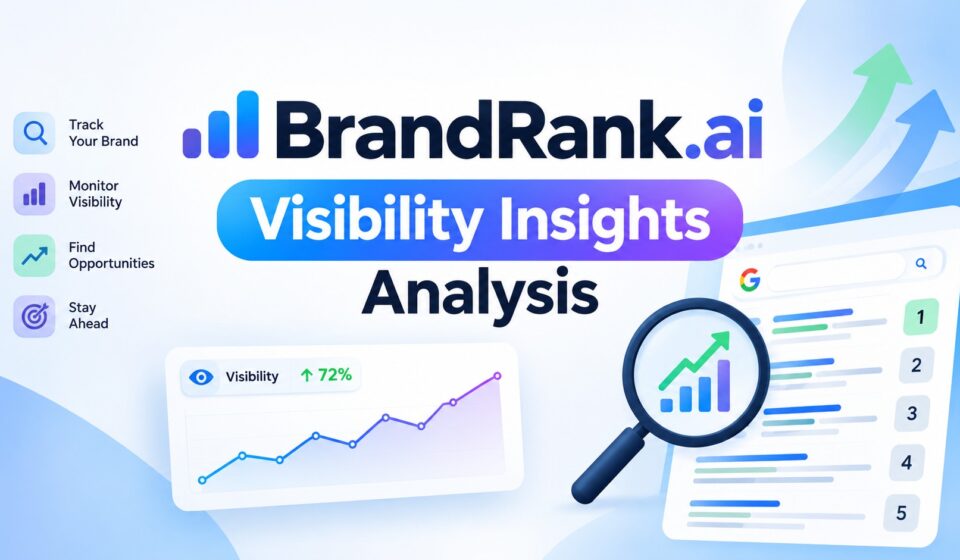
BrandRank.ai visibility insights analysis centers on a specific, named metric — Recommendation Share — built by running a fixed set of priority search phrases daily across seven AI answer engines and measuring how often, and how favorably, a brand gets named relative to competitors. That’s a more concrete definition than most coverage of this topic gives you, and the specifics matter here: how many phrases, which engines, and who this is actually built for change whether it’s the right tool for your situation.
What Recommendation Share Actually Tracks
According to BrandRank.AI’s own platform description, the analysis runs against roughly 170 priority search phrases, checked daily across seven AI answer engines: OpenAI’s ChatGPT, Google Gemini, Anthropic’s Claude, Perplexity, Grok, Meta AI, and DeepSeek. Rather than a one-time snapshot, this is designed as a continuous tracking system — the same core question set gets re-checked repeatedly, so a business can see whether its position is improving, declining, or holding steady over time, and where competitors are gaining ground.
The platform organizes what it finds into a few consistent categories:
- Search Prompts Visibility — whether and how often the brand is named at all across the tracked phrase set.
- AI Content Readiness — an assessment of whether the brand’s own website gives AI systems enough clear, structured information to describe it accurately.
- Vulnerability Over Time — tracking of reputational risk, including whether outdated or inaccurate claims about the brand are being repeated by AI engines.
A number worth treating carefully: BrandRank.AI’s marketing cites a stat that 78% of consumers go on to pursue a specific brand after researching it through AI. Treat vendor-cited conversion statistics like this as a directional argument for why the category matters, not as a number you should build a specific ROI projection around without your own data.
Who BrandRank.ai Is Actually Built For
This is the detail most coverage of this topic skips, and it matters more than any feature list: BrandRank.AI explicitly positions itself around enterprise brand and communications teams, not smaller businesses trying to build initial visibility from scratch.
| Good fit | Poor fit |
|---|---|
| CMOs and global brand leaders monitoring representation across a high volume of daily prompts | Startups building brand awareness from zero |
| Regulated industries (financial services, CPG) managing reputational risk at scale | Small teams without a dedicated brand-monitoring budget |
| Multi-brand or multi-market enterprises needing centralized, executive-level reporting | Businesses that only need occasional, one-off visibility checks |
If your business falls in the right-hand column, the DIY method further down this page will get you most of the practical insight without an enterprise sales conversation.
BrandRank.ai vs. the Named Alternatives
Most coverage of this topic treats BrandRank.AI in isolation. In practice, it competes in a category with several other named tools, each with a different angle:
| Tool | Positioning |
|---|---|
| BrandRank.AI | Enterprise-focused audit model with named strategist review, built around a defensible Recommendation Share metric for boards and legal teams |
| Profound | Connects AI visibility monitoring directly to measurable business impact, often cited as a strong pick for teams wanting outcome-linked reporting |
| Otterly.AI | Frequently mentioned as a more accessible, self-serve entry point into AI-visibility tracking |
| Peec AI | Positioned in the same monitoring category, commonly compared alongside Otterly.AI for small-to-mid-size teams |
| Ahrefs Brand Radar | Built inside an existing, widely-used SEO platform, which gives it an advantage for teams already working in Ahrefs daily |
The practical takeaway: if you’re an enterprise brand team that needs a defensible number for legal or the board, BrandRank.AI’s audit-plus-strategist model is built specifically for that use case. If you’re a smaller team wanting ongoing self-serve monitoring without an enterprise sales cycle, the other named tools are worth evaluating first.
Pricing: What’s Actually Public
BrandRank.AI does not publish standard pricing — every tier routes to a “Contact Us” sales conversation. What is publicly visible is the general shape of the tiers:
- An entry-level plan (referred to as Scout in some of the platform’s own materials), aimed at challenger brands and agile marketing teams with a smaller seat count.
- A mid-tier plan adding a full BrandRank Audit, quarterly strategic reviews, and growth recommendations, with 10 user seats, aimed at cross-functional brand, PR, and communications teams.
- An Enterprise tier adding multi-brand dashboards, data-feed integration, unlimited organization-wide access, and enterprise risk management, sold as an annual subscription.
Given the sales-led pricing model and enterprise positioning, expect a cost structure closer to other enterprise SaaS brand-monitoring tools than to a self-serve monthly subscription.
How to Run a Basic AI Visibility Check Yourself, Right Now
Before committing budget to any platform, you can get a rough, manual read on your own AI visibility in about twenty minutes:
- Write down 10–15 real customer questions — not your brand name, but the category questions a prospective customer would actually type: “best [your category] for [your audience],” “[your category] vs [known competitor],” “is [your brand] good for [use case].”
- Run each question through ChatGPT, Gemini, Perplexity, and Claude separately, in fresh conversations with no prior context, and record whether your brand is mentioned, where it ranks relative to competitors, and how it’s described.
- Note which sources get cited, if the platform shows them — this tells you which third-party content is currently shaping how AI describes your category, and whether your own site or press coverage shows up at all.
- Repeat the same question set monthly, not just once — a single check is a snapshot, not a trend, and AI-generated answers can shift meaningfully between checks based on model updates and newly indexed content.
This won’t give you a formal Recommendation Share score or historical trend charting, but it will tell you within an afternoon whether you have a visibility problem worth investing further tooling or content work into.
Limitations Worth Knowing Before You Invest in Any of This
- AI-generated answers vary by prompt wording, platform, and date — a single response is not a permanent ranking, and treating one good or bad result as definitive is a common mistake.
- Vendor-reported statistics, including conversion claims, are marketing inputs, not independently audited research — useful for framing the problem, not for building a precise budget justification.
- Visibility tracking is a leading indicator, not the end goal — the metric that ultimately matters is whether increased AI visibility translates into actual site visits, inquiries, or sales, which requires connecting this data back to your own analytics.
Also Read: BrandRank.AI Normalization Transformation Rules: The Complete 2026 Guide
Frequently Asked Questions
What does BrandRank.ai’s visibility insights analysis actually measure?
It centers on Recommendation Share, tracked by running roughly 170 priority search phrases daily across seven AI answer engines — ChatGPT, Gemini, Claude, Perplexity, Grok, Meta AI, and DeepSeek — showing how often and how favorably a brand is named relative to competitors.
Is BrandRank.ai a good fit for a small business or startup?
Generally, no. BrandRank.AI positions itself around enterprise brand and PR teams and regulated industries managing reputational risk at scale, explicitly excluding startups building initial brand awareness and small teams without a dedicated monitoring budget.
How much does BrandRank.ai cost?
Pricing isn’t published. Plans are structured in roughly three tiers — an entry Scout-level plan, a mid-tier with a full audit and more seats, and an Enterprise tier with multi-brand dashboards — all sold through a “Contact Us” sales process.
What are the main alternatives to BrandRank.ai?
Profound, Otterly.AI, Peec AI, and Ahrefs Brand Radar are the most frequently cited alternatives, with Similarweb AI Search Intelligence and Siftly also mentioned as adjacent options.