
IoT technology is quietly reshaping the world around you. From the smart thermostat in your home to sensors on a factory floor, the Internet of Things connects physical devices to the internet — and to each other. In 2026, understanding IoT is no longer optional. It’s essential.
What Is IoT Technology?
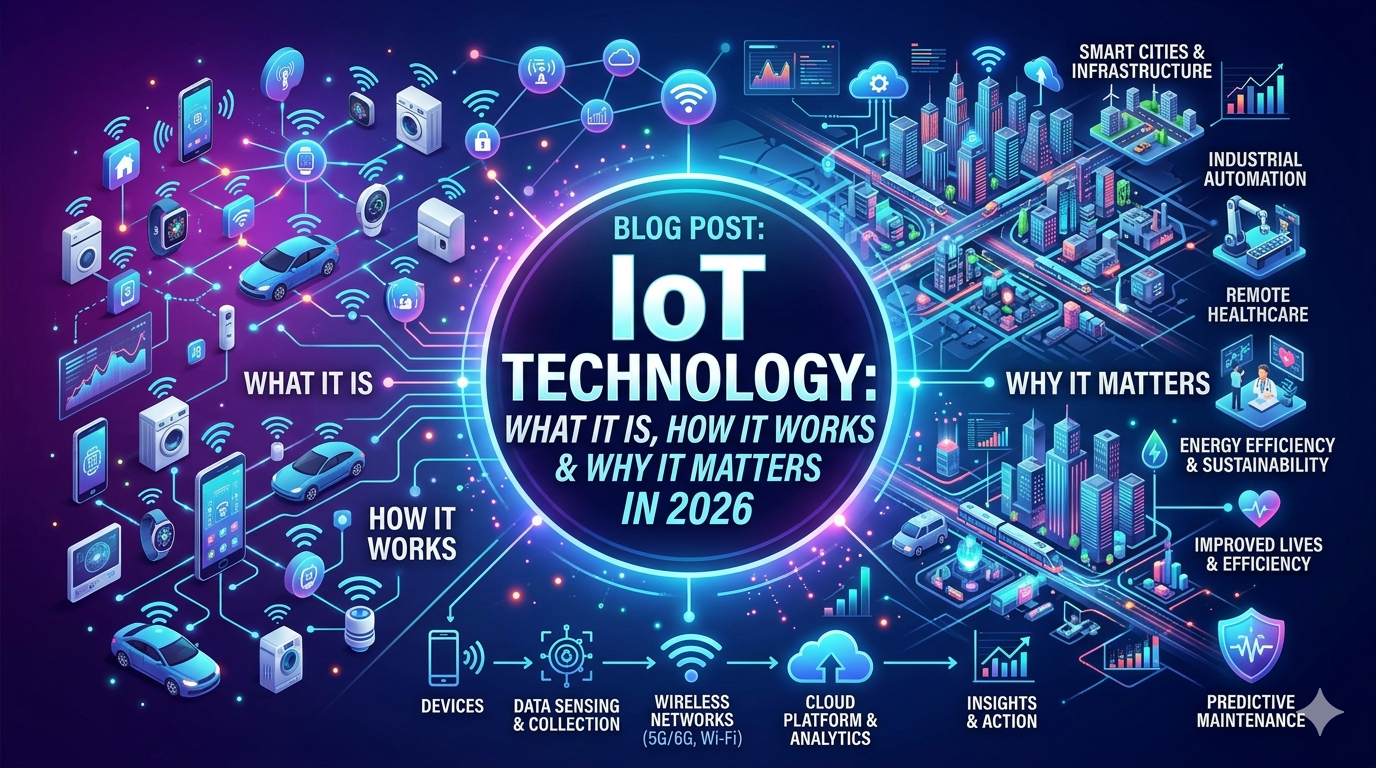
IoT technology — short for Internet of Things technology — refers to the network of physical devices, sensors, software, and connectivity tools that allow objects to collect and exchange data over the internet without requiring human intervention. These “smart” devices range from household appliances and wearables to industrial machines and city infrastructure.
Here’s how IoT works in four steps:
- Sensors & devices collect real-world data (temperature, motion, location, etc.)
- Connectivity (Wi-Fi, Bluetooth, 5G, or cellular) transmits the data to the cloud or a local server
- Data processing analyzes the information using software or AI algorithms
- Action or alert is triggered — either automatically or sent to a user interface
How Big Is IoT Technology Right Now?
The numbers behind IoT technology are staggering. According to Grand View Research, the U.S. IoT market was valued at $413 billion in 2024 and is projected to grow at a CAGR of 7.6% through 2030. Globally, the IoT solutions and services market is expected to hit $1.33 trillion by 2034, according to Market.us.
North America leads the world in IoT adoption, holding a 38.4% market share — and the United States is the single largest contributor to that figure. This growth is fueled by advancements in 5G connectivity, cloud computing, edge computing, and artificial intelligence (AI) integration.
Core Components of IoT Technology
Understanding IoT means knowing what makes it tick. Every IoT system is built on four core layers.
1. Connected Devices and Sensors
At the foundation of any IoT system are the physical devices themselves. These include temperature sensors, GPS trackers, smart meters, cameras, wearable health monitors, and more. Sensors are the “eyes and ears” of IoT — they capture raw data from the physical world.
2. Connectivity and Communication Protocols
Once data is captured, it needs to travel somewhere. IoT devices use several communication technologies depending on range, power, and bandwidth needs. Common options include Wi-Fi, Bluetooth, Zigbee, Z-Wave, LoRaWAN, NB-IoT (Narrowband IoT), LTE-M, and 5G networks. The rise of 5G in the U.S. has been a major catalyst for IoT expansion, enabling faster, lower-latency connections for millions of devices simultaneously.
3. Cloud Computing and Edge Computing
Data from IoT devices is processed either in the cloud or at the “edge” — closer to the device. Cloud computing offers scalable storage and powerful analytics. Edge computing reduces latency by processing data locally, which is critical for time-sensitive applications like autonomous vehicles or industrial automation.
4. Data Analytics and AI
Raw data alone has little value. IoT platforms use machine learning, predictive analytics, and artificial intelligence to turn streams of device data into actionable insights. This layer is what enables smart decisions — like predicting when a machine will fail before it breaks down.
Also Read: What is Edge Computing?
Real-World Applications of IoT Technology
IoT is not just a tech buzzword. It’s deployed across virtually every major industry in the United States today.
Smart Homes and Consumer IoT
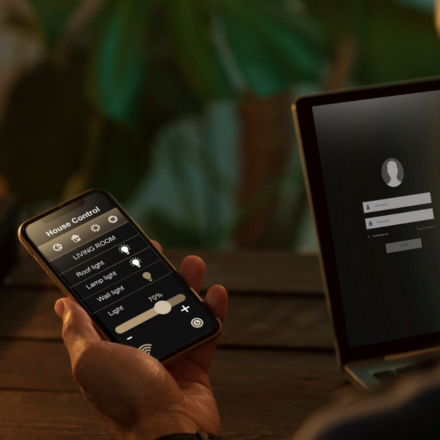
The consumer IoT market is the most visible face of this technology. Smart speakers (like Amazon Echo and Google Nest), smart thermostats, connected security cameras, and automated lighting systems have become mainstream household products. These devices make everyday life more convenient, energy-efficient, and secure.
Industrial IoT (IIoT)
In manufacturing and logistics, Industrial IoT — often called IIoT — is transforming operations. Factories use connected sensors to monitor equipment health in real time, enabling predictive maintenance that prevents costly downtime. According to Grand View Research, the U.S. Industrial IoT market alone was valued at $142.35 billion in 2024 and is projected to reach nearly $672 billion by 2033.
Healthcare and Wearables
IoT technology is revolutionizing patient care. Wearable health monitors track heart rate, blood oxygen, sleep patterns, and more. Remote patient monitoring systems allow doctors to track chronically ill patients at home, reducing hospital readmissions. Connected medical devices in hospitals improve workflow and patient safety.
Smart Cities and Infrastructure
Across the U.S., cities are deploying IoT solutions to manage traffic signals, reduce energy consumption in public buildings, optimize waste collection routes, and improve public safety with connected surveillance networks. Smart city technology is a fast-growing segment driven partly by federal infrastructure investment.
Agriculture and Environment
Precision agriculture uses IoT sensors to monitor soil moisture, crop health, and weather conditions in real time, helping farmers reduce water usage and increase yield. Environmental agencies deploy connected sensors to track air quality, water contamination, and wildlife movement.
Key Benefits of IoT Technology
Why are businesses and consumers embracing IoT at such a rapid pace? The advantages are concrete and measurable.
- Operational efficiency: Automated monitoring and real-time alerts reduce manual labor and human error
- Cost savings: Predictive maintenance cuts equipment repair costs dramatically
- Better decision-making: Data-driven insights replace guesswork in business operations
- Improved safety: Connected sensors can detect hazardous conditions and trigger alerts instantly
- Enhanced customer experience: Personalized, real-time service delivery becomes possible at scale
- Energy efficiency: Smart building systems can cut energy costs by 20–30% according to multiple industry studies
IoT Security and Privacy Challenges
No technology is without its risks, and IoT is no exception. Because IoT devices often have limited computing power, they are harder to secure with traditional cybersecurity tools. Common challenges include:
- Weak default passwords on consumer devices
- Unencrypted data transmission between sensors and the cloud
- Limited software update mechanisms on older or budget devices
- Large attack surface — millions of connected endpoints create more entry points for hackers
The U.S. government has taken notice. In 2020, Congress passed the IoT Cybersecurity Improvement Act, which mandates minimum security standards for IoT devices purchased by federal agencies. The National Institute of Standards and Technology (NIST) publishes guidelines to help both companies and consumers protect IoT deployments. You can read NIST’s official IoT security guidance at https://www.nist.gov/publications/nist-special-publication-800-213.
IoT Technology Trends to Watch in 2026
The IoT landscape is evolving faster than ever. Here are the most important trends shaping the industry right now.
AI-Powered IoT (AIoT)
The fusion of artificial intelligence with IoT — often called AIoT — is one of the most transformative trends of 2026. AI enables IoT systems to learn from patterns, make autonomous decisions, and improve accuracy over time without human input. Think self-optimizing smart grids or factory robots that adapt to new tasks in real time.
5G Expansion
As 5G networks continue to roll out across the United States, they unlock new IoT use cases that were previously limited by bandwidth or latency. Ultra-reliable low-latency communication (URLLC) enabled by 5G is critical for autonomous vehicles, remote surgery, and real-time industrial control systems.
Edge Computing Growth
Rather than sending all data to centralized cloud servers, more IoT architectures now process data locally at the network “edge.” This reduces bandwidth costs, improves response speed, and enhances data privacy — a growing concern among U.S. consumers.
Digital Twins
A digital twin is a real-time virtual replica of a physical device, system, or process. Manufacturers, urban planners, and healthcare systems are using digital twins powered by IoT data to simulate scenarios, test changes, and optimize performance without disrupting real-world operations.
How to Get Started with IoT Technology
Whether you’re a business owner or a curious individual, entering the world of IoT is more accessible than ever.
For businesses:
- Identify a specific problem you want to solve — don’t deploy IoT for its own sake
- Choose the right connectivity standard for your use case (Wi-Fi vs. cellular vs. LPWAN)
- Work with a trusted IoT platform provider (AWS IoT Core, Microsoft Azure IoT, Google Cloud IoT)
- Prioritize security from day one — build it into the architecture, not as an afterthought
- Start small and scale — pilot a single use case before expanding enterprise-wide
For consumers, explore smart home ecosystems from Apple (HomeKit), Google (Nest/Home), or Amazon (Alexa). These platforms offer easy onboarding for beginners and wide device compatibility.
Conclusion
IoT technology is one of the most consequential technological shifts of the 21st century. By connecting the physical world to the digital one, it creates new levels of efficiency, intelligence, and convenience across every sector — from homes and hospitals to farms and factories. The United States is leading this transformation, and the opportunity for businesses and individuals to leverage connected device technology has never been greater.
If you’re looking for more in-depth guides on emerging technologies, smart devices, connected systems, and the latest digital innovations, explore the full resource library at tonicoftech.com — your go-to destination for trusted, expert-written tech insights.
Frequently Asked Questions About IoT Technology
Q1: What is IoT technology in simple terms?
IoT technology (Internet of Things technology) connects physical devices — like thermostats, appliances, vehicles, and industrial machines — to the internet so they can collect and share data automatically. It allows everyday objects to “talk” to each other and to users through apps or dashboards, enabling smarter automation and real-time decision-making without constant human input.
Q2: What are the most common examples of IoT devices?
The most common IoT devices in everyday life include smart speakers (Amazon Echo, Google Nest), smart thermostats (Nest, Ecobee), connected security cameras, wearable fitness trackers (Fitbit, Apple Watch), and smart light bulbs. In industry, connected sensors, GPS fleet trackers, automated robotic arms, and remote monitoring equipment are widely used IoT technology examples.
Q3: Is IoT technology safe to use?
IoT technology carries real security risks, including weak default passwords, unencrypted data, and large attack surfaces. However, following best practices — using strong passwords, keeping firmware updated, segmenting IoT devices on a separate network, and choosing reputable brands — significantly reduces risk. The U.S. government’s IoT Cybersecurity Improvement Act also pushes manufacturers to meet minimum security standards.
Q4: How does IoT technology work with 5G?
5G enhances IoT technology by providing faster data speeds, lower latency, and the ability to connect thousands of devices simultaneously in a small area. This is essential for time-sensitive IoT applications like autonomous vehicles, real-time industrial control systems, and remote medical procedures. As 5G networks expand across the United States, more advanced IoT use cases are becoming commercially viable.
Q5: What industries benefit most from IoT technology?
Manufacturing, healthcare, logistics, agriculture, and smart cities benefit most from IoT technology in the United States. Industrial IoT (IIoT) drives massive efficiency gains in factories. Healthcare IoT enables remote patient monitoring. Supply chain IoT improves fleet tracking and inventory management. Smart city IoT reduces energy waste and improves public infrastructure. Each of these sectors is seeing double-digit growth in connected device adoption.