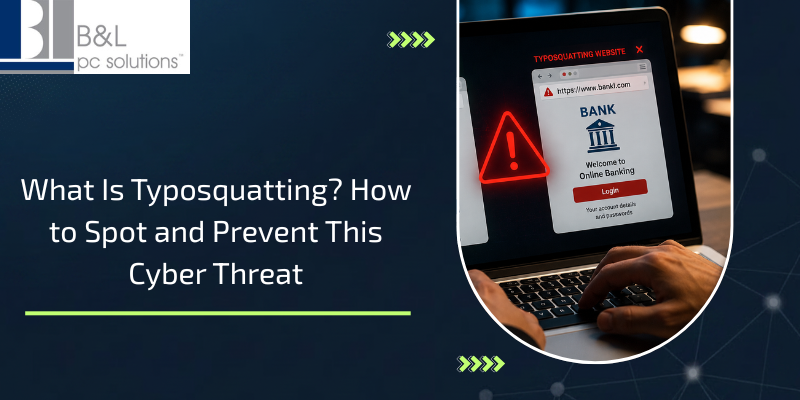

You type your bank’s website into the address bar. Your thumb slips. You land on a page that looks exactly right: same logo, same login box, same everything. Except it isn’t your bank. It’s a domain someone registered for about ten dollars, built specifically to catch people who type just a little too fast.
That’s typosquatting, and it’s not a fringe problem anymore. Lately, IT support in Tampa has been noticing this as a threat to digital safety. In the first week of June 2026 alone, more than 1.6 million new domains were registered worldwide, and close to 8 million went live in May 2026 alone. Not all of those are malicious, obviously, but a growing share are built for exactly one purpose: catching the traffic meant for someone else.
For IT companies in Florida and business owners, this isn’t a “keep an eye out” issue anymore. It’s a line item on the risk register.
What Typosquatting Actually Is: A Tampa IT support entity explains
Typosquatting is the practice of registering a domain name that’s almost identical to a real one. It feeds on people’s mistyped URLs constantly, for example, Nykee.com instead of Nike.com (correct one) and so on.
Twenty years ago, these domains were mostly parked pages stuffed with ads, annoying but not dangerous. That’s changed. Research now shows that over 90% of visits to parked look-alike domains get redirected into scams, malware, or scareware. The nuisance-domain era is over. What replaced it is a lot more calculated.
Why Typosquatting Attacks Are Surging in 2026
A few things collided to make this worse this year.
AI Made Fake Sites Cheap To Build
Cloning a company’s homepage used to take real design work. Now a convincing knockoff can be generated in minutes, right down to the fonts and layout.
ReliaQuest’s research into the threat group Octo Tempest found that 81% of the domains tied to their campaigns used typosquatting, and the keywords showing up again and again were “vpn,” “helpdesk,” “okta,” and “sso.”
It’s not just websites anymore, either.
Developers have gotten hit with typosquatted software packages designed to run during a build process and quietly steal credentials or tokens. A malicious npm package called “@acitons/artifact” one letter off from the legitimate “@actions/artifact” was built to slip into GitHub build pipelines. Check Point separately found a single campaign involving more than 500 malicious PyPI packages, mostly created through automation. If your dev team pulls open-source dependencies without checking package names carefully, this is a live risk, not a theoretical one.
Who Typosquatters Actually Target
Big consumer brands still take the largest share. Zscaler’s research puts Google at roughly 29% of typosquatting attempts, Microsoft around 24%, and Amazon near 22%. But the sector-level data tells a more useful story for businesses: internet services, professional services, and online shopping together account for over 78% of domain-impersonation phishing traffic, according to Zscaler’s ThreatLabz team. Akamai’s research adds that financial institutions alone receive more than 36% of all traffic sent to impersonated domains.
Major events attract targeted waves, too. Ahead of the 2026 World Cup, researchers tracked a single group of Chinese-speaking threat actors registering 4,300+ domains impersonating FIFA’s official presence.
However, you don’t need to be Google or FIFA to get hit. A firm that has little or no assistance from IT Support Services Tampa FL may also be quite vulnerable.
How to Protect Your Business from Typosquatting
For IT and security teams, spotting individual fake sites isn’t a strategy, it’s damage control. The real fix is structural.
Register the obvious variants of your own domain while consulting an IT Support Company Tampa, FL. Common misspellings, the most likely TLD swaps, and hyphenated versions. It’s a small annual cost against a real reputational risk.
Lock down email authentication. SPF, DKIM, and DMARC won’t stop someone from registering a look-alike domain, but they make it much harder for attackers to spoof your actual domain in phishing emails.
Train employees on the domains that matter most. Don’t just say “watch for phishing.” Show real examples of VPN, helpdesk, and SSO login pages side by side with the fakes. That’s where the Octo Tempest data points attackers are going after: login pages tied to remote access, not just marketing sites.
Vet your software dependencies. If your team writes code, add package-name verification to your build process. A one-character typo in a dependency name shouldn’t be able to reach production.
Know your legal options. In the U.S., the Anti-Cybersquatting Consumer Protection Act allows businesses to pursue damages of up to $100,000 per domain against bad-faith typosquatters.
The Bottom Line
As a business, having a Business IT Support Tampa, FL by your side makes you way safer against any digital threat.
Typosquatting isn’t new, but the tools behind it are sharper than they used to be, and the targets have shifted from “anyone who mistypes a URL” to “anyone logging into a VPN, helpdesk, or SSO portal under time pressure.” That’s every business with remote employees, which, at this point, is most businesses.
Also Read: 21 Best Study Apps for College Students in 2026 (Free & Paid, Tested)
Frequently Asked Questions
Q1:What is typosquatting in simple terms?
Typosquatting is when someone registers a domain name that looks almost identical to a legitimate website.
Q2: How do typosquatters make money from fake domains?
They typically profit through phishing pages that steal login credentials, malware downloads disguised as legitimate software, ad revenue from visitors who landed by mistake, or selling the domain back to the real brand at an impractical price.
Q3: Can typosquatting affect small businesses, or is it only a big brand problem?
Small businesses get targeted too, particularly those in financial services, healthcare, or legal sectors.
Q4: How do I know if someone has registered a typosquatted version of my domain?
Domain monitoring services continuously scan new registrations for similarities to your domain and alert you when a lookalike appears. Here, B&L PC Solutions can set this up as part of a broader cybersecurity engagement.
Q5: How can we connect to B&LPC Solutions for digital security purposes?
You can contact us to schedule a quick consultation and discuss your IT needs and priorities at 727-628-4120.
Q6. Which sectors and areas does B&LPC Solutions serve?
We work with small and mid‑sized businesses in sectors like professional services, healthcare, finance, and retail in NYC.