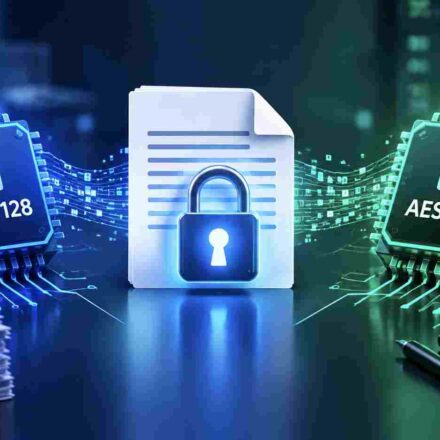
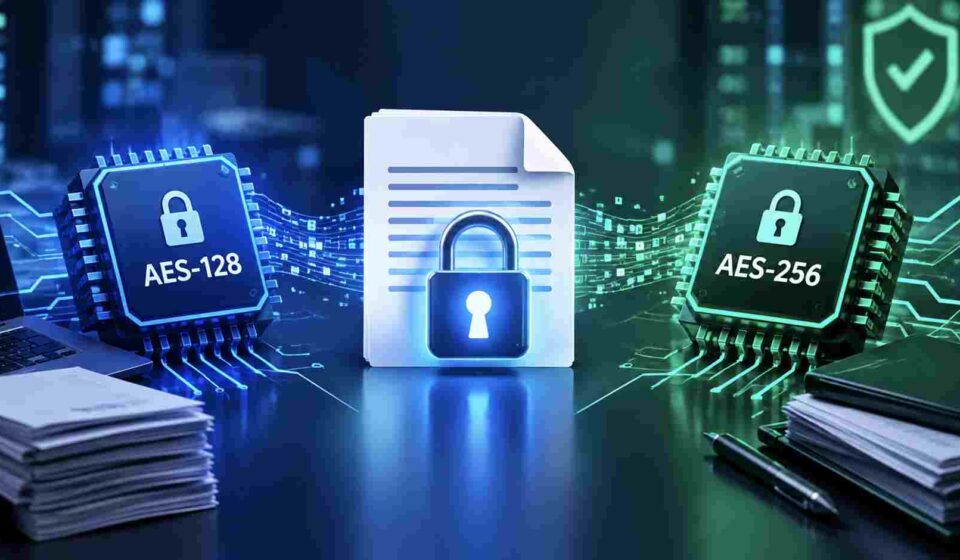

Every time you encrypt a PDF or a confidential report, a small decision hides behind the “security settings” menu: should you use AES-128 or AES-256? Both are trusted encryption standards, both are approved by governments and enterprises worldwide, and both will stop casual snooping cold. But the difference between them matters more than most people realize, especially when you’re protecting documents that carry real financial or legal weight. Understanding which AES key length is better for document security starts with knowing what’s actually happening under the hood.
Understanding Advanced Encryption Standard (AES) for Document Protection
AES is the encryption algorithm the U.S. government adopted in 2001 to replace the aging DES standard. It’s a block cipher, meaning it chops your data into fixed-size blocks and scrambles each one using a secret key. Virtually every modern document security tool, from Adobe Acrobat to enterprise DRM platforms, relies on AES.
The Role of Symmetric Key Cryptography
AES is a symmetric algorithm: the same key encrypts and decrypts the data. This makes it fast and efficient compared to asymmetric methods like RSA, which use separate public and private keys. For document protection, symmetric encryption is ideal because the priority is speed and confidentiality rather than key exchange between strangers. The challenge shifts to how you distribute and store that single key securely.
Key Lengths and Block Cipher Basics
AES always operates on 128-bit blocks of data, regardless of key size. The “128” or “256” in the name refers to the length of the encryption key itself. A longer key means a larger number of possible combinations an attacker would need to try: AES-128 offers 2^128 possible keys (roughly 3.4 × 10^38), while AES-256 offers 2^256 (about 1.1 × 10^77). That exponential jump is the core of the security difference.
Technical Differences Between AES-128 and AES-256
The two variants share the same fundamental algorithm but differ in how many times they transform your data and how they generate their internal sub-keys.
Number of Transformation Rounds
AES-128 processes each block through 10 rounds of substitution, shifting, mixing, and key addition. AES-256 runs 14 rounds. Each additional round adds another layer of diffusion, making it harder to reverse-engineer the original plaintext from the ciphertext. Those four extra rounds are not trivial: they increase the mathematical complexity of any cryptanalytic attack significantly.
Key Expansion and Complexity
Both versions use a key schedule to derive round keys from the original master key. AES-256’s key schedule is more complex because it must produce sub-keys for 14 rounds from a 256-bit input instead of 10 rounds from a 128-bit input. This added complexity contributes to stronger resistance against related-key attacks, a class of theoretical vulnerabilities that target weaknesses in how sub-keys relate to each other.
Security Strength and Resistance to Attacks
Brute-Force Vulnerabilities and Time-to-Crack
No one has ever brute-forced AES-128. With current hardware, trying all 2^128 key combinations would take billions of years, even using every supercomputer on the planet in parallel. AES-256 is astronomically harder to crack: the key space is 2^128 times larger than AES-128’s. For context, that factor is larger than the estimated number of atoms in the observable universe. Against brute-force attacks alone, both are effectively unbreakable in 2026.
Quantum Computing and Post-Quantum Resilience
This is where the conversation gets interesting. Grover’s algorithm, if run on a sufficiently powerful quantum computer, could theoretically halve the effective key length of a symmetric cipher. That would reduce AES-128 to an effective strength of 64 bits, which is crackable. AES-256 would drop to 128-bit effective strength, still considered secure. No quantum computer capable of running Grover’s algorithm at scale exists yet, but organizations handling documents with multi-decade sensitivity (think defense contracts, pharmaceutical IP, or legal records) should treat AES-256 as the safer long-term bet.
Performance and Resource Efficiency
Encryption Speed on Mobile vs. Desktop Devices
On modern desktop and laptop processors with AES-NI hardware acceleration, the speed difference between AES-128 and AES-256 is roughly 20-30%. For encrypting a 50-page PDF, that difference is measured in milliseconds: completely imperceptible. On mobile devices or older hardware without AES-NI, AES-256 can be noticeably slower when processing large batches of documents, though single-file encryption remains fast.
Impact on Battery Life and CPU Overhead
For mobile apps or IoT devices encrypting documents on the fly, AES-128 uses fewer CPU cycles per block and generates less heat. If your use case involves thousands of documents being encrypted daily on resource-constrained devices, AES-128’s lighter footprint is a genuine advantage. On a standard laptop or server, the CPU overhead difference is negligible enough to ignore.
Compliance and Industry Standards for Data Security
Regulatory frameworks often dictate your encryption choice. HIPAA doesn’t specify a key length but requires “reasonable and appropriate” safeguards, and most auditors accept AES-128 as sufficient. PCI DSS requires “strong cryptography” and lists AES as acceptable without mandating 256-bit keys.
Government agencies handling classified information at the TOP SECRET level, however, are required to use AES-256 under NSA guidelines. If your documents fall under ITAR, CMMC, or similar defense-related frameworks, AES-256 is typically the only compliant option. Checking the compliance box matters, but remember that passing an audit and actually preventing data exfiltration are two different things: encryption alone won’t stop an authorized user from screenshotting a document and emailing it.
Choosing the Right Encryption for Your Specific Use Case
The question of AES-128 versus AES-256 for document security isn’t purely academic. Your choice should depend on what you’re protecting, for how long, and on what hardware.
When to Prioritize AES-128 for User Experience
AES-128 makes sense for documents with a short sensitivity window: marketing drafts, internal memos, or training materials that will be outdated within a year or two. It’s also the better choice when you’re deploying on low-power devices or need to minimize latency in high-volume document workflows. The security is more than sufficient for the vast majority of business documents, and the lighter resource footprint keeps the user experience smooth.
Why High-Sensitivity Documents Require AES-256
Financial models, legal contracts, medical records, trade secrets, and any document that needs to remain confidential for a decade or more should use AES-256. The quantum computing threat, even if distant, makes this a straightforward decision for long-lived sensitive data. The performance cost on modern hardware is trivial, and the compliance benefits are immediate. If you’re protecting intellectual property that represents real revenue, the stronger key length is cheap insurance.
Protecting What Matters Most
Choosing between AES-128 and AES-256 is only one piece of a sound document security strategy. AES-256 is the stronger option for sensitive or long-lived documents, while AES-128 remains perfectly viable for everyday business files where performance and simplicity matter. But encryption alone doesn’t prevent authorized recipients from copying, printing, or redistributing your files. A true defense-in-depth approach pairs strong encryption with DRM controls like dynamic watermarking, device binding, and remote access revocation.