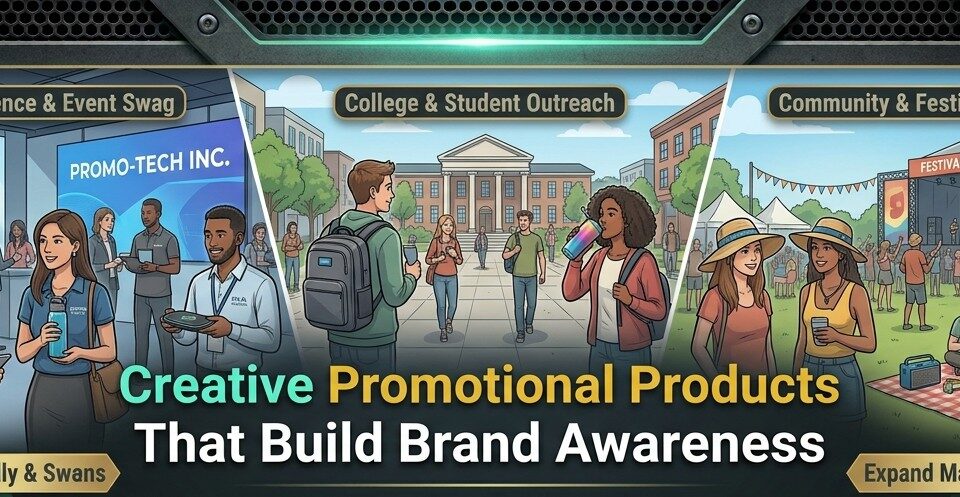

Promotional products work best when people actually keep and use them. A cheap giveaway that goes straight into a drawer creates little brand exposure, while a useful or well-designed item can put a company name in front of customers repeatedly.
For small businesses, the goal is not to order the largest quantity possible. It is to choose products that fit the audience, reflect the brand, and have a clear role in a campaign. Here are some promotional product ideas that can build awareness without feeling like generic advertising.
1. Branded Tech Accessories
Technology-related products are practical because customers can use them at work, while traveling, or at home.
Cable organizers, charging accessories, webcam covers, phone stands, and mouse pads provide everyday utility while creating repeated exposure to a company logo.
Choose the item around the customer rather than the latest trend. A B2B software company may get more value from a quality desk accessory than a product designed for outdoor events.
Keep branding restrained. A smaller logo on a useful product often feels more premium than oversized promotional messaging.
2. Printed Patches With Detailed Artwork
Patches give businesses more room for creative branding than many traditional promotional items. They can reproduce mascots, campaign graphics, event artwork, or limited-edition designs rather than displaying only a basic company logo.
A printed embroidery patch combines stitched detailing with a printed design approach, making it useful when artwork contains more visual detail than conventional embroidery can easily reproduce. Custom Patch Factory describes its printed patches as using durable twill and notes that printing is suited to preserving full-color artwork and background images.
Businesses can distribute patches through event packs, loyalty campaigns, customer appreciation programs, or special product launches. Limited runs can also create more interest than producing the same design indefinitely.
3. Useful Tote Bags
Tote bags provide a large printable area and can continue circulating long after the original event or purchase.
They work particularly well for retailers, bookstores, food businesses, trade shows, conferences, and community organizations. Customers may reuse them for shopping, commuting, or carrying everyday items.
Material quality matters. Thin bags with weak handles may be used once, while heavier cotton or durable nonwoven designs have a better chance of remaining in circulation.
Design them like products people would choose to carry. A strong illustration or understated logo often works better than filling the entire surface with contact information.
4. Custom Notebooks for B2B Marketing
Notebooks are useful when the audience works in offices, attends meetings, studies, or regularly takes notes.
They can be included in onboarding packages, conference kits, client gifts, training sessions, or sales presentations.
Businesses should pay attention to paper quality, binding, cover material, and page format. These small technical details influence whether the notebook feels disposable or useful.
A subtle logo on the cover can provide long-term visibility every time the recipient brings the notebook into a meeting.
5. Small Desk Products
Promotional products do not have to leave the office to create repeated impressions.
Desk mats, magnets, pen holders, coasters, calendars, and other workstation items may remain visible for months or years.
The best desk products solve a small practical problem. A branded cable organizer, for example, has more functional value than a decorative object with no obvious purpose.
Evaluate a Desk Product Based On
- Available branding area
- Expected useful life
- Material quality
- Shipping size and weight
- Relevance to the target customer
- Frequency of likely use
Consider where the item will physically sit before choosing the design.
6. Event-Specific Collectibles
Trade shows and community events are crowded with identical pens and brochures. A limited-edition collectible gives attendees a stronger reason to stop and interact.
Pins, patches, stickers, magnets, tokens, and small themed products can be connected to a specific event rather than using the company’s everyday brand artwork.
This approach also supports repeat participation. A company attending an annual conference could release a different design each year, encouraging customers or industry contacts to collect the series.
The product becomes part of the event experience rather than simply another advertisement.
7. Branded Kits Instead of Single Giveaways
Combining several low-cost products into a small kit can make the promotion feel more intentional.
A remote-work kit might contain a notebook, cable organizer, webcam cover, and coffee accessory. A conference kit could contain a badge holder, pen, notebook, and reusable bag.
Do not add products simply to increase the number of items.
Each component should support the theme or use case. Good packaging can also make inexpensive products feel more coordinated.
Kits are particularly useful for employee onboarding, customer welcome packages, product launches, and high-value sales prospects.
8. Custom Drinkware for Everyday Visibility
Drinkware works because it can remain in regular use instead of disappearing after a single campaign.
Businesses can choose custom drinkware such as mugs, tumblers, water bottles, cups, can coolers, and other beverage-related products. Imprint Now offers multiple drinkware formats that can be customized for branding and promotional use.
The format should match the audience. Travel tumblers may suit commuters, while insulated bottles can work well for outdoor events or fitness-related campaigns.
Keep the artwork readable at the actual print size. Detailed logos that look good on a computer screen can become difficult to recognize when reduced to a small imprint area.
9. Practical Travel Products
Travel products can produce strong brand exposure because recipients use them outside their normal environment.
Luggage tags, compact organizers, travel pouches, reusable bottles, and charging accessories can fit campaigns aimed at business travelers, conference attendees, or hospitality customers.
Durability is important because travel products are handled frequently.
Avoid overly bulky merchandise unless the recipient has a clear reason to carry it. Lightweight products are easier to distribute at events and cheaper to ship.
10. QR-Enabled Promotional Products
Physical merchandise can also connect customers with digital campaigns.
A QR code can direct users to a landing page, product tutorial, loyalty program, event registration page, or special offer.
Before Printing a QR Code
Test:
- Scanning from the expected distance
- Contrast between the code and background
- Mobile loading speed
- Landing-page accuracy
- Tracking parameters
- Code size on the final product
Avoid sending people to a generic homepage when a more specific destination is available.
Track the QR code separately so the business can measure whether the promotional product generates visits or conversions.
Also Read: 10 Fun Social Media Beauty Challenges to Explode Your Follower Count
Choose Products Based on Use, Not Novelty
Creative promotional products should support a marketing objective rather than simply look interesting in a catalog.
Start with the audience. Consider where recipients work, what they carry, what they use repeatedly, and what type of product naturally fits the business.
Then evaluate cost per item alongside useful life and expected exposure.
A product that costs twice as much but stays on a customer’s desk for two years may generate more value than hundreds of inexpensive giveaways that are discarded immediately.
The best promotional products earn their visibility. They are useful enough to keep, distinctive enough to remember, and designed well enough that customers are comfortable using them in everyday life.