
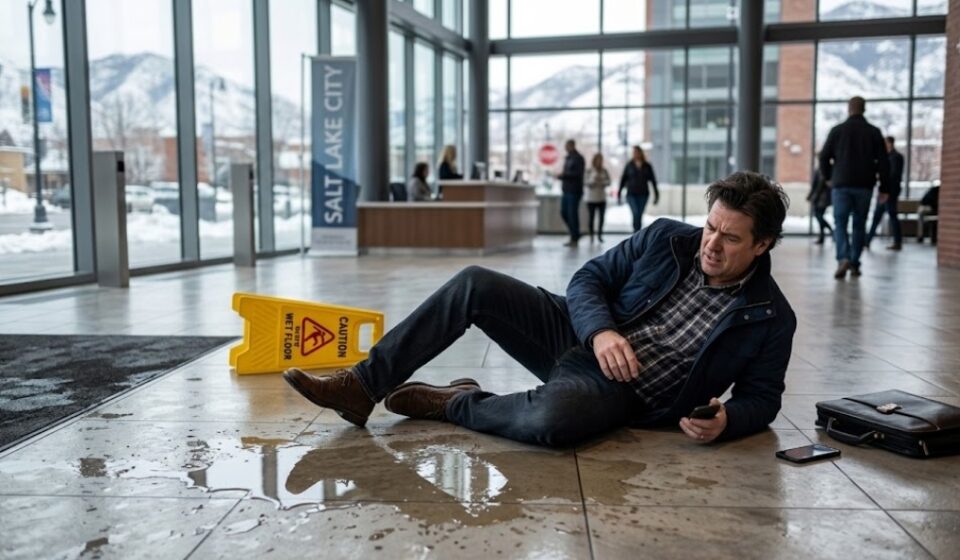

Slip and fall while heading toward a shopping center? At that moment, you may wonder what to do next and how to prove negligence because most people don’t know.
To prove negligence, you need evidence against the property owner or the entity responsible for keeping the premises safe for pedestrians. Every piece of timely collected evidence can increase the chances of your claim winning.
In this article, we’ll explain what elements help prove slip and fall negligence, what Utah law says, what evidence you need, and when to approach a slip and fall accident lawyer. Here is more to know.
What Are The 4 Elements Of Negligence In Utah Slip And Fall Cases?
For every business, property owner, and organization, there are laws to keep their premises safe. Negligence can hold them accountable for causing harm to other people. Here are the four core elements you must establish to prove negligence in a Utah slip and fall case:
1. Duty of Care
The property owner should keep their premises safe for lawful visitors.
2. Breach of Duty
Breach of duty occurs when a property owner fails to warn or fix a dangerous condition like a wet floor, broken stairs, etc.
3. Causation
To make your slip and fall case more concrete, you need evidence to prove your injury is directly caused by the present (avoidable) hazard.
4. Damages
Your losses as a result of personal injury, including medical bills, lost wages, and physical and emotional pain, must be documented.
How Do You Prove a Dangerous Condition Existed?
First, make sure that the hazard is real and documentable. In Utah, slip and fall cases commonly occur because of:
- Wet floors without warning
- Ice or snow accumulation on walkways
- Broken stairs or missing handrails
- Trash or cords in walkways
- Uneven floors or sidewalks
- Poor lighting
- Loose flooring like mats or rugs
To prove a dangerous condition, you should collect valuable evidence that no one can deny. Take clear pictures of hazards, the absence of warning signs, and the exact location. If you can’t preserve physical evidence, video footage and eyewitness statements mean a lot.
How Do You Prove Notice in a Utah Slip and Fall Case?
To prove that the property owner knew about the hazard, you must establish actual notice or constructive notice. This is the most important and hardest element to prove. Here is more about them:
Actual Notice
Actual notice applies when a property owner or employee knew a dangerous condition was present (either saw it or heard about it). Conditions that can establish someone responsible for the property knew the hazard include:
- An employee saw the spill.
- A customer reported it.
- A prior complaint was filed.
- An internal maintenance communication documented the problem.
Constructive Notice
Constructive notice applies when the danger was present, and the unaware owner should have conducted a routine inspection to find and fix it. The answer to the question, “How long was the hazard present before the fall?” decides whether the owner is liable or not.
If the damage appears just a few seconds before, then the owner may not be negligent. However, liability isn’t created at a specific time. The facts of each case determine whether notice is established.
Evidence that supports notice includes:
- Surveillance footage
- Cleaning logs
- Inspection records
- Maintenance records
- Employee testimony
- Prior complaints about the same condition
What Evidence Can Help Prove Slip and Fall Negligence?
Here is the list of evidence that helps determine who is negligent in a slip and fall case in Utah:
| Evidence | What It May Show |
| Photos | Condition of the hazard at the time of the fall |
| Video footage | What happened and what the area looked like before and after |
| Witnesses | What others observed before, during, and after the fall |
| Incident report | How and when the accident was documented by the property |
| Maintenance records | Inspection frequency and cleaning practices |
| Prior complaints | Possible prior knowledge of the same hazard |
| Medical records | Injury, treatment, and connection to the accident |
| Clothing or footwear | Physical evidence from the scene |
What Should You Do After a Slip and Fall in Utah?
Your immediate actions after a slip and fall can either make or break your case. So, make sure to follow these steps in this critical time:
- First, make sure to report the accident and obtain a copy
- Capture the hazard in your camera before it is wiped out
- Get witness contact information
- Seek medical care the same day
- Preserve your clothing and footwear
- Request surveillance footage in writing immediately
- Keep all medical records and bills
- Do not give any loose statement to insurance companies
Why Talk to a Utah Slip and Fall Accident Lawyer?
Slip and fall accident cases are not always simple; you cannot handle legal aspects while being injured. So, legal guidance is worth considering when:
- Liability is disputed.
- The property owner denies any knowledge of the hazard.
- Evidence is at risk of being lost.
- Injuries are serious or long-term.
- Multiple parties may share fault.
- The insurer is disputing the claim.
These are the scenarios that demand the presence of an experienced slip and fall lawyer. The Law Offices of Roberto Hernandez focuses on helping Utah slip and fall victims understand their rights and evaluate what options are available. Their professional team knows all about Utah premises liability laws and insurer negotiations and fights to get the compensation you deserve.
FAQs
Can I still recover damages if I was partially at fault in Utah?
Absolutely, you can. Utah follows modified comparative fault rules. So, you can get compensation only if you share less than 50%. However, your damages are reduced by your percentage of fault.
What damages can you recover in a slip and fall case?
When you got injured in a slip and fall accident in Utah, facts play a decisive role in confirming that you may recover damages for:
- Present and future medical care
- Your lost income and lost earning capacity
- Pain and suffering you have gone through
- Psychological distress
- Out-of-pocket expenses like travel expenses
How long does a Utah slip and fall case take to resolve?
There is no fixed timeline for Utah slip and fall case resolution. Most cases settle within 3 months to 1.5 years; however, the severity of injuries, treatment, and disputed liability confirm what time it takes.
What if I fell on government-owned property in Utah?
In case you slip and fall on government premises, the Utah Governmental Immunity Act demands you file a formal notice within one year. After that deadline, your claim will not be considered.
What injuries can result from a slip and fall accident?
A slip and fall accident can commonly cause bone fractures, head and spine injuries, tissue damage, and psychological disorders.
Conclusion
The right set of evidence is all you need to prove negligence in a slip and fall case. Your evidence should prove either actual or constructive notice. Among evidence, pictures/videos of the damaged surface and witness statements matter the most. If liability and damages are disputed, the Utah slip and fall attorney you hire will review the situation and explain your options.