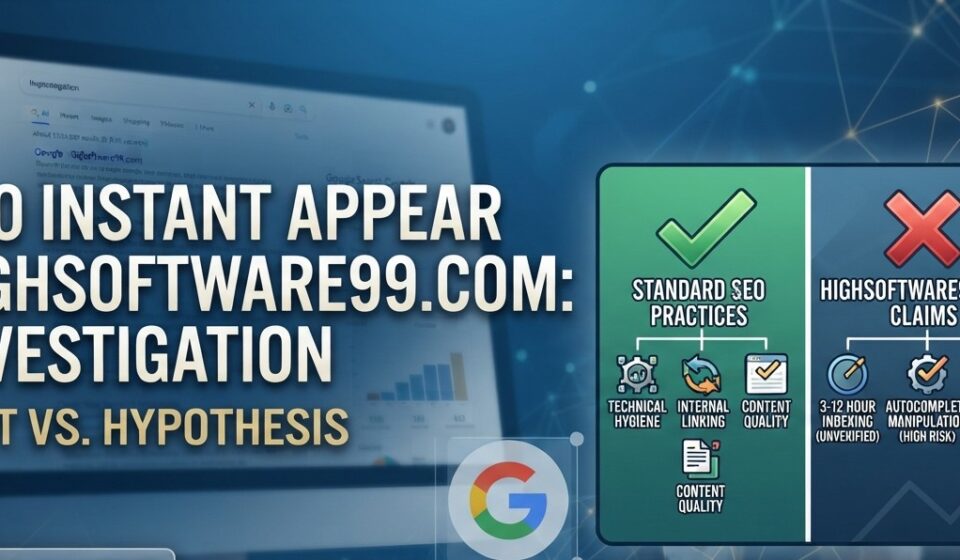

SEO instant appear highsoftware99.com is a viral search phrase tied to HighSoftware99.com, a digital marketing and web services domain claiming to accelerate how quickly new web pages are discovered, crawled, and indexed on Google—sometimes citing windows as short as 3 to 12 hours or leveraging Google Autocomplete manipulation. While the core mechanisms referenced under this umbrella (structured HTML hierarchy, semantic entity clarity, internal link architecture, and technical crawlability) are legitimate Google-documented practices, there are zero independently verified case studies, third-party platform audits (Clutch, G2, Trustpilot), or controlled crawl-rate tests proving that HighSoftware99.com outperforms standard technical SEO.
If you are trying to get a new website, blog post, or landing page indexed and ranking in Google USA without wasting budget on unverified “instant indexing” claims, this breakdown separates real search engine mechanics from marketing hype—and gives you the exact technical workflow to trigger rapid Googlebot discovery yourself.
Executive Fact-Check: HighSoftware99.com Claims vs. Public Evidence
Before evaluating the technical claims behind seo instant appear highsoftware99.com, it helps to isolate what can be verified from public records versus what circulates through syndicated guest posts and promotional blogs.
| Evaluation Criteria | Verified Reality & Public Evidence | Risk / Verification Level |
| Domain & Service Existence | HighSoftware99.com exists as an active website publishing articles on SEO, tech, and digital visibility services. | Confirmed |
| Core SEO Methodology | References structured content, semantic relevance, internal linking, and technical hygiene—all standard practices. | Verified (Standard SEO) |
| 3–12 Hour “Instant Appear” Claim | Circulated heavily in third-party blogs; lacks timestamped Google Search Console logs or controlled A/B crawl tests. | Unverified Assertion |
| Google Autocomplete Manipulation | Some promotional descriptions cite pushing brand terms into Google Autocomplete suggestions within hours. | High Spam Policy Risk |
| Independent Third-Party Reviews | Zero verified client profiles or reviews found on G2, Clutch, Trustpilot, or Google Business Profile at time of audit. | No External Validation |
| Documented Client Case Studies | No attributable before-and-after domain metrics, Search Console exports, or verifiable traffic graphs published. | Unverified |
| Pricing Transparency | Public pricing is largely absent; third-party mentions cite wide ranges ($500–$7,000) without clear deliverable tiers. | Opaque |
What Is “SEO Instant Appear HighSoftware99.com”?
The phrase seo instant appear highsoftware99.com functions less like a proprietary software product and more like a branded search query generated by an aggressive network of syndicated articles, press releases, and SEO comparison posts.
Across these publications, the concept is framed around two distinct mechanisms:
1. The “Rapid Indexing” Content & Technical Framework
Promotional materials describe HighSoftware99.com’s methodology as a three-pillar framework designed to eliminate crawl friction:
- Structured Content Architecture: Using clean H1–H3 hierarchies, bulleted summaries, and schema-ready formatting so Googlebot parses page intent immediately.
- Semantic Clarity: Replacing outdated keyword stuffing with entity-rich phrasing and natural topical coverage.
- Technical Optimization: Resolving broken links, improving Core Web Vitals, compressing assets, and maintaining clean XML sitemaps.
The Reality: Every single one of those pillars is foundational SEO taught in Google’s official Search Essentials documentation. Calling them an “instant appear” framework is a rebranding of standard on-page and technical SEO—not a proprietary backdoor into Google’s index.
2. The Google Autocomplete Placement Pitch
A second set of articles ties seo instant appear highsoftware99.com to Google Autocomplete (Search Box Optimization)—the practice of artificially generating search volume for a brand or keyword combination so Google’s predictive text suggests your brand name when users type a query.
The Reality: Google Autocomplete suggestions are not organic search rankings. Furthermore, artificially inflating query volume using click farms, bots, or incentivized searchers directly violates Google’s Spam Policies regarding Automated Traffic and Manipulative Behavior. Even if a brand term briefly appears in autocomplete, Google’s systems routinely purge manipulated suggestions—and doing so does nothing to improve your actual organic SERP rankings.
How Google Indexing Actually Works (The Real Timeline)
To understand why “instant appear” promises are misleading, you have to separate three completely different stages of Google Search: Discovery/Crawling, Indexing, and Serving (Ranking).
[1. URL Discovery & Crawl]  --->  [2. Rendering & Indexing]  --->  [3. Serving & Ranking]
   (Hours to Days)                  (Minutes to Weeks)               (Weeks to Months)
Stage 1: URL Discovery and Crawling
Googlebot discovers new URLs primarily by following internal and external <a href> links, reading XML sitemaps, or receiving manual pings via Google Search Console.
- According to public presentations by Google Search Relations (including Gary Illyes), under ideal conditions on an established domain, Googlebot can discover a new URL in roughly 20 hours.
- However, if your site has weak internal linking, poor crawl budget efficiency, or thousands of low-value parameter URLs, discovery alone can take days or weeks.
Stage 2: Rendering and Indexing
Once Googlebot fetches your HTML and renders the page (executing JavaScript if required), Google’s indexing pipeline evaluates whether the page deserves space in its index.
- Under optimal conditions on a trusted site, indexing happens within 1.5 to 2 hours after crawling.
- The Quality Bottleneck: When a page gets stuck in “Discovered – currently not indexed” or “Crawled – currently not indexed,” it is almost never because you lacked an “instant indexing tool.” Google explicitly states that indexing speed is governed by overall site quality, originality, and canonical clarity. If Google deems a page thin, duplicative, or derivative of existing top-10 results, it will deliberately withhold indexing.
Stage 3: Serving and Organic Ranking
Being indexed does not mean appearing on Page 1. A newly indexed URL may sit at position #85 for weeks while Google’s ranking systems test user engagement signals, evaluate topical authority across your domain, and measure backlink equity against entrenched competitors. No legitimate SEO service can bypass this competitive evaluation in 3 hours.
Also Read: What Is Sosoactive? History, What the Site Is Today, and Facts vs. Myths
SEO Instant Appear HighSoftware99.com vs. Proven Technical SEO
If you compare what is marketed under the HighSoftware99.com banner against verifiable, best-practice SEO workflows, the difference comes down to transparency, cost, and measurable control:
| Comparison Factor | HighSoftware99.com (“Instant Appear”) | Standard Technical & Semantic SEO |
| Primary Promise | Rapid visibility / 3–12 hour discovery claims | Predictable crawlability, clean indexing, and sustainable SERP growth |
| Discovery Mechanism | Unspecified outreach, structure, and alleged autocomplete tactics | XML Sitemaps, contextual internal links, and GSC URL Inspection |
| Algorithm Compliance | Gray-hat risk if autocomplete manipulation is used | 100% compliant with Google Search Essentials |
| Verification & Audit Trail | No public case studies or third-party reviews | Direct verification inside your own Google Search Console & server logs |
| Cost Structure | Opaque; third-party mentions cite $500–$7,000+ | Free (DIY via GSC) or transparent agency retainers with clear SLAs |
| Long-Term Asset Value | Unproven; potential volatility if manipulative signals are used | Builds permanent domain authority, topical depth, and organic traffic |
How to Get New Pages Indexed Fast in Google USA (Free 6-Step Blueprint)
You do not need to pay for a proprietary “instant appear” package to accelerate Googlebot discovery. Execute this exact 6-step protocol whenever you publish high-value content:
Step 1: Verify HTTP Status & Crawl Accessibility
Before requesting indexing, confirm that Googlebot can actually read your page without friction:
- Ensure the URL returns a clean
200 OKHTTP status code (no301/302redirect chains or404/5xxerrors). - Check your
robots.txtfile to ensure noDisallowrule blocks the URL path or critical CSS/JS rendering files. - Confirm your essential content is present in the initial HTML source rather than hidden behind client-side JavaScript interactions.
Step 2: Audit Meta Robots & Canonical Tags
A single conflicting directive will stall indexing indefinitely:
- Verify there is no
<meta name="robots" content="noindex">tag orX-Robots-Tag: noindexHTTP header. - Confirm the self-referencing canonical tag (
<link rel="canonical" href="[https://yourdomain.com/exact-url/](https://yourdomain.com/exact-url/)" />) matches the exact URL protocol (https), subdomain (wwwvs. non-www), and trailing slash format.
Step 3: Build Immediate Contextual Internal Links (Crucial)
Googlebot crawls links, not isolated URLs. A new page with zero internal links is an orphan page—and Google treats orphan pages as low priority.
- Open 2 to 3 of your highest-traffic, already-indexed pages in the same topic cluster.
- Add descriptive, contextual anchor text links pointing directly to your new URL.
- Ensure the new post is also linked from your primary category archive or homepage feed so it sits within 2 to 3 clicks of your root domain.
Step 4: Update & Ping Your XML Sitemap
- Confirm your SEO plugin (Rank Math, Yoast, or custom XML generator) automatically adds the new URL to your
sitemap_index.xmlwith an accurate<lastmod>timestamp. - Keep your sitemap strictly clean—exclude tag archives, thin author pages, and
noindexURLs so Google doesn’t waste crawl resources on low-value paths.
Step 5: Trigger Manual Inspection in Google Search Console
- Log into Google Search Console (GSC) and paste your exact URL into the top URL Inspection bar.
- Click “Test Live URL” to confirm Googlebot can fetch and render the page cleanly.
- Click “Request Indexing” once. (Note: Google confirms that clicking “Request Indexing” multiple times does not push your URL higher in the queue—submit once and let the crawler run.)
Step 6: Validate Content Differentiation (The “Information Gain” Check)
If your page still isn’t indexed after 72 hours, look at content quality rather than technical settings. Google’s ranking and indexing systems evaluate Information Gain—whether your page offers original data, deeper comparisons, clearer step-by-step execution, or fresh insights that existing top-10 pages lack. Rewriting thin sections to add unique tables, real benchmarks, and direct answers frequently triggers indexing within days.
Also Read: GrammarVista.com USA: The Ultimate Guide to American English Writing & Tools
Diagnostic Troubleshooting: Why Your Page Isn’t Showing Up
Use Google Search Console’s Indexing > Pages report to match your exact status message to the right fix:
| GSC Status Message | Root Technical or Quality Cause | Exact Fix to Apply |
| URL is unknown to Google | Orphan page with no internal links or missing from XML sitemap. | Add 2–3 internal links from indexed pages and submit via URL Inspection. |
| Discovered – currently not indexed | Crawl budget bottleneck or low domain trust; Google knows the URL exists but hasn’t crawled it yet. | Prune low-value URLs from sitemap, strengthen internal link authority, and improve site speed. |
| Crawled – currently not indexed | Googlebot read the page but decided its content value, uniqueness, or search intent match wasn’t strong enough. | Expand content depth, add unique data/tables, eliminate thin boilerplate, and re-submit. |
| Duplicate, Google chose different canonical | Another URL on your site (or external syndication) has nearly identical content. | Consolidate duplicate pages via 301 redirect or differentiate the page angle substantially. |
| Indexed, not ranking in Top 50 | Indexing succeeded, but your page loses on topical authority, backlinks, or intent satisfaction. | Optimize title/H2 alignment, earn niche-relevant backlinks, and build supporting cluster posts. |
Due Diligence Checklist: Before Paying Any “Instant SEO” Provider
Whether you are evaluating HighSoftware99.com or any agency advertising rapid search visibility, require written answers to these five checkpoints before signing a contract or sharing GSC access:
- Attributable Case Studies: Ask for 2–3 live client domains where they can verify before-and-after GSC indexing timelines and organic traffic growth—not cropped, anonymous screenshots.
- Written Scope of Deliverables: Require exact numbers (e.g., number of technical fixes, pages optimized, or editorial backlinks built) rather than vague promises of “visibility enhancement.”
- Spam Policy Guarantee: Get written confirmation that they do not use automated search bots, CTR manipulation networks, or Google Autocomplete spamming that could trigger a manual action on your domain.
- Transparent Reporting: Insist on direct reporting inside your own Google Search Console and GA4 properties, separating crawled pages from indexed pages and ranking keywords.
- Clear Pricing & Asset Ownership: Confirm that all content, schema markup, and technical changes remain 100% owned by your business if you cancel.
Also Read: Tozymagazine.com USA: The Ultimate Guide to Features, Categories & Legitimacy (2026)
Frequently Asked Questions (FAQ)
Can any tool or SEO service make a page appear on Google instantly?
No. No third-party tool, plugin, or agency can force Google to index and rank a page instantaneously. While the Google Indexing API (officially restricted to JobPosting and BroadcastEvent schema) and Google Search Console’s URL Inspection tool can accelerate discovery to a few hours on established sites, final indexing and Page 1 ranking always depend on Google’s automated quality evaluation.
Is HighSoftware99.com legitimate for SEO services?
HighSoftware99.com is an active website that publishes accurate, foundational SEO concepts regarding content structure, technical optimization, and crawlability. However, because there are no independently verified case studies, public pricing tiers, or third-party reviews on platforms like Clutch, G2, or Trustpilot, buyers should request verifiable client references and a written scope of work before purchasing.
Does Google Autocomplete manipulation improve organic search rankings?
No. Google Autocomplete predictions are separate from organic search rankings. Attempting to force brand or commercial keywords into Google Autocomplete using automated search volume violates Google’s spam policies, rarely produces lasting organic traffic, and risks algorithmic suppression.
Why does Google say “Crawled – currently not indexed” on my new post?
This status means Googlebot successfully accessed and read your page, so technical blocking is not the issue. Instead, Google’s quality algorithms determined that the page overlaps too closely with existing indexed content or lacks sufficient original value. Adding unique research, structured comparisons, and stronger internal links from authoritative pages on your domain is the most effective fix.
How long does it normally take for a brand-new website to appear in Google USA?
For a newly registered domain with zero backlinks or historical authority, initial discovery and indexing typically take 1 to 4 weeks. Ranking competitively for commercial or informational keywords in Google USA generally takes 3 to 6 months of consistent content publishing, technical hygiene, and authoritative link acquisition.