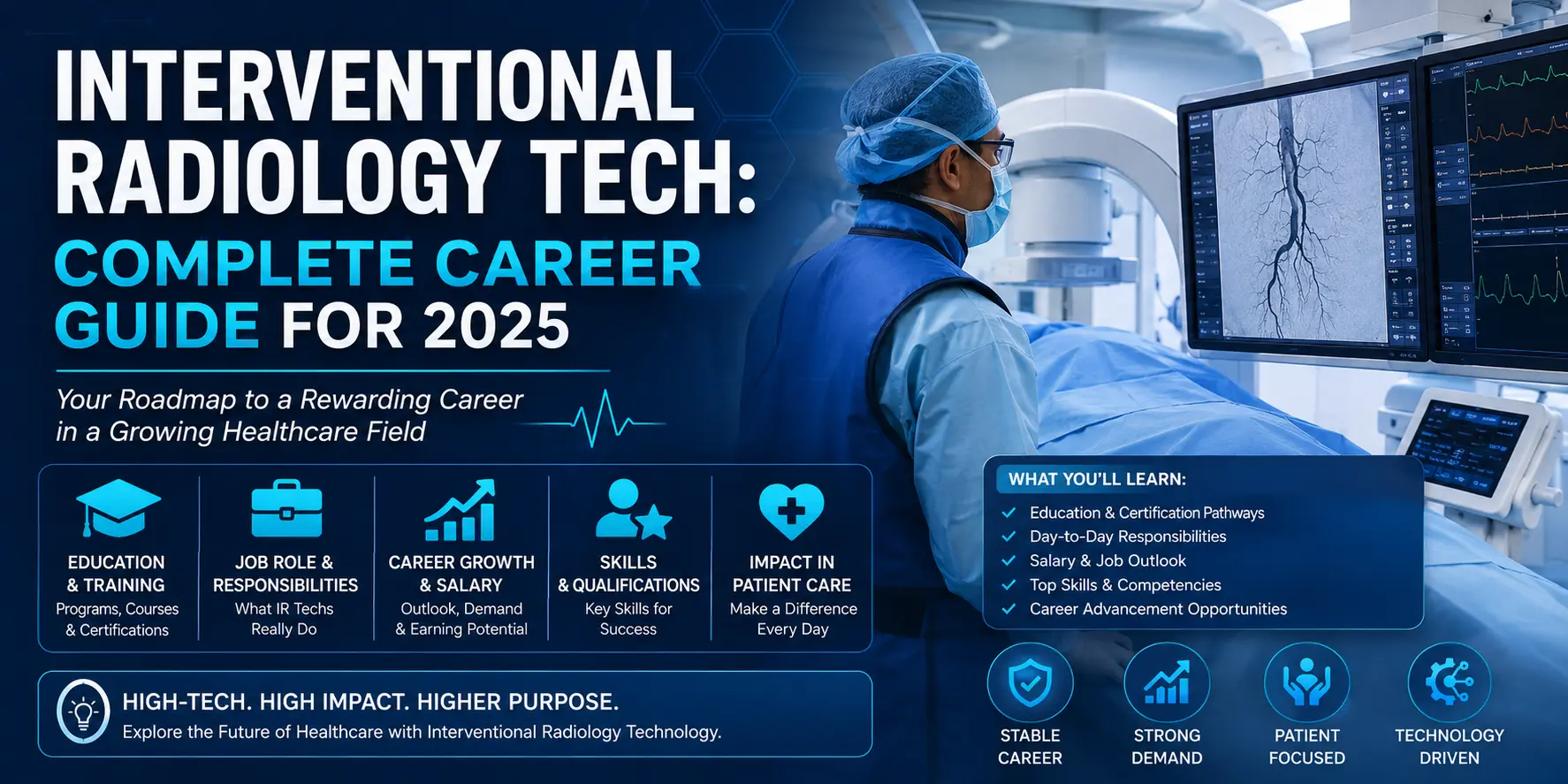

Modern medicine has quietly undergone a revolution — and most patients never see it happening. Procedures that once required open surgery, weeks of recovery, and significant risk can now be completed through a nick in the skin, guided by real-time imaging. At the center of this shift is the interventional radiology tech (IR tech), one of the most in-demand, technically challenging, and financially rewarding roles in allied healthcare.
Whether you’re a radiology student mapping your specialty path, a general imaging tech ready to level up, or someone exploring healthcare careers from scratch — this guide covers everything you need to know about becoming an interventional radiology tech in the United States
What Is an Interventional Radiology Tech?
An interventional radiology tech, also called a vascular-interventional technologist or IR tech, is a specialized radiologic technologist who assists physicians during minimally invasive, image-guided procedures. Unlike diagnostic radiographers who primarily capture images for interpretation, IR techs are active clinical participants — operating imaging systems in real time while physicians treat conditions inside the body using catheters, wires, stents, and needles.
The role sits at the crossroads of surgery, diagnostic imaging, and patient care. That combination is what makes it both challenging and deeply rewarding.
What Does an Interventional Radiology Tech Do?
On a typical day, an IR tech’s responsibilities span technical operation, patient care, and procedural support. Core duties include:
Preparing the IR suite — setting up sterile trays, calibrating fluoroscopy or C-arm equipment, verifying that contrast agents and procedural supplies are ready before the physician arrives.
Positioning and preparing patients — explaining the procedure clearly, answering questions, and ensuring patients are correctly positioned for accurate imaging and physician access.
Operating imaging equipment — running fluoroscopy units, digital subtraction angiography (DSA) systems, ultrasound guidance, or CT during live procedures.
Monitoring patient status — tracking vitals and alerting the care team to any changes, particularly during contrast injections or prolonged procedures.
Maintaining sterile technique — working within strict aseptic protocols, as many IR procedures carry infection risks comparable to traditional surgery.
Documenting procedures — entering procedural notes, imaging data, and contrast usage into patient records and PACS systems.
Assisting with post-procedure care — monitoring patients in recovery and communicating with nursing staff about post-procedural instructions.
Also Read: 2026 F-150 Smart Tech Features: The Complete Guide (BlueCruise, SYNC 4, Pro Power & More)
Common Procedures Performed in the IR Suite
One of the most compelling aspects of working as an interventional radiology tech is the sheer variety of procedures you’ll assist with. IR covers far more ground than most people realize.
Vascular procedures form the backbone of many IR departments. These include angioplasty and stenting for peripheral artery disease, embolization to stop internal bleeding, and thrombolysis to break down dangerous clots in deep veins or pulmonary arteries.
Oncological interventions have made IR a legitimate cancer treatment pathway. Transarterial chemoembolization (TACE) delivers chemotherapy directly to liver tumors, while radiofrequency ablation (RFA) uses heat to destroy cancerous tissue — all without open surgery.
Drainage and access procedures are among the most frequently performed IR cases. These include nephrostomy tube insertions, biliary drain placements, abscess drainage, and central venous catheter insertions for patients requiring long-term medication access.
Neurological interventions such as cerebral angiography, aneurysm coiling, and treatment of arteriovenous malformations (AVMs) are performed in hospital-based IR suites with specialized neuro-IR teams.
Women’s health procedures have expanded IR’s reach significantly. Uterine fibroid embolization (UFE) is now a widely accepted non-surgical alternative to hysterectomy, giving millions of women a faster recovery and preserved fertility.
Each of these procedures requires the IR tech to understand the anatomy, pathology, and imaging nuances involved — making this a role where intellectual curiosity is genuinely an asset.
How to Become an Interventional Radiology Tech
The path to becoming an IR tech is structured and follows a clear progression of education, certification, and clinical experience.
Step 1: Complete an Accredited Radiologic Technology Program
The foundation is an Associate’s or Bachelor’s degree in Radiologic Technology from a program accredited by the Joint Review Committee on Education in Radiologic Technology (JRCERT). Associate’s programs typically take two years and include both classroom instruction and supervised clinical rotations covering anatomy, imaging physics, patient positioning, and radiation protection.
Step 2: Pass the ARRT Certification Exam
After graduating from an accredited program, candidates must pass the American Registry of Radiologic Technologists (ARRT) examination to earn the Registered Radiologic Technologist (R.T.) credential. This is the baseline requirement for employment in virtually every U.S. healthcare facility and state licensing board.
Step 3: Build Clinical Experience in Imaging
Most IR departments require one to two years of hands-on experience in general radiography, fluoroscopy, or another imaging modality before hiring into a dedicated IR role. This foundational time builds the imaging confidence and patient care instincts that are essential in the IR suite.
Step 4: Earn the ARRT Vascular-Interventional Certification
The ARRT’s post-primary certification in Vascular-Interventional Radiography (VI) is the gold standard credential for IR techs in the United States. Earning it requires documenting clinical competency in a defined list of IR procedures, passing a structured examination, and demonstrating ongoing continuing education. Many employers list this certification as required — not just preferred — for IR tech positions.
Some IR techs also pursue the Cardiovascular-Interventional Technology (CV) or Cardiac-Interventional Radiography certification depending on their work setting, particularly in hybrid labs or cath labs.
Also Read: 7 Best Free AI Image Generators With No Sign-Up Required (Tested 2026)
Interventional Radiology Tech Salary in the USA (2026 Data)
Salary for IR techs varies depending on data source, experience, work setting, and geography — but the numbers are consistently strong relative to other allied health roles.
According to Salary.com, the average annual salary for an Interventional Radiological Technologist in the United States is approximately $93,357, with a typical range from $80,246 to $115,956. High-demand states pay meaningfully more — the District of Columbia averages $103,365, California averages $102,973, and Massachusetts averages $101,600 annually. Salary.com
Glassdoor data from February 2026 puts the average salary for an Interventional Radiology Technologist at $126,737 per year, with top earners at the 90th percentile reporting compensation up to $223,798. Glassdoor
Salary growth in the field has also been notable. Vascular interventional techs have seen a 13.6% salary increase since 2022, reflecting strong demand for specialized imaging professionals. The HJN Blog
For those willing to take travel assignments, compensation climbs even higher. Travel IR techs consistently out-earn travel general radiologic technologists, with staffing platforms reporting weekly packages that exceed travel rad tech rates by a meaningful margin. Vivian Health
Factors that shape your IR tech salary:
Experience and years in IR-specific work, geographic location and cost-of-living adjustments, holding the ARRT VI certification, working in hospitals versus outpatient centers versus federal facilities, and taking on shift differentials for evenings, nights, or on-call rotations.
Job Outlook: Is the Demand for IR Techs Growing?
The short answer is yes — and the data backs it up.
According to the U.S. Bureau of Labor Statistics, employment for radiologic and MRI technologists is projected to increase by 5% from 2024 to 2034, slightly faster than the average across all occupations — translating to roughly 15,400 job openings per year on average. TNAA
The drivers behind this growth are structural, not cyclical. The surge in demand comes from advancing medical technology and an aging population, with the total number of radiologic technologist jobs expected to climb from 227,800 to 241,000 during this period. The HJN Blog
IR specifically benefits from medicine’s broader shift toward minimally invasive treatment. Procedures that once required open surgery — from cancer treatment to vascular repair to women’s health interventions — are increasingly moving into the IR suite. As hospital systems invest in expanding their interventional programs, qualified IR techs remain among the most sought-after specialists in medical imaging.
Key Skills Every Interventional Radiology Tech Needs
Technical training gets you into the field. The following skills are what make you exceptional in it.
Imaging equipment proficiency — You need deep comfort with fluoroscopy units, C-arms, DSA systems, and PACS. Understanding how to optimize image quality while minimizing radiation dose to patients and staff is foundational.
Anatomy and pathophysiology — IR techs who understand vascular anatomy, organ structure, and disease presentation are infinitely more effective during procedures. You’re not just running equipment — you need to understand what you’re seeing.
Sterile technique — IR is quasi-surgical. Setting up sterile trays, maintaining aseptic fields, and recognizing contamination risks are non-negotiable daily skills.
Contrast media management — Understanding contrast agents, recognizing allergic reactions, and following proper injection protocols is a core IR tech competency. Adverse contrast reactions require immediate recognition and response.
Critical thinking under pressure — No procedure runs exactly as planned. The ability to anticipate problems, communicate anomalies to the physician, and respond to patient changes separates good techs from great ones.
Patient communication — Many IR patients arrive anxious, in pain, or uncertain about their procedure. A calm, clear, reassuring manner directly impacts patient compliance and outcomes.
Team collaboration — IR suites are tight-knit teams. You’ll work alongside interventional radiologists, scrub technologists, nurses, and anesthesia providers simultaneously. Precise, confident communication is critical.
Also Read: Gemini vs ChatGPT (2026): Which AI Is Actually Better for Daily Use?
Work Settings for IR Techs
Most interventional radiology techs work in hospitals, where dedicated IR suites handle both scheduled cases and emergency interventional calls. Hospitals employ approximately 58% of all radiologic technologists, making them the most common work environment for IR techs. Vivian Health
Beyond traditional hospital settings, IR techs also work in:
Outpatient vascular and interventional centers, which handle elective procedures in a higher-volume, clinic-style environment. Academic medical centers, which pair clinical work with teaching and research. Ambulatory surgical centers, particularly for procedures like UFE or port placements. Federal healthcare facilities including VA hospitals, which tend to offer some of the highest salaries for radiologic technologists despite employing a smaller percentage of the workforce. Vivian Health
Career Advancement Opportunities
An IR tech certification is a career accelerator, not a career ceiling. From the IR suite, experienced techs commonly move into:
Lead or charge technologist roles — overseeing daily suite operations, staff scheduling, equipment maintenance coordination, and quality assurance.
Clinical education and training — serving as a clinical educator within a hospital system or adjunct instructor at an accredited radiologic technology program.
Applications specialist positions — working with imaging equipment manufacturers such as Siemens, Philips, or GE to train hospital staff on new systems and support product implementation.
Radiology management — with additional business or healthcare administration education, moving into department director or imaging operations management roles.
Advanced clinical practice — some IR techs pursue Physician Assistant or Nurse Practitioner programs, using their procedural experience as a distinctive foundation for clinical practice.
Is Interventional Radiology Tech the Right Career for You?
If you’re drawn to a healthcare role that combines technical precision, real-time decision-making, and direct clinical impact — interventional radiology tech deserves serious consideration.
It’s not an easy path. The learning curve is steep, the environment is fast-paced, and the procedures carry genuine stakes. On-call demands, emergency cases, and the complexity of managing critically ill patients in the IR suite are real parts of the job.
But for those who thrive in that environment, few allied health careers offer what IR does: a front-row seat to medicine that changes lives — often in a single procedure, without a surgical incision, and with a recovery measured in days rather than months.
The salary is competitive, the job market is growing, the specialty continues to expand its clinical reach, and the credential you earn opens doors well beyond the IR suite.
If that sounds like your kind of career, the path starts with a JRCERT-accredited radiologic technology program and a commitment to building toward the ARRT VI certification. Every clinical experience you accumulate along the way brings you closer to one of the most technically rewarding roles in American healthcare.
For official certification requirements, visit arrt.org. For program accreditation standards, visit jrcert.org. For salary and employment data, refer to the U.S. Bureau of Labor Statistics Occupational Outlook Handbook.
Also Read: 20 Tech Activities Outdoor for Kids That Actually Stick
Frequently Asked Questions About Interventional Radiology Tech
How long does it take to become an interventional radiology tech?
The total path typically takes four to six years: two to four years for a radiologic technology degree, one to two years of clinical experience in general imaging, and the time required to accumulate the procedure competencies needed for the ARRT VI certification exam.
Do you need a bachelor’s degree to become an IR tech?
No — an Associate’s degree in Radiologic Technology from a JRCERT-accredited program meets the educational requirement. However, a bachelor’s degree can strengthen advancement opportunities and may be preferred by some employers for leadership roles.
Is the ARRT VI certification required?
It is not required by law in most states, but it is required or strongly preferred by the vast majority of employers hiring for dedicated IR tech positions. It is also strongly associated with higher pay.
Can IR techs specialize further?
Yes. Beyond the ARRT VI credential, IR techs can pursue certifications in Cardiovascular-Interventional Technology (CV), Cardiac-Interventional Radiography, CT, or additional imaging modalities — each of which expands both clinical capability and earning potential.
What is the difference between an IR tech and a radiology tech?
A general radiology tech primarily performs diagnostic imaging — X-rays, fluoroscopic studies, and basic procedures — for physician interpretation. An IR tech works in the procedural setting, actively assisting during interventions. The IR role requires additional specialized training, procedural competency, and typically commands higher compensation.