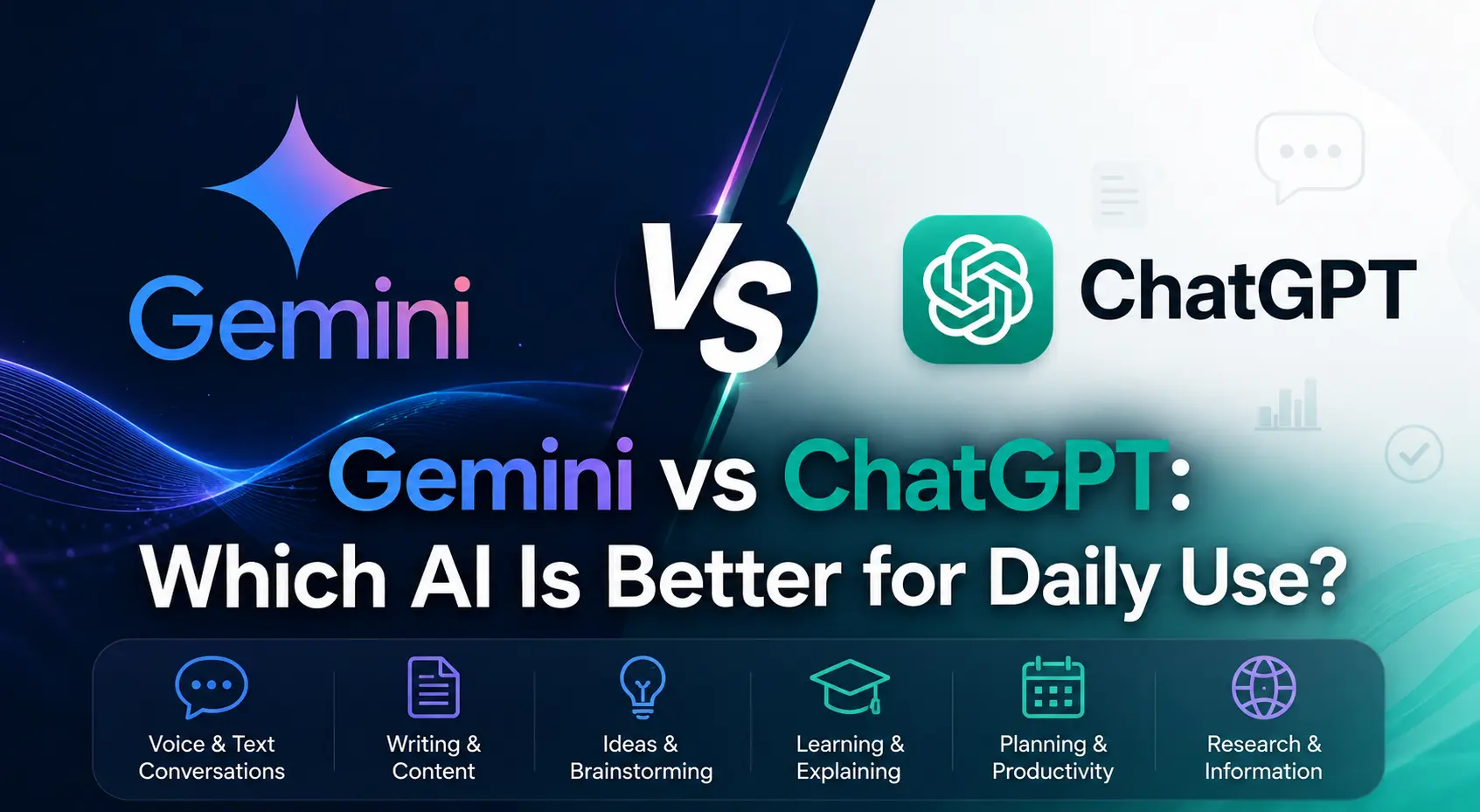

If you’ve typed “gemini vs chatgpt” into Google in the last few months, you already know the honest answer isn’t simple. Both companies have shipped new model families since the start of the year — Google with the Gemini 3.x line, OpenAI with GPT‑5.4 and GPT‑5.5 — and the gap between them keeps narrowing and shifting depending on what you’re trying to do. This guide skips the hype and breaks down exactly where each tool wins, where it falls short, and which one actually fits your daily workflow.
Gemini vs ChatGPT: Quick Verdict (Summary Table)
| Category | Winner | Why |
|---|---|---|
| Everyday writing & tone | ChatGPT | More polished prose, slightly more reliable instruction-following |
| Coding | ChatGPT (slight edge) | Stronger benchmark scores via Codex-trained models, though Gemini is close |
| Research with live data | Gemini | Native Google Search grounding and tight integration with Search’s AI Mode |
| Long documents / huge context | Gemini | Context windows up to 1–2 million tokens vs. ChatGPT’s smaller windows |
| Image generation | Tie (close) | Both are strong; preference is largely subjective |
| Video generation | Gemini | Veo 3.1 is built in; ChatGPT phased out Sora in April 2026 |
| Google Workspace users | Gemini | Native Gmail, Docs, Drive, and Search integration |
| Free tier generosity | Gemini (slightly) | Daily Pro-model access, image generation, and Deep Research included free |
| Budget-friendly paid plan | ChatGPT Go / Google AI Plus | Both sit around $8/month, roughly tied |
The short version: if you live inside Gmail, Docs, and Google Search, Gemini will feel like it was built for you. If you want the most polished writing assistant with the broadest plugin and agent ecosystem, ChatGPT still has the edge — though the margin has shrunk a lot in 2026.
What Is Gemini? (And What’s New in 2026)
Gemini is Google’s AI assistant, built on DeepMind’s Gemini model family and woven directly into the Google ecosystem — Search, Gmail, Docs, Drive, Android, and Chrome. Since early 2026, Google has moved fast: Gemini 3 launched with major reasoning and multimodal upgrades, followed by Gemini 3.1 Pro in February for harder reasoning tasks, and then Gemini 3.5 Flash and Gemini 3.5 Pro at Google I/O in May, with the latter offering a 2-million-token context window — the largest of any production model currently on the market.
A few things genuinely changed the experience this year. Nano Banana Pro, Google’s native image model, has become one of the most talked-about image generators around, and it now supports turning videos into thumbnails, posters, or infographics directly from a prompt. Gemini Canvas also rolled into Google Search’s AI Mode, turning search itself into an interactive workspace for planning, writing, and building simple apps without leaving the results page. For subscribers, Gemini 3 Deep Think mode pushes further into complex, multi-step reasoning territory aimed at research and advanced problem-solving.
What Is ChatGPT? (And What’s New in 2026)
ChatGPT is OpenAI’s flagship assistant, and 2026 has been a rapid-fire year of releases: GPT‑5.2 in December 2025, GPT‑5.3 and its Codex-focused sibling, GPT‑5.4, and then GPT‑5.5 in April 2026, which became the new default model across Plus, Pro, Business, and Enterprise tiers. OpenAI has leaned hard into reducing hallucinations in sensitive categories like law, medicine, and finance, and GPT‑5.5 Instant added the ability to pull context from past conversations, uploaded files, and connected Gmail accounts for more personalized answers.
Not everything has expanded, though. OpenAI discontinued the standalone Sora video tool from ChatGPT in April 2026, narrowing its native video capabilities right as Google was leaning further into Veo. On the productivity side, ChatGPT has pushed into agentic territory with Codex (an agentic coding model), Agent Mode, and a “Record Mode” that can transcribe and summarize meetings or voice notes into action items, project plans, or code. OpenAI has also been iterating quickly on pricing, splitting its once-simple Pro tier into two separate price points to serve casual power users and heavy professionals differently.
Also Read: Fireworks.ai Products Services: A Complete Guide to Offerings, Use Cases, and Value
Gemini vs ChatGPT: Head-to-Head Comparison
Writing and content creation
For general writing — emails, blog drafts, scripts, brainstorming — both tools are genuinely capable, but most hands-on reviewers in 2026 still give ChatGPT a slight edge on tone and polish. It tends to follow nuanced style instructions a bit more reliably and produces prose that reads as more natural in creative and narrative contexts. Gemini has closed much of that gap, and it pulls ahead the moment your writing task needs to be grounded in current information, since it can blend live search results into the draft without a separate step.
Coding and technical tasks
This is closer than it used to be. ChatGPT, powered by its Codex-trained models, generally produces cleaner, more idiomatic code across Python, TypeScript, and similar languages, and tends to score higher on coding benchmarks like SWE-bench Verified. Gemini 3.1 Pro holds its own for standard development tasks and benefits from deep Google Cloud integration, which matters if your stack already runs on GCP. Worth noting: dedicated coding-focused tools from other labs (Anthropic’s Claude models, for instance) are frequently cited in 2026 benchmarks as outperforming both on complex, agentic coding workflows — so if coding is your primary use case, it’s worth comparing beyond just these two. (Internal link idea: point this sentence to your own “best AI for coding 2026” post if you have one — it’s a natural next click for this reader.)
Research and fact-checking
Gemini has a structural advantage here because it’s wired directly into Google Search and Search’s AI Mode, so grounding a response in current web data feels native rather than bolted on. It also offers Deep Research through NotebookLM for longer, citation-backed reports. ChatGPT’s Deep Research feature is genuinely strong too, and it includes web browsing, but the run limits are tighter outside of paid tiers, and the search experience feels more like a tool ChatGPT reaches for rather than a feature it was built around.
Image generation and multimodal features
Both have become excellent at producing usable images from a prompt, and head-to-head testing tends to come down to taste rather than a clear technical gap. One practical difference: Gemini generates a set of four image variations per request and gives free users a higher daily image quota, while ChatGPT generates a single image per request. For video, Gemini has the clear lead — Veo 3.1 produces video with native audio and character consistency across paid Gemini tiers, while ChatGPT lost its dedicated video tool when Sora was phased out of the app in April 2026.
Integration with other apps and tools
If your work already lives in Gmail, Google Docs, Drive, Calendar, or Google Maps, Gemini’s native integration is hard to beat — it can read, draft, and act across those apps without extra setup. ChatGPT instead leans on a broader third-party Connectors system (SharePoint, GitHub, Dropbox, Google Drive) available mainly on Team, Enterprise, and Edu plans, plus a large library of Custom GPTs for specialized workflows. It’s also worth knowing that GPT models power parts of Microsoft Copilot, so if your organization is Microsoft-centric, ChatGPT’s underlying models may already be touching your workflow indirectly.
Gemini vs ChatGPT: Free Plan Comparison
Pricing verified: June 2026. Both companies have changed tiers and prices multiple times this year, so treat the figures below as directional rather than exact, and confirm current rates on Google’s official Gemini pricing page and OpenAI’s ChatGPT pricing page before you buy.
Both companies offer real free tiers in 2026, though both have also introduced ads on their free plans in the US as a way to subsidize the cost.
ChatGPT’s free tier runs on a lighter model with a hard cap of around 10 messages every 5 hours before falling back to a smaller model, and it lacks Deep Research, Codex, and most advanced tools. Its $8/month Go plan multiplies those limits roughly tenfold and adds more image generation and coding access, though it’s still ad-supported in some markets and skips the bigger features reserved for Plus.
Gemini’s free tier is comparatively generous: it defaults to the fast Flash model but gives limited daily access to the more powerful Pro model, along with image generation, voice mode, and even some Deep Research reports at no cost. Google’s own budget tier, branded Google AI Plus, sits in a similar price range to ChatGPT Go and adds higher usage limits plus access to Nano Banana Pro and basic video tools.
Bottom line: for someone who just wants occasional help with everyday tasks and isn’t ready to pay, Gemini’s free tier currently gives you a bit more to work with.
Also Read: How Sony AI is Revolutionizing Creativity
Gemini vs ChatGPT for Students
Both tools are widely used for studying, but they tend to be useful in different ways. ChatGPT remains the more popular choice among students for essay drafting, code homework, and general Q&A, partly because of habit and partly because of its writing quality. Gemini’s strengths show up more in research-heavy work: its huge context window means you can drop in an entire textbook chapter, lecture transcript, or research paper and ask detailed questions without losing earlier context, and NotebookLM (built on Gemini) is specifically designed for turning source documents into study guides, summaries, and even audio overviews.
For students on a budget, both companies now offer steep discounts or free access in several regions through education and telecom partnerships, so it’s worth checking current student offers before paying full price for either. (Internal link idea: link to a “free AI tools for students” or “ChatGPT/Gemini student discount” post here if your site has one.)
Gemini vs ChatGPT for Professionals and Businesses
For individual professionals, the choice often comes down to ecosystem. Marketers, writers, and consultants who want the most capable all-around assistant with the deepest plugin and agent ecosystem tend to lean ChatGPT, especially with Agent Mode and Codex handling more autonomous, multi-step work. Teams and professionals already standardized on Google Workspace tend to get more out of Gemini, since it can draft directly inside Docs, summarize Gmail threads, and pull data from Sheets without switching context.
At the business level, both offer team plans with admin controls, compliance certifications, and usage analytics, and large organizations frequently end up paying for both rather than picking one — using ChatGPT for coding and content generation while using Gemini for Workspace-embedded tasks and large-document analysis.
Which Is Better for Indian Users?
India has become a genuine pricing battleground between the two companies in 2026, and Indian users currently get some of the best value of any market. OpenAI launched ChatGPT Go in India at a sub-$5 monthly price with usage limits roughly ten times the free tier, and at various points has offered extended free access to new and existing subscribers. Google answered with its own Google AI Plus plan, priced at roughly ₹399 per month (with a discounted ₹199 introductory rate for new users), which bundles Gemini 3 Pro access, Nano Banana Pro, basic video tools, and 200GB of shared Google storage across up to five family members.
Gemini has a practical edge for many Indian users on the payments side — it accepts UPI directly and bills natively in rupees, while ChatGPT’s INR pricing can vary slightly depending on whether you subscribe through the website or an app store. Telecom bundling has also shaped access here: Google has partnered with Reliance Jio to offer free periods of its higher Gemini tiers, while OpenAI and Perplexity have run similar promotions with other carriers. For most everyday Indian users, the realistic answer is that free or heavily discounted access to both tools is currently available — so trying both before committing to a paid plan is genuinely worth doing right now.
Which Should You Choose? Our Final Recommendation
There isn’t a single universal winner, and that’s not a cop-out — it reflects how differently these two tools are built. Choose ChatGPT if you want the most polished writing output, a mature agent and plugin ecosystem, and you don’t live primarily inside Google’s apps. Choose Gemini if you’re already in Gmail, Docs, and Drive every day, you regularly work with very long documents or need video generation, or you want a free tier that gives you a taste of the top-tier model without paying immediately.
If you’re still unsure, the lowest-risk move is to use both for a couple of weeks: most people land on one as their daily driver and keep the other around for the handful of tasks where it clearly performs better.
Also Read: AGI vs AI: What’s the Real Difference?
Frequently Asked Questions
Is Gemini more accurate than ChatGPT?
It depends heavily on the task. On some 2026 reasoning and knowledge benchmarks, Gemini’s latest Pro models have edged ahead, while ChatGPT has generally scored higher on coding-specific benchmarks. Both companies release new models every few months, so any specific benchmark comparison can shift within weeks — for accuracy-critical work, it’s worth testing both on your actual use case rather than relying on a single leaderboard.
Is ChatGPT or Gemini free?
Yes, both offer functional free tiers. ChatGPT’s free plan gives limited access to a lighter model with a strict message cap every few hours. Gemini’s free plan defaults to its fast Flash model but throws in limited daily access to the more powerful Pro model, plus image generation and some Deep Research use. Both have introduced ads on their free tiers in the US as of early 2026, and both offer affordable paid tiers (around $8/month) that remove most of those restrictions.
Which AI is best for writing in 2026?
For pure prose quality and tone control, most reviewers still give ChatGPT a slight edge, particularly for creative and narrative writing. Gemini is a strong choice when your writing needs to incorporate current events or long source documents, since its search grounding and context window let it work with more material at once. For most everyday writing tasks, the practical difference between the two is small enough that personal preference and existing app habits matter more than raw capability.
Sources
This comparison draws on official release notes and announcements rather than secondhand recaps. Key references:
- Google, “A new era of intelligence with Gemini 3” and “Gemini 3.1 Pro” — Google Blog
- Google AI for Developers, Gemini API release notes
- OpenAI, “Introducing GPT-5.5” and “GPT-5.5 Instant”
- OpenAI Help Center, ChatGPT release notes and model release notes
- TechCrunch, “Google launches sub-$5 AI Plus plan in India to compete with ChatGPT Go”