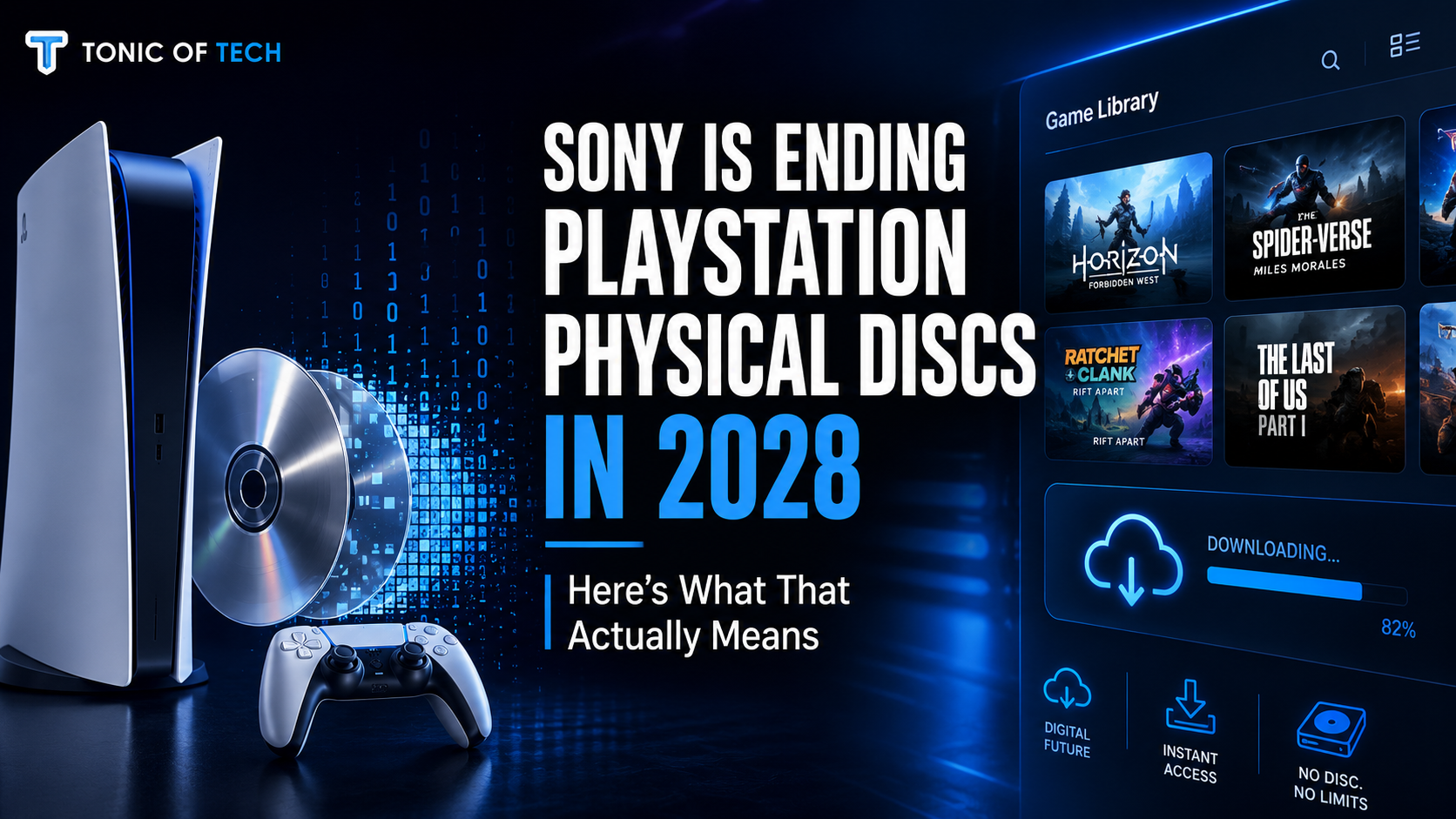
Sony Is Ending PlayStation Physical Discs in 2028 — Here’s What That Actually Means
Sony confirmed on July 1, 2026 that it will stop manufacturing physical discs for new PlayStation games starting January 2028. Games already on shelves and titles releasing before the cutoff are unaffected. The move follows data showing digital sales already account for roughly 80% of PlayStation software revenue, with Sony earning an estimated $28 per digital unit sold compared to $14 on a physical copy. Existing disc hardware keeps working — only new game production ends.
Key Facts at a Glance
- Physical disc production cutoff date: January 2028
- Announcement made: July 1, 2026 via the PlayStation Blog
- Digital share of PlayStation software sales: ~80% (analyst estimate)
- Digital vs. physical units shipped in FY2025: 248 million vs. 70 million
- Estimated Sony profit per digital sale: ~$28 vs. ~$14 per physical sale
- Physical share of PlayStation sales in 2024: just 3% (Sony corporate report)
- GameStop has closed 1,300+ stores over the past two fiscal years
- PS5 disc model price raised from $549.99 to $649.99 in April 2026
- Same-day announcement: PS3 and PS Vita PlayStation Store closures
- Capcom’s current digital share across all platforms: 93% of total game sales
What Did Sony Actually Announce?
Sony announced that starting January 2028, it will no longer manufacture physical game discs for new titles releasing on PlayStation consoles. After that date, new games will be sold exclusively through the PlayStation Store or as digital downloads through other retailers.
The announcement, posted to the PlayStation Blog by Sid Shuman, senior director of content communications at Sony Interactive Entertainment, was deliberately narrow. Two things it does not do: it doesn’t affect any game already on shelves, and it doesn’t end retail sales of whatever physical stock exists after production stops. Retailers can keep selling existing disc inventory after January 2028 — the same way stores sold remaining DVD stock for years after studios stopped pressing new ones. What ends is Sony making more of them.
Sony framed the decision as following where its players already are, stating the shift would “enable us to align more closely with how most of our community prefers to access and play games today.”
Also Read: How Sony AI is Revolutionizing Creativity
Why Is Sony Ending Physical PlayStation Discs?
Sony is ending physical PlayStation discs because the business case for maintaining a disc supply chain has effectively collapsed. During FY2025, Sony shipped 248 million digital copies of PlayStation games against 70 million physical ones — a ratio of more than 3 to 1. Revenue tells an even starker story: analysts estimate Sony generated roughly seven times more from digital sales than physical over the same period.
The per-unit math is the real driver. Sony nets an estimated $14 profit on a physical game sale compared to roughly $28 on a digital one — nearly double — because digital removes manufacturing, packaging, shipping, and retail margin from the equation. A disc supply chain built around 22% of unit sales and roughly 3% of revenue by Sony’s own 2024 corporate report numbers is overhead the company no longer has a financial case for keeping.
The same-day announcement of PS3 and PS Vita PlayStation Store closures reinforces the point. Sony is systematically retiring distribution channels that cost more to maintain than they return in value, and physical disc production is the latest one to reach that threshold.
What Happens to Games and Hardware You Already Own?
Nothing changes for existing games and hardware. Discs you own today keep working exactly as they do now — the cutoff only applies to new titles manufactured after January 2028. A PS5 with a disc drive continues reading every disc it currently supports.
Between now and the cutoff, publishers are likely to treat the runway as a marketing opportunity. Expect collector’s editions, limited physical runs, and disc-based re-releases to be promoted more aggressively as the deadline approaches. Collector demand often spikes before a format disappears, which can push up prices on exactly the games people are trying to preserve. For collectors, that’s both an opportunity and a warning.
After January 2028, retailers can continue selling whatever physical stock they have. What they can’t do is reorder more once it runs out.
How Does This Compare to Xbox and Nintendo?
Sony is moving first among the three major console platforms, but neither Microsoft nor Nintendo is standing completely still.
Microsoft has taken a softer approach. The Xbox Series S launched in 2020 without a disc drive, and Microsoft hasn’t announced any plan to stop producing physical Xbox games. What it has reportedly done is more interesting: Xbox employees are currently testing a “disc-to-digital” feature that would let players convert owned Xbox One and Series X/S discs into digital licenses. That’s a tool aimed at migrating existing physical libraries into Microsoft’s digital ecosystem rather than eliminating physical purchases outright — a slower, less confrontational path toward the same destination.
Nintendo sits furthest from a disc cutoff on paper, with the Switch 2 still shipping physical cartridges. But Nintendo has complicated its own physical story with “Game-Key Cards” — Switch 2 cartridges that contain no game data at all and simply act as license keys that trigger a mandatory download before the game will run. That’s a physical product in packaging only, which GameSpot and other outlets criticized for blurring the already thin line between a physical purchase and a boxed download code.
| Platform | Physical Media Status | Recent Price Change |
|---|---|---|
| PS5 (disc model) | Ends for new titles Jan. 2028 | Raised to $649.99 in April 2026 |
| PS5 Digital Edition | Digital-only since Nov. 2020 | — |
| Xbox Series X | No announced end date | Now $799.99 |
| Xbox Series S | All-digital since 2020 | Rising ~$100 to ~$500 from Aug. 1, 2026 |
| Nintendo Switch 2 | Cartridges continue (incl. Game-Key Cards) | Rising $50 from Sept. 1, 2026 |
What Does This Mean for GameStop and Used Game Sales?
GameStop is the most exposed business in this story. The retailer’s trade-in model depends on physical discs entering and re-entering circulation. Fewer new discs means a shrinking supply of the product its business was built on. GameStop has already closed more than 1,300 stores over the past two fiscal years — a contraction that predates Sony’s announcement but that a hard 2028 production cutoff will likely accelerate.
Digital storefronts don’t solve this problem. Digital licenses generally can’t be resold, so there’s no direct replacement for the used physical game market — only alternatives like subscription services, deeper discounting, and third-party key resale. As fewer publishers offer anything resembling a transferable physical product, game key marketplaces become one of the few remaining ways for players to buy or sell a “used” game at all.
Collector-focused resellers may see short-term demand rise as buyers stock up ahead of the January 2028 cutoff. But the long-term math cuts the other way: fewer new discs each year means a shrinking pool of recent titles available secondhand, shifting resale activity toward older back-catalog games rather than current releases.
What Does It Mean for Game Preservation?
Physical discs have always served a secondary purpose as insurance. A disc keeps working if a storefront shuts down, a publisher goes under, or a license expires — which is exactly the scenario that game preservation advocates have warned about as publishers delist digital titles and shut down always-online games. The Stop Killing Games campaign, which pushes publishers to keep games playable after official support ends, failed to advance through California’s legislature earlier in 2026, a reminder that policy hasn’t caught up with how much of the industry has already gone digital-only.
Sony’s disc cutoff doesn’t directly raise offline-support concerns for PlayStation Store purchases, since downloads stay re-accessible independent of any individual game’s servers. But it does eliminate the simplest long-term backup option for anything Sony releases after January 2028. For preservationists, that makes the pre-2028 PlayStation back catalog more historically significant, not less — the last generation of PlayStation titles guaranteed to exist entirely outside of Sony’s own infrastructure.
Frequently Asked Questions
When does Sony stop making physical PlayStation game discs?
January 2028. Sony’s July 1, 2026 announcement sets that as the cutoff for manufacturing new discs. Games already released or launching before that date keep their physical versions.
Can I still play my existing PlayStation discs after January 2028?
Yes. The change only applies to manufacturing new discs — it doesn’t disable existing hardware or affect games already released. A PS5 disc drive keeps working exactly as it does today.
Why is Sony ending physical PlayStation discs?
Digital already dominates. Sony’s FY2025 data shows digital outselling physical by more than 3 to 1, Sony earns roughly double the margin on digital sales, and its own 2024 corporate figures put physical at just 3% of total PlayStation sales revenue.
Will Xbox and Nintendo also end physical games?
Not yet. Microsoft is testing disc-to-digital conversion tools but hasn’t announced a production cutoff. Nintendo continues shipping Switch 2 cartridges, though its “Game-Key Cards” require a mandatory download before play.
What happens to GameStop after Sony ends disc production?
GameStop has already closed over 1,300 stores in two fiscal years. A hard cutoff on new disc production shrinks the supply of physical games its trade-in model depends on, likely speeding up the retailer’s long-running pivot away from game sales toward collectibles and accessories.
Can I still buy physical PS5 games before the cutoff?
Yes, and retailers can keep selling existing stock even after manufacturing ends in January 2028, until supply runs out.
The Takeaway
Sony ending physical disc production in January 2028 isn’t a surprise — it’s the math finally catching up with the reality. Digital already carried 80% of PlayStation software revenue before this announcement, and Sony earns nearly twice as much per sale without a disc involved. What changes in 2028 isn’t how most players already buy games. What changes is that the option to do it differently goes away for new releases. For collectors and preservationists, the window to stock up on disc-based PlayStation titles is now officially on the clock.
Tonic of Tech covers how gaming’s biggest business shifts affect the players, retailers, and industry behind the games — follow us for updates as the 2028 cutoff approaches.