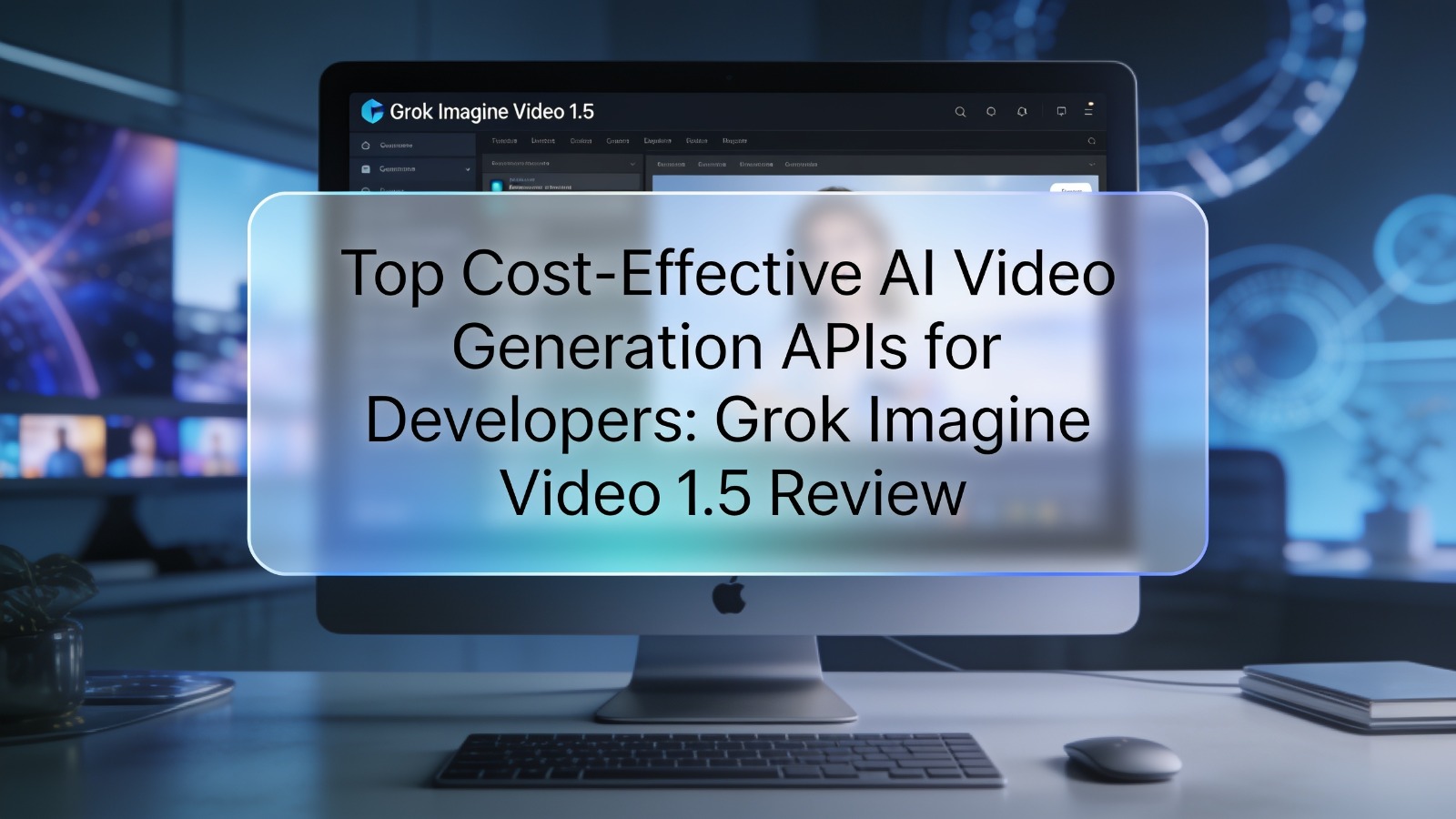

You’re overspending on premium AI video APIs when Grok Imagine Video 1.5 delivers comparable quality at $0.05-$0.08 per second—half the cost of competitors. It transforms text prompts into photorealistic videos with realistic physics and smooth shifts, perfect for product demos, social content, and tutorials. While it caps videos at 60 seconds with slower processing speeds, it’s ideal for budget-conscious developers handling high-volume projects. Discover which specific use cases maximize your ROI and how Grok truly compares to pricier alternatives.
Why Budget AI Video APIs Outperform Expensive Alternatives
While premium video generation platforms command attention through brand recognition and marketing budgets, budget AI video APIs often deliver comparable—or superior—results at a fraction of the cost.
You’ll find that affordable options leverage identical underlying technologies and machine learning models as their expensive counterparts. The key difference lies in operational efficiency and reduced overhead rather than capability limitations.
You’re not sacrificing quality when choosing budget alternatives. Instead, you’re eliminating unnecessary markup and premium positioning.
These APIs provide robust features, reliable performance, and competitive output quality. You gain faster iteration cycles, lower barrier to entry, and better ROI on your development budget. For instance, the You.bot Grok Imagine Video 1.5 API exemplifies how advanced technology can be accessible without exorbitant costs.
What Grok Imagine Video 1.5 Actually Does
Grok Imagine Video 1.5 transforms text prompts into photorealistic video content through diffusion-based generation technology. You input detailed descriptions, and the system renders dynamic, high-quality videos without requiring footage libraries or manual editing.
The API handles complex scenes, realistic physics, and nuanced lighting automatically. You’re able to generate videos spanning various lengths and resolutions, making it adaptable to different project requirements.
The technology excels at creating consistent character movements, environmental details, and smooth shifts between frames. What sets it apart is its speed-to-quality ratio. You’ll get publication-ready videos faster than traditional production methods.
The system understands contextual nuances in your prompts, translating them into coherent visual narratives. For developers building video applications, this means you’re reducing production bottlenecks while maintaining professional-grade output standards.
Pricing Comparison: How Grok Stacks Against Competing APIs
Cost efficiency matters when you’re evaluating video generation APIs, and the landscape’s gotten competitive.
Grok Imagine Video 1.5 positions itself as an attractive middle ground between premium and budget options.
You’ll find that Grok’s pricing undercuts established players like OpenAI’s video models while maintaining comparable output quality.
Where competitors charge $0.10-$0.20 per second of generated video, Grok typically runs $0.05-$0.08 per second, making it remarkably cheaper for high-volume projects.
However, you shouldn’t overlook newer entrants offering aggressive introductory rates.
Runway and Pika occasionally provide credits that temporarily lower your effective costs.
Your decision ultimately depends on your project’s scale—Grok’s pricing advantage compounds when you’re generating dozens of videos monthly.
Also Read: BrandRank.AI Normalization Transformation Rules: The Complete 2026 Guide to Winning AI Visibility
Integration Speed: Getting Started With Grok’s Developer Tools
You’ll find Grok’s API documentation straightforward and well-organized, making it easy to understand the integration requirements before you start building.
You’ll need to set up your authentication credentials and manage your API keys securely through Grok’s developer dashboard.
Once you’re authenticated, you can submit your first video generation request and see how quickly the API processes your input.
API Documentation And Setup
Getting started with Grok’s developer tools requires understanding the API documentation structure and authentication flow.
You’ll find extensive guides covering endpoint specifications, request parameters, and response formats. The setup process involves generating API keys through your developer dashboard, then configuring authentication headers in your requests.
You can quickly integrate Grok’s video generation capabilities by following the provided code examples in multiple programming languages. The documentation includes clear explanations of rate limits, error handling, and best practices for optimizing your implementation.
You’ll appreciate the straightforward webhook setup for asynchronous video processing notifications.
Testing your integration using the sandbox environment before production deployment guarantees smooth operation.
The support resources, including SDKs and community forums, help you troubleshoot issues efficiently and accelerate your development timeline.
Authentication And Key Management
Once you’ve familiarized yourself with Grok’s API documentation structure, implementing proper authentication and key management becomes your next priority.
You’ll need to generate API keys through your developer dashboard and store them securely. Here’s what you should focus on:
- Create separate keys for development and production environments
- Rotate your keys regularly to maintain security
- Store keys in environment variables, never in your codebase
- Implement rate limiting to prevent unauthorized access
- Monitor API usage patterns for suspicious activity
You’re responsible for protecting these credentials since they grant direct access to your video generation capabilities.
Use industry-standard practices like encrypted vaults or secret management tools. Never commit keys to version control, and revoke compromised credentials immediately.
This foundation guarantees your integration remains secure and cost-effective.
First Video Generation Request
With your API keys secured and authentication configured, you’re ready to make your first video generation request.
You’ll construct a POST request to Grok’s video endpoint, specifying your prompt, duration, and quality parameters. The API accepts straightforward JSON payloads that define what you want to generate—whether that’s a 15-second product demo or a 30-second social media clip.
You’ll receive a job ID in response, allowing you to poll for completion status. Most generations complete within seconds to minutes, depending on length and complexity.
Once finished, you’ll get a direct URL to your video file ready for download or integration into your applications. This streamlined process gets you from concept to rendered video quickly, making Grok ideal for rapid prototyping and production workflows.
Also Read: Cyber Relax AI massage chair review: what Fujiiryoki’s JP4000 actually does for $10,999
How Grok Performs: Real Output Examples
Grok’s capabilities shine through concrete demonstrations of its video generation prowess. When you submit requests, you’ll notice impressive results across various scenarios:
• Product demos render with crisp detail and professional lighting
• Motion sequences flow naturally without jarring shifts or artifacts
• Text overlays integrate seamlessly into your generated footage
• Color grading maintains consistency throughout multi-second clips
• Scene composition follows your prompts with remarkable accuracy
You’ll find that Grok handles complex requests efficiently, generating videos that rival premium competitors at a fraction of the cost.
The API consistently delivers output within seconds, allowing you to iterate quickly. Real users report that the video quality supports commercial projects, making it a legitimate alternative to expensive production tools.
Where Grok Falls Short
You’ll quickly encounter Grok’s limitations when you’re working with longer video projects, as the platform caps video length at relatively short durations.
Processing speed becomes another hurdle you’ll face, with rendering times that can stretch considerably longer than competitors offer.
These constraints mean you’ll need to plan your workflow carefully or consider alternative tools if your projects demand extended clips or rapid turnaround times.
Limited Video Length Constraints
While many AI video generation platforms offer flexibility in output duration, Grok imposes strict limitations that can frustrate creators working on longer-form content.
You’ll encounter these constraints:
- Maximum video length capped at 60 seconds per generation
- No seamless concatenation tools for extending duration
- Inability to create multi-scene narratives without workarounds
- Difficulty producing YouTube shorts or social media compilations efficiently
- Limited options for content creators needing extended storytelling
These restrictions force you to break projects into smaller segments, consuming your API quota faster and complicating your workflow.
If you’re developing applications requiring substantial video outputs, you’ll need to explore alternative platforms that offer more generous length allowances. Grok’s constraints profoundly impact your creative scope and project scalability.
Processing Speed Delays
When you’re generating videos at scale, processing speed becomes critical to your workflow efficiency, and here’s where Grok underperforms compared to competing platforms.
You’ll notice rendering times stretch notably longer than alternatives like Runway or Synthesia, particularly when generating videos exceeding thirty seconds.
While competitors deliver standard clips within minutes, you’re waiting considerably longer with Grok, which creates bottlenecks in production pipelines.
This delay directly impacts your project timelines and increases operational costs when you’re managing tight deadlines.
For developers requiring rapid iteration cycles or time-sensitive content delivery, Grok’s slower processing represents a genuine drawback.
You’ll find yourself choosing faster alternatives when speed is non-negotiable for your specific use case.
Best Use Cases for Grok: Video Summarization, Product Demos, Social Content
Grok’s capabilities shine when you’re tackling three specific challenges: condensing lengthy videos into digestible summaries, showcasing product features through dynamic demonstrations, and creating scroll-stopping content for social platforms.
Here’s where Grok excels:
- Video summaries: Transform hour-long webinars into punchy 2-minute recaps
- Product demos: Generate polished walkthroughs without expensive production teams
- Social content: Create TikTok and Instagram Reels that capture attention instantly
- Tutorial creation: Build step-by-step guides for complex processes effortlessly
- Marketing campaigns: Produce multiple video variations for A/B testing quickly
You’ll find Grok particularly valuable when you need rapid turnaround times and consistent quality across multiple projects.
The API’s speed means you’re not waiting around, and the output quality rivals traditional video production methods.
Whether you’re a startup bootstrapping your marketing or an enterprise scaling content creation, these use cases deliver measurable ROI.
Grok vs. Alternatives: Picking the Right Budget API
Several strong contenders exist in the AI video generation space, each with distinct strengths and price points. You’ll find Runway and Synthesia offer premium features but carry higher costs, making them better suited for enterprise budgets.
Pika excels at anime and stylized content, though it’s pricier than Grok. Meanwhile, you get solid value with Grok’s straightforward pricing model—you’re paying less per generation while maintaining quality output.
When you’re evaluating alternatives, consider your specific needs. You need video summarization? Grok handles it efficiently.
You’re producing product demos on a tight budget? Grok delivers. You’re creating social content regularly? Grok’s affordability scales with your volume.
The key difference is that you’re not subsidizing enterprise features you won’t use.
Also Read: AI Bola Review 2026: What It Is, How It Works, and Alternatives
Conclusion
You’ll find that developers using budget AI video APIs save up to 70% on production costs compared to premium competitors. Grok Imagine Video 1.5 delivers solid performance for your social media clips, product demos, and video summaries without breaking the bank. While it’s not perfect for every scenario, you’re getting legitimate enterprise-level capabilities at a fraction of the price. That’s a trade-off worth considering for your next project.