

Enterprise AI has evolved rapidly over the last few years. Large language models (LLMs) are now capable of reasoning, planning, and interacting with enterprise systems through autonomous AI agents. Yet despite these advances, many organizations still struggle to move beyond successful proofs of concept.
The challenge isn’t the intelligence of the model—it’s the quality of the context provided to it.
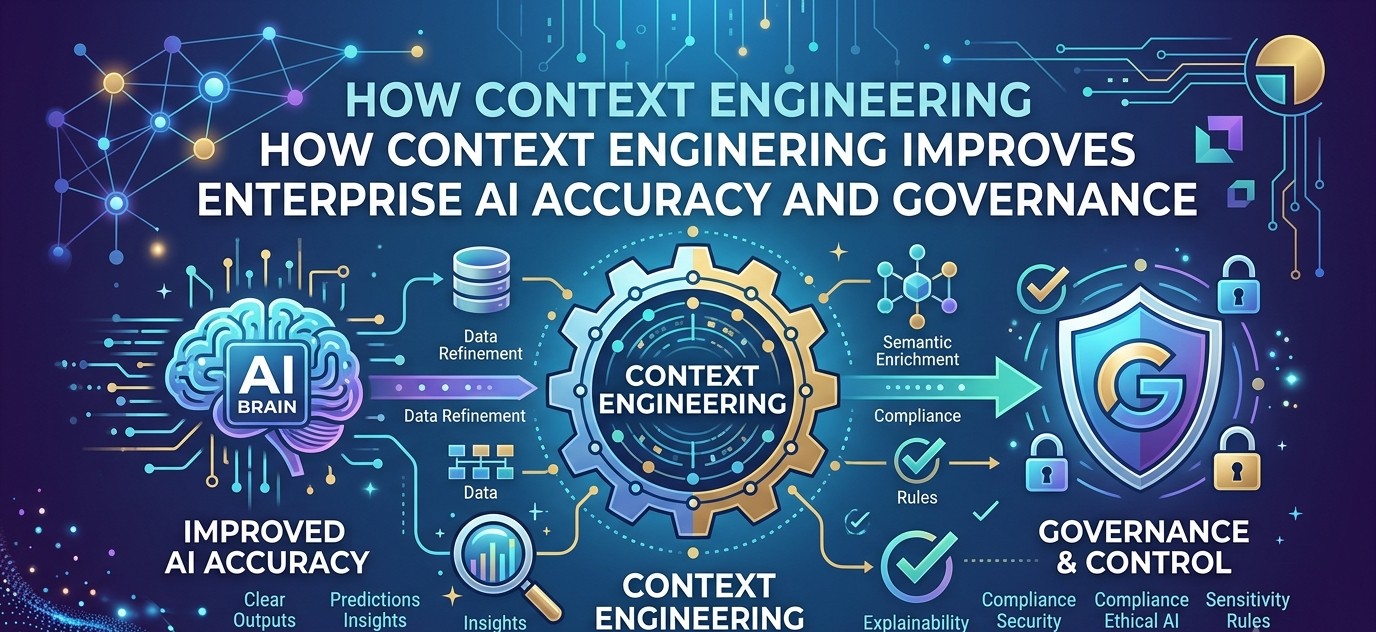
Without accurate, governed, and timely enterprise context, even the most advanced AI models can produce inaccurate recommendations, inconsistent responses, and compliance risks. This is why context engineering is emerging as one of the most important disciplines in enterprise AI.
Rather than relying solely on prompt engineering, context engineering focuses on designing the data, knowledge, policies, memory, and retrieval mechanisms that enable AI systems to make informed decisions using trusted enterprise information.
Why Enterprise AI Still Produces Inaccurate Results
Many AI initiatives fail because they depend on generic model knowledge rather than organization-specific business context.
Common causes include:
- Fragmented enterprise data
- Outdated documentation
- Inconsistent metadata
- Limited access to business rules
- Poor retrieval strategies
- Lack of governance
- Missing user and role context
The result is familiar to many enterprise teams:
- AI hallucinations
- Inconsistent answers
- Compliance concerns
- Low user trust
- Poor adoption
Increasing model size alone does not solve these issues. Enterprises need a systematic approach to delivering relevant, secure, and governed information to AI systems.
What Is Context Engineering?
Context engineering is the practice of designing and managing the information ecosystem that AI models use to understand enterprise tasks and make decisions.
This includes:
- Structured business data
- Unstructured documents
- Metadata
- Knowledge graphs
- Retrieval-Augmented Generation (RAG)
- User roles and permissions
- Historical interactions
- Business policies
- External APIs
- Real-time operational data
Instead of asking AI to “guess” the answer, context engineering ensures the model receives the right information at the right time.
Also Read: Camerabewaking App: The Complete Guide to Smarter Home & Business Security in 2026
The Five Pillars of Enterprise Context Engineering
1. AI-Ready Data Foundation
Reliable AI begins with trusted enterprise data.
Organizations need:
- High-quality data pipelines
- Unified data platforms
- Master data management
- Metadata catalogs
- Data lineage
- Real-time synchronization
Modernizing legacy data environments creates a strong foundation for AI systems to access consistent, governed information.
2. Intelligent Retrieval
Retrieval is no longer just keyword search.
Modern enterprise AI combines:
- Vector search
- Semantic search
- Hybrid retrieval
- Knowledge graphs
- Business ontologies
- Context ranking
These capabilities help AI agents retrieve the most relevant information while reducing hallucinations.
3. Enterprise Memory
Effective AI agents require memory beyond a single conversation.
Memory includes:
- User preferences
- Previous decisions
- Workflow state
- Business context
- Organizational knowledge
Persistent memory enables AI systems to deliver more consistent and personalized experiences.
4. Governance by Design
Context engineering must incorporate governance from the start.
Key capabilities include:
- Role-based access control
- Data masking
- Audit trails
- Policy enforcement
- Compliance monitoring
- Responsible AI guardrails
Governance ensures AI systems use only authorized information while supporting regulatory requirements.
5. Continuous Evaluation
Enterprise AI is dynamic.
Organizations should continuously measure:
- Retrieval precision
- Context relevance
- Hallucination rates
- Response quality
- Latency
- User satisfaction
- Business outcomes
These metrics help improve AI performance over time.
How Context Engineering Improves AI Accuracy
Context engineering enhances AI accuracy by grounding responses in enterprise knowledge rather than relying solely on model predictions.
Benefits include:
- More accurate responses
- Reduced hallucinations
- Better reasoning
- Higher consistency
- Improved explainability
- Faster decision-making
AI systems become significantly more reliable when responses are based on governed enterprise data.
Strengthening Enterprise AI Governance
Governance is becoming a strategic priority as organizations deploy AI agents across business functions.
Context engineering supports governance through:
- Identity-aware retrieval
- Fine-grained access controls
- Context filtering
- Policy-driven orchestration
- Secure tool integration
- Comprehensive audit logging
These controls help organizations meet regulatory and security requirements while maintaining user trust.
Why Data Modernization Matters
Legacy systems often store valuable business knowledge in disconnected databases, ETL workflows, reports, and documents.
Modernizing these environments enables organizations to:
- Consolidate enterprise knowledge
- Improve metadata quality
- Enable semantic search
- Support real-time AI applications
- Scale Agentic AI initiatives
A modern data foundation is essential for effective context engineering.
Context Engineering and Agentic AI
Agentic AI systems perform complex tasks by planning, reasoning, and interacting with enterprise tools.
Their success depends on reliable context.
A mature context engineering strategy enables agents to:
- Understand business intent
- Access trusted enterprise knowledge
- Follow governance policies
- Coordinate across workflows
- Make consistent, explainable decisions
Without this foundation, autonomous agents risk producing unreliable or non-compliant outcomes.
Also Read: How to Delete Cash App Account: Complete 2026 Guide
A Practical Enterprise Roadmap
Organizations can adopt context engineering through a phased approach:
- Assess AI readiness and data maturity.
- Modernize fragmented data platforms.
- Build a unified enterprise knowledge layer.
- Implement semantic retrieval and knowledge graphs.
- Integrate governance, security, and observability.
- Continuously evaluate and refine AI performance.
This approach helps reduce implementation risk while delivering measurable business value.
How Impetus Helps Enterprises Build Trusted AI
Enterprise AI depends on more than powerful models—it requires trusted data, modern architectures, and strong governance.
Impetus helps organizations prepare for production-scale AI by combining data modernization, AI engineering, and cloud transformation expertise. By modernizing legacy data estates, establishing AI-ready data platforms, and implementing enterprise-grade governance, organizations can build the contextual foundation required for reliable Agentic AI.
Rather than treating context engineering as an isolated capability, it becomes part of a broader strategy that connects modern data platforms, enterprise knowledge, and AI operations to support scalable, trustworthy AI systems.
Conclusion
The future of enterprise AI will be defined not by larger models, but by better context.
Organizations that invest in context engineering can improve AI accuracy, strengthen governance, reduce hallucinations, and accelerate enterprise adoption. Combined with modern data platforms and robust governance, context engineering enables AI systems that are not only intelligent but also secure, explainable, and production-ready.
For enterprise leaders, the next competitive advantage lies in building AI systems that understand the business as well as they understand language.
Frequently Asked Questions
What is context engineering in enterprise AI?
Context engineering is the practice of designing and managing the enterprise data, knowledge, memory, and governance that AI systems use to generate accurate and reliable responses.
How does context engineering reduce AI hallucinations?
It grounds AI responses in trusted enterprise data using retrieval, metadata, knowledge graphs, and governance controls, reducing reliance on model assumptions.
Why is context engineering important for Agentic AI?
Agentic AI systems require access to enterprise context to plan, reason, and execute tasks safely. Context engineering ensures they have relevant, secure, and up-to-date information.
How does data modernization support context engineering?
Modern data platforms improve data quality, metadata, governance, and accessibility, making it easier to provide trusted context to AI systems.
What are the core components of context engineering?
Key components include AI-ready data foundations, intelligent retrieval, enterprise memory, governance, security, metadata, and continuous evaluation.