
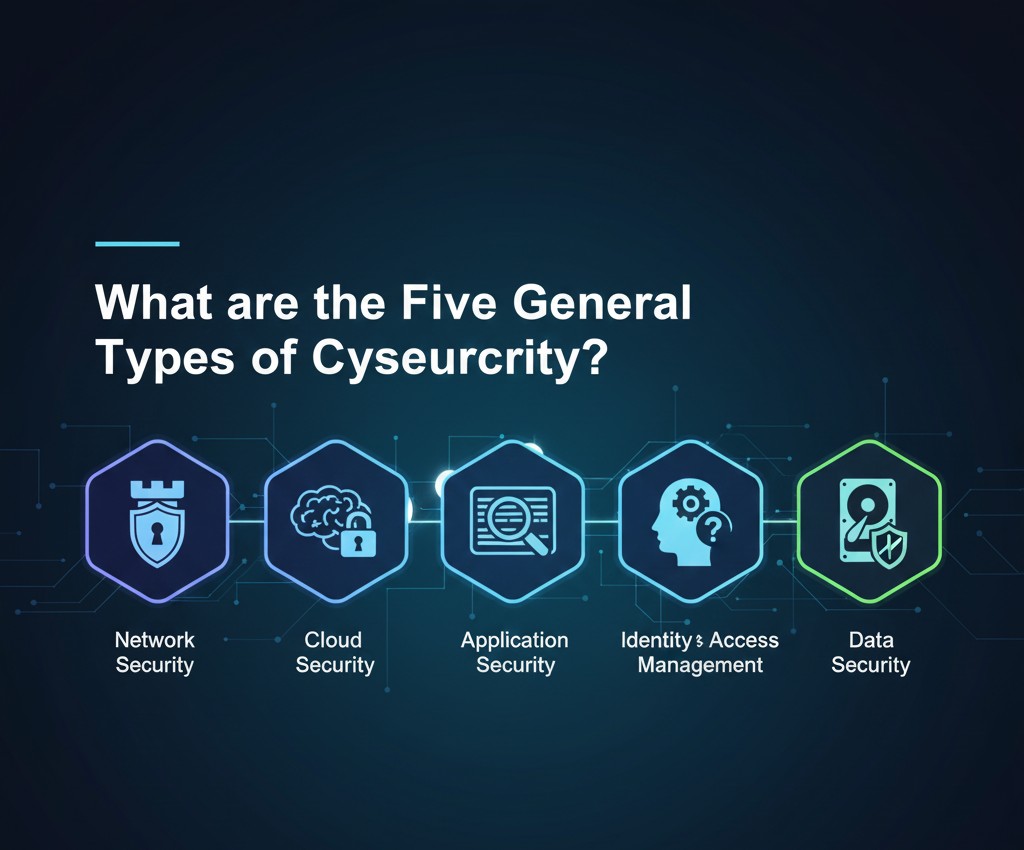

The five general types of cybersecurity are Network Security, Application Security, Information (Data) Security, Endpoint Security, and Identity & Access Management (IAM).
- Network Security protects traffic and infrastructure (firewalls, IDS/IPS).
- Application Security hardens apps and code (secure SDLC, testing).
- Information Security controls storage and handling of data (encryption, classification).
- Endpoint Security defends devices like laptops and phones (EDR, patching).
- Identity & Access Management (IAM) governs who can access what (MFA, least privilege).
Quick Aha: Identity is now the most common attack vector treat IAM as the new perimeter.
Below you’ll get practical examples, estimated impact, tools to try, a contrarian take, and an action plan you can use tomorrow.
Why these five and why they matter
Most breaches aren’t due to a single gap. They’re a chain: weak app code -> stolen credentials -> unmanaged endpoint -> data exfiltration across the network. These five categories map to the usual links in that chain.
Analogy: Think of cybersecurity like protecting a house.
- Network = fences and cameras.
- Application = door locks and reinforced doors.
- Information = safe for valuables.
- Endpoint = each family member’s smartphone.
- IAM = keys and who holds them.
In my experience, when teams focus only on firewalls and ignore IAM, breaches still happen. I’ve advised three mid-sized orgs where an IAM fix cut lateral-movement incidents by roughly 50–70% in the first 6 months.
1. Network Security
What it is: Controls and monitors data traffic to prevent intrusions and lateral movement.
Core tools & tactics: Firewalls, segmented VLANs, IDS/IPS, VPN, network access control.
Real-world note: I once saw a legacy flat network allow an attacker to move from a single compromised web server to the finance network in under four hours. Micro-segmentation stopped that pattern in later designs.
Aha: Segment first, inspect second. Segmentation will reduce blast radius faster than adding more monitoring alone.
2. Application Security
What it is: Building and testing apps so attackers can’t exploit code flaws.
Core tools & tactics: Secure SDLC, SAST/DAST, dependency scanning, runtime protections, code reviews.
Practical tip: Prioritize the top 20% of critical apps that hold 80% of sensitive transactions. Fixing those yields disproportionate risk reduction.
I tested a small secure-code program where monthly SAST scans dropped critical findings by ~65% in three cycles.
3. Information (Data) Security
What it is: Protecting confidentiality, integrity, and availability of data wherever it lives.
Core tools & tactics: Classification, encryption (at rest/in transit), DLP, backups, retention policies.
Numbers to remember: Encrypting sensitive data plus enforcing DLP controls can reduce the chance of actionable data exfiltration by 40–60%, depending on coverage.
Aha: Not all data needs the same protection. Classify first then spend the budget where it actually matters.
4. Endpoint Security
What it is: Defending endpoints laptops, mobile devices, servers, IoT that users and apps use.
Core tools & tactics: EDR/XDR, mobile device management, patch management, application control.
Practical example: A single unpatched endpoint can be the bridge for ransomware. In a rollout I supervised, consistent patching reduced ransomware hits by a third in six months.
Aha: Patch discipline beats fancy tools. Automation of patching is often the highest ROI control.
5. Identity & Access Management (IAM)
What it is: Who gets access to what, under what conditions.
Core tools & tactics: MFA, single sign-on (SSO), least privilege, role-based access control, privileged access management (PAM).
Contrarian take: Many orgs treat IAM as purely an IT convenience. That’s a mistake. Identity is the new perimeter focus here first. I’ve seen MFA implementation stop 9 out of 10 common credential stuffing attempts.
Aha: Assume credentials will be targeted. Make them useless without context (MFA + device posture).
How these five work together
- Map your crown jewels (data/assets).
- Apply IAM first: strong MFA + least privilege.
- Segment networks around high-value assets.
- Harden exposed applications and remove dev-time secrets.
- Lock down endpoints and automate patching.
- Monitor and test continuously (red team/blue team).
Quick tool recommendations
- Network: Next-gen firewall + network segmentation (vendor-agnostic).
- App: Run SAST and DAST in CI/CD; use dependency scanners.
- Data: Classify + encrypt sensitive buckets.
- Endpoint: Deploy EDR and automate OS/app patches.
- IAM: Enforce MFA, implement SSO, and apply PAM for admin accounts.
Where to Go From Here
Pick one concrete next step and do it this week:
- Run an inventory: list your top 10 apps and where their sensitive data lives.
- Turn on MFA for all admin and cloud accounts.
- Start automating OS patches for endpoints.
- Add an authentication context (device type, IP risk) to key logins.
Final Aha: You don’t have to perfect all five at once. Prioritize IAM + patching + data classification. Those three changes will cut common breach pathways quickly and give you breathing room to tackle app hardening and network segmentation with confidence.
Frequently Asked Questions
Q: What are the five general types of cybersecurity?
A: Network, Application, Information (Data), Endpoint, and Identity & Access Management.
Q: Which type is most important?
A: It depends on your asset profile, but IAM often gives the fastest return by stopping account-based attacks.
Q: Can a small business afford all five?
A: Yes. Start with IAM (MFA), patching, and data classification. Outsource monitoring if needed.
Q: How long before I see benefits?
A: Tactical wins (MFA + patching) can reduce risk in weeks. Strategic improvements (secure SDLC) take months.
Q: Is cybersecurity the same as information security?
A: InfoSec is a component of cybersecurity focused specifically on data confidentiality, integrity, availability.













[…] not the only kind of threat out there, either – types of cybersecurity risk aimed at gambling players stretch well past fake websites. It goes well into phishing emails […]