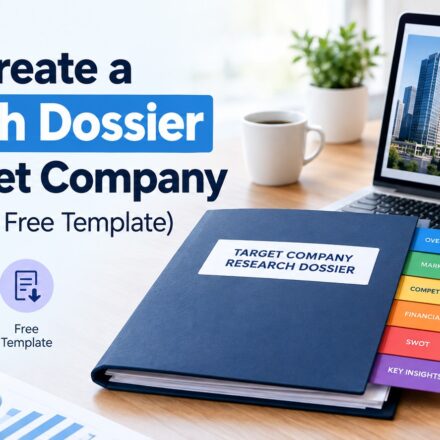
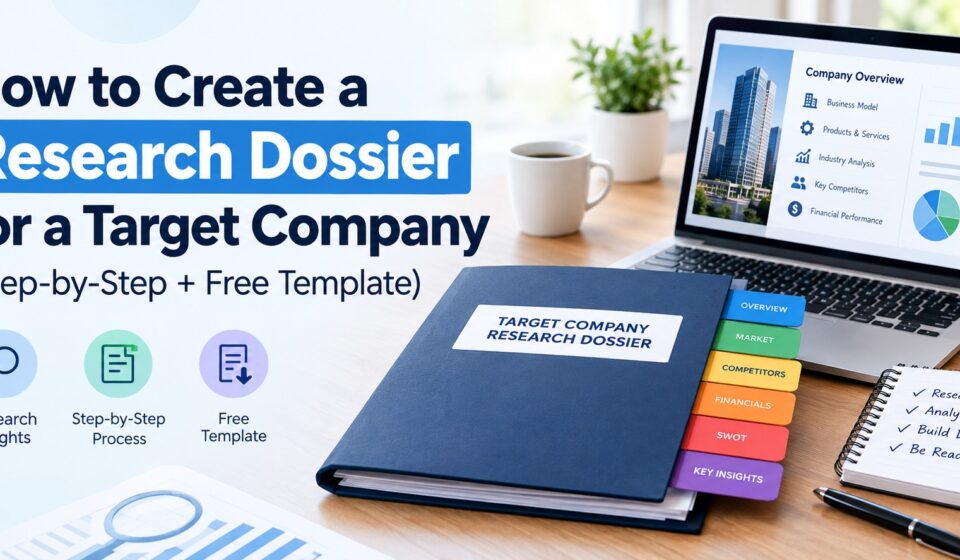

Whether you are preparing for M&A due diligence, evaluating a potential supplier, researching a sales prospect, or analyzing a competitor, a target company research dossier is essential. A well-constructed dossier turns fragmented, raw corporate data into an actionable intelligence report.
While basic web searches yield promotional fluff, a professional company dossier separates verified corporate facts from unvetted marketing claims, highlighting operational risks, executive structures, and financial stability.
Below is a step-by-step framework to create a target company research dossier, complete with recommended research tools and a free copyable dossier template.
What is a Target Company Research Dossier?
A target company research dossier is a structured document that synthesizes operational, financial, legal, and market intelligence about a specific business entity.
Unlike a simple sales brief or executive summary, a research dossier provides a 360-degree evaluation of a company’s past performance, present operations, and future stability. It answers critical strategic questions:
- Who really controls the business? (Corporate structure & ultimate beneficial owners)
- How does the business generate revenue? (Business model & core monetization)
- What are the hidden liabilities? (Legal disputes, regulatory actions, operational risks)
- Where is the business positioned in the market? (Competitor comparison & digital footprint)
The 8-Part Target Company Research Dossier Framework
To conduct thorough intelligence gathering, organize your research into eight core modules:
1. Identity Baseline │ Official legal name, DBAs
2. Ownership & Leadership│ Executives, board, UBOs
3. Products & Services │ Pricing, distribution, value
4. Business Model │ Revenue streams, unit econ.
5. Market Positioning │ Direct/indirect competitors
6. Digital Footprint │ Web traffic, SEO, stack
7. Reputation & Review │ Customer/employee sentiment
8. Legal & Risk Checks │ Regulatory filings, lawsuits
1. Identity Baseline & Corporate Structure
Establish the precise legal identity of the organization before diving into secondary research. Companies frequently operate under trading names (DBAs) that differ from their registered legal entity.
- Primary Details to Document: Legal entity name, place of incorporation, registration/tax numbers, parent company, subsidiaries, active state/national filings.
- Verification Tip: Compare state business registries (e.g., Delaware Division of Corporations, Secretary of State records) or international commercial registries to verify active status.
2. Ownership, Leadership, & Stakeholder Mapping
Analyze who manages the organization and who holds ultimate financial control.
- Key Executive Evaluation: Document current C-suite executives, directors, and major investors. Research executive backgrounds on corporate disclosures, SEC filings, or professional networks to identify past operational exits or legal liabilities.
- Beneficial Ownership: Differentiate between operational directors, minority shareholders, and Ultimate Beneficial Owners (UBOs).
3. Products, Services, & Value Proposition
Examine what the target company delivers to its clients and how those offerings are priced and distributed.
- Core Product Line: Catalog main products or services, key features, and pricing structures.
- Promotional Claims vs. Reality: Distinguish between company marketing claims (e.g., “Industry-leading uptime”) and verifiable metrics (e.g., public status pages, independent SLA reports).
4. Business Model & Financial Stability
Understanding revenue mechanics is critical to evaluating commercial viability.
- For Public Companies: Analyze recent 10-K (annual) and 10-Q (quarterly) filings, balance sheets, debt-to-equity ratios, and cash flow statements via regulatory databases like SEC EDGAR.
- For Private Companies: When primary financial statements are unavailable, cross-reference employee counts, hiring velocity, funding rounds (Crunchbase/PitchBook), government contract awards, and industry benchmarking.
5. Market Position & Competitor Intelligence
A target company cannot be evaluated in isolation. Compare its offerings against direct and indirect competitors using consistent benchmarks:
- Direct Competitors: Companies targeting the exact same customer segment with similar solutions.
- Indirect Competitors: Alternative methods or legacy workflows customers use to solve the same problem.
- Market Differentiation: Evaluate competitive moats (e.g., proprietary IP, cost advantages, switching costs, brand power).
6. Digital Footprint & Tech Stack
A business’s digital presence offers non-obvious signals regarding growth, marketing efficiency, and technology investment.
- Website Traffic & Reach: Measure organic search visibility, traffic channels, and domain authority using tools like Semrush, Ahrefs, or Similarweb.
- Technology Infrastructure: Identify software dependencies, hosting, analytics, and CRM tools using BuiltWith or Wappalyzer.
7. Reputation & Stakeholder Sentiment
Evaluating external sentiment exposes operational friction points before they show up on financial statements.
- Customer Feedback: Review recurring trends on G2, Capterra, Trustpilot, or BBB. Focus on repeating patterns regarding customer support, billing issues, or product bugs.
- Employee Feedback: Monitor sentiment on Glassdoor and Indeed to gauge turnover rates, leadership satisfaction, and internal culture issues.
8. Legal, Regulatory, & Operational Risks
Identify active compliance issues, ongoing litigation, or regulatory hurdles that could impact valuation or partnership safety.
- Litigation History: Search court dockets (e.g., PACER in the United States) for contract disputes, IP infringement, or labor suits.
- Regulatory Compliance: Check industry-specific regulatory bodies (e.g., FTC, OSHA, CFPB, SEC) for enforcement actions or administrative penalties.
Also Read: What Happens to Your TFN Records After You Close a Business
Free Target Company Research Dossier Template
Copy and paste the template below into your word processor or Google Docs to standardise your research process:
[Target Company Name] – Target Company Research Dossier
Date of Research: [YYYY-MM-DD]
Lead Researcher: [Name/Title]
Objective: [M&A Due Diligence / Vendor Assessment / Competitor Analysis / Sales Prospecting]
1. Executive Summary
- Operational Status: [Active / High Growth / Stagnant / Distressed]
- Key Strategic Takeaways: [Top 3 high-level insights]
- Critical Risks / Red Flags: [List top identified operational, legal, or financial vulnerabilities]
- Recommendation: [Proceed / Proceed with Caution / Discontinue]
2. Identity Baseline & Corporate Structure
- Official Legal Name:
- Trading Name(s) / DBAs:
- Website URL:
- Primary HQ Address:
- Entity Type & Jurisdiction:
- Registration / EIN Number:
- Parent Entity / Active Subsidiaries:
3. Ownership & Leadership Profile
- Founders / Owners:
- Executive Team (CEO, CFO, CTO):
- Board of Directors / Key Advisors:
- Primary Investors / Parent Ownership:
4. Products, Services, & Monetization
- Primary Offerings:
- Target Audience / Customer ICP:
- Monetization Model: [SaaS Subscription / Transactional / Licensing / Services]
- Pricing Breakdown:
5. Financial Overview & Market Performance
- Funding History / Total Raised:
- Estimated Annual Revenue:
- Employee Count & Growth Trajectory:
- Direct Competitors:
6. Risk Analysis & Source Confidence
- Legal Disputes / Regulatory Actions:
- Customer / Employee Reputation Red Flags:
- Source Quality Score: [Tier 1 (Official Filings) / Tier 2 (Third-party Data) / Tier 3 (Unverified Statements)]
Verified Tools for Corporate Research
| Research Category | Primary Tools | Recommended Usage |
| Financials & Filings | SEC EDGAR, OpenCorporates, UK Companies House | Retrieve verified corporate registrations, annual filings, and legal ownership. |
| Funding & Valuations | Crunchbase, PitchBook, Dealroom | Track venture funding rounds, investor networks, and estimated company valuations. |
| Digital Traffic & SEO | Semrush, Ahrefs, Similarweb | Analyze web traffic trends, top search keywords, and digital market share. |
| Litigation & Legal | PACER, CourtListener, State SOS | Search federal and state court filings for legal disputes and judgments. |
| Tech Stack Analysis | BuiltWith, Wappalyzer | Detect hosting, software integrations, and web technologies used by the target company. |
Also Read: The Most Important Qualities to Look for When Hiring a Sales Director
Frequently Asked Questions
What is the difference between a company profile and a research dossier?
A company profile is a brief summary focusing on basic business details and marketing overviews. A research dossier is an in-depth intelligence document that cross-verifies company facts against legal records, financial disclosures, competitor metrics, and risk assessments.
How do you gather financial information for private companies?
While private companies are not required to publish public financial statements, you can estimate financial health by cross-referencing corporate filings, employee growth rates on professional networks, venture funding history, government contract disclosures, and press releases verified by reputable business publications.
How often should a target company dossier be updated?
Company details change rapidly due to leadership turns, funding events, legal disputes, and market shifts. For active M&A or high-value partnerships, re-verify critical findings (leadership status, legal filings, domain records) every 30 to 60 days.