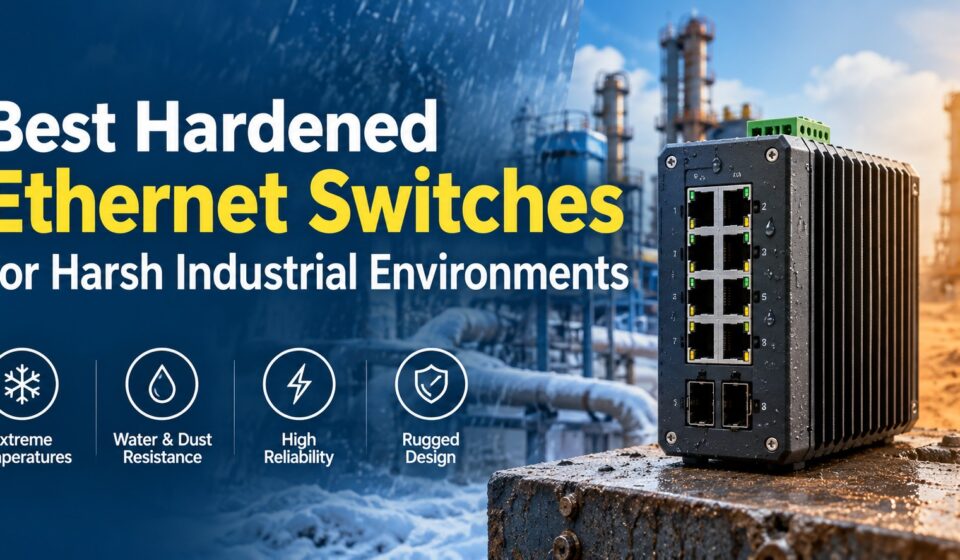

Most network switches spend their lives in climate-controlled server rooms. Plenty of networks don’t have that luxury. A traffic cabinet on a desert highway can bake well past 60°C in summer, a substation yard sits in a cloud of electromagnetic noise, and a switch bolted inside a rail car feels every bump in the track.
Put a standard office switch in any of those places and it will usually fail within months, sometimes within days. Fans clog, power supplies brown out, and solder joints crack under constant vibration.
Hardened Ethernet switches are designed for exactly these conditions. This guide explains what separates a hardened switch from a commercial one, walks through the best types for different deployments, and covers the specifications worth checking before you buy.
What Makes an Ethernet Switch “Hardened”?
“Hardened” is not a marketing word when it is used properly. It describes a set of design choices that let a switch keep forwarding traffic in conditions that would shut down commercial hardware.
The most common features include:
- Extended operating temperature, typically -40°C to +75°C, and sometimes up to +85°C
- Fanless, passive cooling that relies on the metal housing to move heat, so dust and debris have no path inside
- Redundant DC power inputs with a wide voltage range, often 12 to 57 VDC, plus reverse polarity and surge protection
- Rugged metal enclosures with IP30 or higher ingress protection and DIN rail or panel mounting
- High EMI and surge immunity for installations near motors, drives, and high-voltage equipment
- Conformal coating on circuit boards in some models to resist humidity and corrosive air
Certifications tell you which environments a switch has actually been tested for. IEC 61850-3 and IEEE 1613 apply to electrical substations. NEMA TS2 covers traffic control equipment. EN 50121-4 is the benchmark for railway applications, and Class I, Division 2 ratings matter in hazardous locations such as oil and gas facilities.
How to Choose the Right Hardened Ethernet Switch
Start with the environment, not the product catalog. Then work through these factors:
- Temperature range. Measure or estimate the worst-case temperature inside the enclosure, not just the outdoor air. Sealed cabinets in direct sun run much hotter than ambient conditions.
- Power source. Check whether the site provides AC, 24 VDC, 48 VDC, or something else. Dual power inputs are worth the small extra cost for any critical installation.
- Port count and mix. Count current devices, then plan for growth. Decide how many copper, PoE, and fiber ports you need, and whether uplinks require gigabit or 10 gigabit speeds.
- Certifications. Match certifications to the application. A switch for a substation without IEC 61850-3 or IEEE 1613 may not be accepted by the utility, no matter how well it is built.
- Management and security. Decide upfront whether you need remote monitoring, redundancy protocols, and access controls. Retrofitting a managed network later is expensive.
- Lifecycle and support. Industrial networks run for 10 to 15 years or longer. Choose a manufacturer with long product lifecycles, solid warranties, and responsive technical support.
It also helps to standardize on a single product family where you can. The ethernet switches from Comnet, for example, span managed and unmanaged industrial hardened models, PoE switches, commercial grade units, and Layer 3 switches. Working within one family simplifies configuration, spare parts, and training across a large deployment.
Best Hardened Ethernet Switches by Application
There is no single “best” hardened switch. The right choice depends on network size, the devices you are connecting, and how much control you need. These are the main categories and where each one fits.
1. Managed Industrial Hardened Switches
Best for: utilities, intelligent transportation systems, and large surveillance networks
Managed hardened switches are the workhorses of serious industrial networks. They give engineers full control over traffic through VLANs, Quality of Service (QoS), and IGMP snooping, which keeps multicast video streams from flooding the network.
Their biggest advantage is redundancy. Ring protocols such as ERPS (ITU-T G.8032) can reroute traffic in under 50 milliseconds when a fiber is cut or a node fails. For a traffic signal network or a substation, that difference is critical.
Managed models also support security features like 802.1X authentication, SSH, RADIUS, and SNMPv3 monitoring. As industrial networks become targets for cyberattacks, those features are no longer optional for critical infrastructure.
2. Unmanaged Industrial Hardened Switches
Best for: small edge networks, machine-level connections, and simple point installations
Unmanaged hardened switches keep the rugged build quality but drop the configuration layer. You plug them in and they work.
They make sense when you only need to connect a handful of devices, such as a PLC, an HMI, and a camera inside a single cabinet. They cost less and require no networking expertise to deploy.
The tradeoff is visibility. Without management, you cannot monitor port status remotely, segment traffic, or build redundant rings. For anything mission-critical, a managed switch is usually the safer investment.
3. Hardened PoE and PoE+ Switches
Best for: outdoor IP cameras, wireless access points, and remote sensors
Power over Ethernet switches deliver data and power over a single cable, which removes the need for separate power runs to every device. In outdoor deployments, that can save a significant amount on installation costs.
Look at the supported standard first. IEEE 802.3af provides up to 15.4 W per port, 802.3at (PoE+) provides up to 30 W, and 802.3bt (PoE++) reaches up to 90 W per port at the switch. PTZ cameras with heaters and wipers often need PoE+ or higher.
Pay close attention to the total power budget. Many hardened PoE switches reduce available power at high temperatures, so a switch rated for 240 W at room temperature may deliver less inside a hot roadside cabinet.
4. Layer 3 Hardened Switches
Best for: network cores, aggregation points, and large ITS corridors
Layer 3 switches add routing capability, so they can move traffic between VLANs and subnets without a separate router. In large networks with dozens of edge switches, they typically sit at the aggregation layer and handle inter-network traffic efficiently.
They support routing protocols such as static routing, OSPF, and VRRP for gateway redundancy. Highway corridors, campus security systems, and utility wide area networks are common use cases.
5. Fiber-Focused Hardened Switches
Best for: long distances and high-interference environments
Copper Ethernet tops out at 100 meters. Fiber-heavy switches with multiple SFP slots let you link sites that are several kilometers apart, with single-mode fiber reaching 20 km or more depending on the optics.
Fiber is also immune to electromagnetic interference and ground loops, which makes it the preferred medium in substations, rail yards, and heavy manufacturing plants. A switch with a mix of copper ports for local devices and SFP uplinks for backhaul covers most field scenarios.
Common Mistakes to Avoid
Even experienced teams make a few predictable errors when buying hardened switches:
- Putting a commercial switch in a rugged enclosure. A NEMA cabinet keeps rain out, but it also traps heat. The switch inside still needs an extended temperature rating.
- Ignoring PoE derating. Total PoE budget often drops at high temperatures, which can leave cameras underpowered on the hottest days of the year.
- Overlooking cybersecurity. Default passwords and unused open ports are common entry points. Look for switches that support standards such as IEC 62443.
- Mixing redundancy protocols. Combining switches from different vendors can complicate ring configurations. Confirm protocol compatibility before you build.
- Skipping a spares plan. Keep at least one configured spare on hand for critical sites, since lead times on industrial hardware can stretch for weeks.
The same design logic runs through all industrial technology. If you are already specifying rugged computing hardware for field installations, the switch connecting those devices has to meet the same environmental bar. Otherwise, it becomes the weakest point in an otherwise durable system.
Final Thoughts
The best hardened Ethernet switch is the one that matches the real conditions of the site it serves. Temperature, power, vibration, interference, and the devices you need to connect should drive every decision.
Managed switches suit critical infrastructure, unmanaged models handle simple edge connections, PoE switches power outdoor devices, and Layer 3 and fiber-focused units hold large networks together. Choose with the full lifecycle in mind, and your network will keep running long after a commercial switch would have failed.