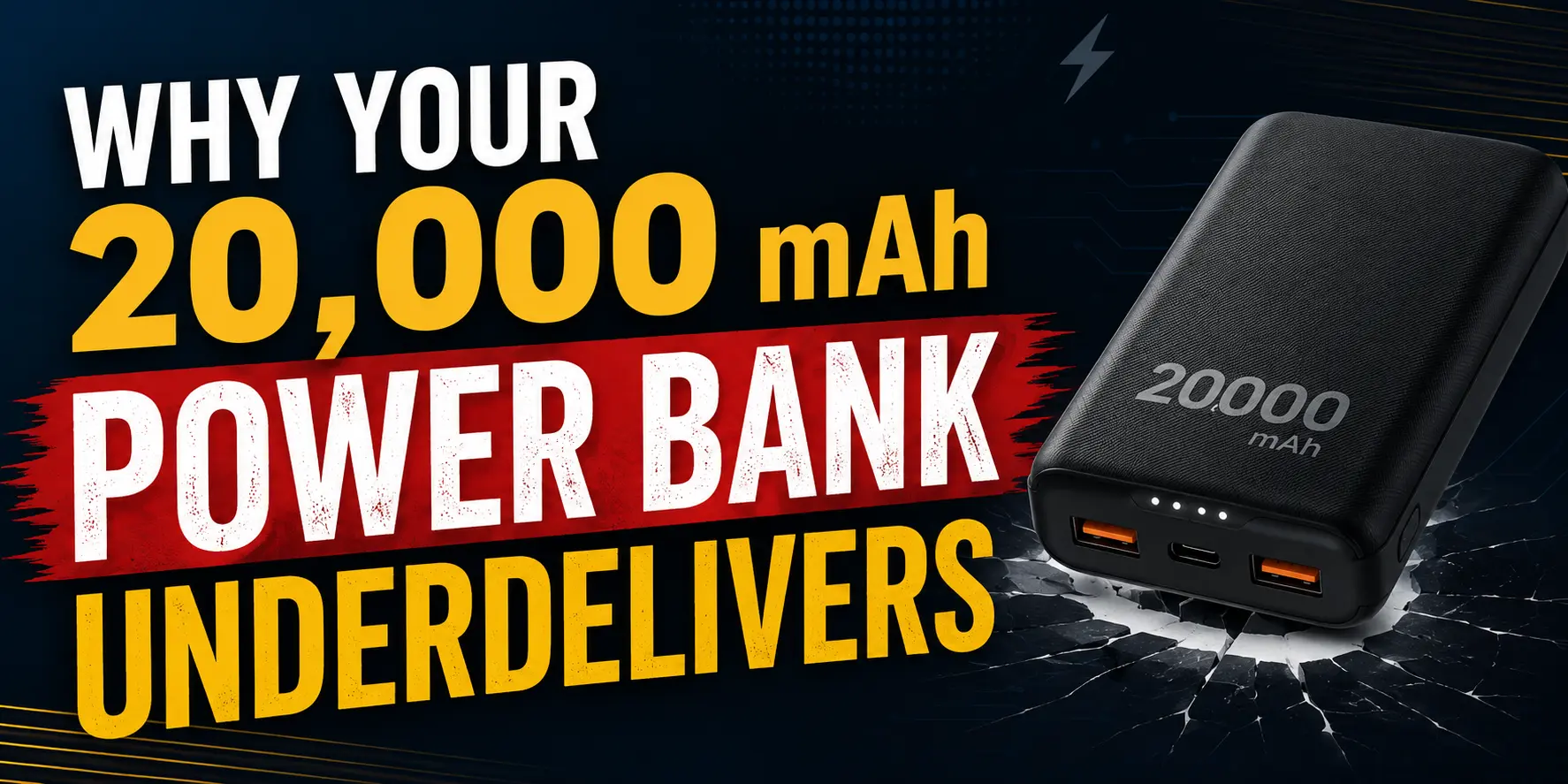

Portable power banks are far more complex than their specifications suggest. A charger labeled 20,000 milliamp-hours (mAh) often delivers only two full phone charges rather than the expected four.
Aviation safety rules have also grown increasingly strict. Most airlines now regulate how passengers transport these devices, and several prohibit recharging them in the cabin. Understanding the underlying technical math and regional flight restrictions before you travel prevents unexpected losses at security checkpoints. Travelers must calculate real-world battery capacities, verify whether a device meets security limits, and weigh the physical trade-offs of larger chargers. A close look at these variables ensures your devices remain powered and compliant throughout your trip.
The Real Math: How Many Charges Do You Actually Get?
The rated capacity advertised on a retail box rarely reflects the actual energy delivered to a device. The discrepancy between theoretical and real-world capacity is significant.
Most power banks utilize internal lithium-ion cells rated at 3.7 volts. Modern smartphones charge via USB at a minimum of 5 volts. The power bank must therefore step up the voltage using an internal boost converter. This conversion process generates heat, causing substantial energy loss.
Factoring in cable resistance and the thermal inefficiencies of fast charging, only 60 to 70 percent of a power bank’s rated capacity reaches the target battery.
Real-World Capacity Projections
- 10,000 mAh: A 10,000 mAh charger delivers roughly 6,000 to 6,500 mAh of usable power. This capacity charges a standard 4,500 to 5,000 mAh smartphone battery approximately 1.5 times, falling short of the multiple charges promised by retail marketing.
- 20,000 mAh: A 20,000 mAh model yields just under three full charges, varying by the capacity of the connected device.
A 10,000 mAh model typically satisfies daily requirements on short trips. When paired with overnight hotel charging, this capacity serves as a reliable emergency backup during extended daytime excursions.
Technical note on manufacturing quality: Two devices with identical 10,000 mAh ratings can exhibit vastly different performance levels. Budget models often utilize low-grade voltage converters that drag efficiency down to 55 percent, whereas premium brands maintain rates closer to 70 percent. Substandard, thin cables compound these losses by dissipating energy as heat, which ultimately slows down the charging process.
Also Read: Gemini AI Photo Prompt Copy Paste: 60+ Prompts That Actually Work
Airline Limits: Will Your Charger Clear Security?
International aviation safety standards restrict portable chargers based on their watt-hour (Wh) ratings.
- Under 100 Wh: Permitted in cabin baggage without carrier approval.
- 100 to 160 Wh: Requires advance airline authorization, often restricted to a maximum of two spare batteries. Passengers must declare these high-capacity devices during check-in.
- Over 160 Wh: Prohibited on passenger aircraft under all circumstances.
The crucial 100 Wh threshold equates to approximately 27,027 mAh when calculated at the standard nominal cell voltage of 3.7 volts. Standard 10,000 mAh (37 Wh) and 20,000 mAh (74 Wh) models sit safely below this threshold. In contrast, heavy-duty power banks designed for laptops, often rated at 27,000 mAh or higher, frequently border on the legal limit.
Airport security personnel inspect physical labels closely during screenings. If the manufacturer specifications printed on the casing are worn or illegible, security agents may confiscate the device regardless of its physical size.
Can You Use and Charge a Power Bank in the Air?
The baseline international directive remains firm: all portable external batteries must be carried exclusively within the aircraft cabin. Lithium batteries are universally banned from checked luggage because cargo hold fires are exceptionally difficult to suppress. In-cabin transport ensures that if a battery enters thermal runaway, flight crews can intervene immediately.
Global safety protocols have tightened further following severe cabin incidents. On January 28, 2025, a lithium-ion battery short-circuited inside an overhead bin aboard Air Busan Flight 391. Although the aircraft was on the ground and all passengers evacuated, the resulting blaze injured seven people and caused structural damage severe enough to write off the Airbus A321.
These risks have prompted carriers to implement targeted safety updates:
- Recharging Bans: Passengers are prohibited from recharging the power bank itself using the aircraft electrical systems. Major carriers increasingly forbid plugging portable batteries into in-seat USB ports or power outlets.
- In-Flight Phone Charging: While passengers can use external batteries to power personal electronics, these devices must remain unplugged during taxi, takeoff, and landing, even if there’s not enough power for playing games at the ethereum casinos canada or just watching videos from your vacation.
- Cabin Storage Rules: Some airlines, such as Emirates, require these devices to be kept in a seat-back pocket or under-seat personal bag rather than in overhead bins. This placement ensures immediate detection if a battery begins to overheat.
- Device Quantity Limits: Standard international guidelines restrict passengers to two power banks. However, strict carriers like Emirates limit individuals to a single power bank.
Because carrier protocols remain fluid, travelers should review specific airline rules before departure.
Finding the Right Balance: Weight vs. Capacity
Physical weight scales directly with energy capacity.
- A standard 10,000 mAh charger weighs between 180 and 250 grams, roughly matching the footprint of a modern smartphone.
- By contrast, a 20,000 mAh unit ranges from 350 to 500 grams. Premium high-output versions featuring built-in diagnostic screens often exceed half a kilogram.
While a few hundred grams may seem negligible, the added load becomes noticeable during extended transit. If a 10,000 mAh model satisfies daily demands, avoiding heavier alternatives prevents unnecessary physical fatigue. Reserve high-capacity bricks for itineraries requiring laptop, tablet, or professional camera support.
Pre-Flight Preparation Guide
- Complete Home Charging: Because on-board recharging is prohibited and airport gate outlets are often unavailable, ensure the power bank is fully charged before departure.
- Inspect Regulatory Labels: Confirm that the manufacturer-printed watt-hour (Wh) rating on the device shell remains entirely legible.
- Secure Carry-On Placement: Store the charger in an easily accessible compartment within cabin baggage to facilitate quick security inspection.
- Review Interline Policies: When booking multi-airline itineraries with layovers, verify compliance parameters for each operating carrier. Safety restrictions are not universally standardized, and a device cleared by one airline may be flagged by another.