
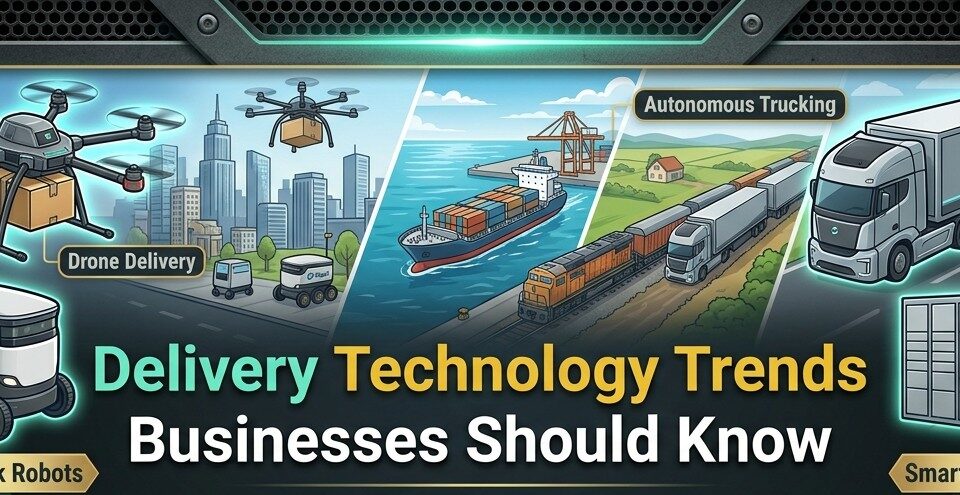

Delivery operations are becoming increasingly data-driven. Businesses can now automate route planning, predict arrival times, track vehicles in real time, capture delivery evidence digitally, and identify problems before they disrupt an entire route.
The important shift is not simply toward more software. Delivery technology is becoming more connected. Routing, warehouse systems, mobile devices, vehicle data, customer communication, and analytics increasingly work from the same operational information.
Here are the delivery technology trends businesses should understand when planning their next stage of growth.
1. Automated Delivery Management
Delivery teams are moving away from spreadsheets, printed route sheets, and manually assigned stops.
Modern software for delivery management can centralize orders, routes, driver assignments, delivery status, and customer information. Instead of moving data between several disconnected tools, dispatchers can manage more of the delivery workflow from one system.
Automation is particularly valuable as order volume increases. Repetitive tasks such as assigning stops, updating delivery status, and sending notifications should not require the same amount of administrative work for every additional order.
2. Dynamic Route Optimization
Traditional route planning creates a route before the driver leaves and assumes the plan will remain valid.
That approach struggles when traffic, cancellations, urgent orders, or long service times change the schedule.
Dynamic routing systems can recalculate stop sequences when operating conditions change. Rather than asking a dispatcher to rebuild an entire route manually, software can evaluate how a disruption affects the remaining stops.
Effective Routing Systems Consider
- Delivery windows
- Vehicle capacity
- Driver schedules
- Stop priority
- Service time
- Pickup dependencies
- Route distance
- Current route progress
The objective is no longer simply finding the shortest distance. Businesses need routes that remain practical throughout the working day.
3. Predictive Delivery Times
A static four-hour delivery window provides limited value to customers.
Predictive estimated arrival times use live route progress and operational data to produce more accurate arrival estimates. As the driver completes stops, the ETA can be updated automatically.
Better estimates also help operations teams.
If the system predicts that a driver will miss several later delivery windows, dispatch can intervene before those stops officially become late.
Historical data improves this process further. If deliveries to office towers regularly require 12 minutes rather than the five minutes originally allocated, future route plans can use a more realistic service-time assumption.
4. Real-Time Fleet Visibility
GPS tracking is becoming a basic part of professional delivery operations.
Managers can see vehicle locations, route progress, stop completion, and delays without repeatedly calling drivers.
The real benefit is exception detection.
A vehicle sitting at one location for 25 minutes may indicate a difficult delivery, mechanical problem, or loading issue. A major route deviation might indicate congestion or an incorrect address.
Real-time visibility allows dispatchers to investigate while there is still time to adjust the schedule.
5. AI-Assisted Delivery Planning
Artificial intelligence is increasingly being applied to forecasting and operational decision-making.
Delivery systems can analyze historical orders, route duration, service time, traffic patterns, seasonal demand, and failed delivery data to identify patterns that are difficult to spot manually.
A retailer might learn that a particular area consistently produces more orders on Friday evenings. A delivery company might discover that certain routes need additional time during particular months.
AI does not eliminate the need for dispatchers. It gives them better information for planning capacity and identifying unusual conditions.
6. Computer Vision in Fulfillment
Some delivery delays begin inside the warehouse.
A package may be placed in the wrong staging area, loaded onto the wrong vehicle, mislabeled, or damaged before dispatch.
Computer vision systems can support automated checks at packing and loading points. Cameras paired with image-recognition software can identify labels, packages, objects, or visible defects depending on the application.
The value comes from catching mistakes before departure.
Correcting a loading error inside the facility may take minutes. Discovering the same error when a driver reaches the customer can require an entire second delivery attempt.
7. Digital Proof of Delivery
Paper signatures are being replaced by more detailed digital records.
Delivery applications can record completion time, GPS location, photographs, signatures, recipient information, and driver notes.
Proof-of-Delivery Data Can Include
- Delivery timestamp
- GPS coordinates
- Recipient name
- Electronic signature
- Package photograph
- Driver comments
- Failed-attempt reason
These records help customer service teams investigate disputes without relying only on driver memory.
They also create data for operational analysis. Frequent failed deliveries at apartment buildings, for example, may indicate that access instructions need improvement.
8. Automated Customer Communication
Delivery communication is becoming event-driven.
Instead of an employee manually sending updates, systems can automatically notify customers when an order is scheduled, dispatched, delayed, approaching, or completed.
This can reduce inbound “Where is my order?” requests.
More importantly, communication can improve delivery success.
Customers who receive an accurate arrival notification have more opportunity to provide access, arrange for someone to receive the package, or update instructions before the driver arrives.
9. Connected Warehouse and Delivery Systems
Warehouse operations and delivery management are becoming more tightly integrated.
An order should not enter an active delivery route if it has not been picked and packed.
Connected systems can pass fulfillment status into the dispatch platform so routes are built around orders that are genuinely ready to leave.
Delivery assignments can also inform warehouse staging.
Instead of organizing packages only by order number, teams can stage them by vehicle, route, or stop sequence. That reduces the amount of sorting drivers need to perform before departure.
10. Vehicle Telematics and Predictive Maintenance
Fleet technology is expanding beyond basic GPS location.
Connected vehicles can provide information about mileage, fuel consumption, engine conditions, battery status, fault codes, and maintenance intervals depending on available hardware.
This data can support preventive maintenance.
If vehicles are serviced according to actual use and condition rather than relying only on fixed calendar intervals, fleet managers can address developing issues before they cause a breakdown during a route.
For delivery businesses, preventing one unexpected vehicle failure can protect dozens of scheduled stops.
11. Driver Technology Is Becoming More Practical
Delivery technology has to work outside an office.
Drivers may spend hours entering and exiting vehicles, scanning packages, checking mobile devices, walking between buildings, and working in changing weather conditions.
That means mobile hardware and everyday equipment need to support movement rather than interfere with it. Rugged phones, vehicle mounts, portable chargers, wearable scanners, and clothing with practical storage can all affect how easily employees use technology in the field.
For roles that involve a combination of driving, outdoor work, and equipment carrying, workwear such as tactical jeans can provide a casual format while adding stretch, reinforced construction, and additional storage options. Those details may be useful when drivers need regular access to phones or other compact work items.
Technology adoption often fails when the system looks efficient at a desk but creates unnecessary friction for the person completing the delivery.
12. Delivery Analytics Are Getting More Detailed
Businesses are also moving beyond simple measures such as total deliveries per day.
Operational systems can calculate performance at the route, driver, vehicle, and stop level.
Useful measures include cost per delivery, miles per stop, first-attempt success rate, on-time percentage, average service time, departure variance, and route completion time.
The most useful comparison is often planned versus actual performance.
If the same route repeatedly takes 20 percent longer than predicted, management can investigate whether the cause is traffic, poor address data, unrealistic service times, or warehouse delays.
Also Read: Sheppard Software: The Complete 2026 Guide to Its Games, Subjects & Safety
Build Around Connected Delivery Data
The next phase of delivery technology is not about adopting every new tool.
It is about connecting the systems that control orders, warehouses, routes, vehicles, drivers, customers, and performance data.
Automated routing can reduce planning work. Predictive ETAs can identify delays early. Computer vision can catch fulfillment mistakes. Telematics can improve vehicle reliability. Digital proof of delivery can create a stronger operational record.
Businesses should start with the areas producing the most manual work or recurring delays.
When technology removes those bottlenecks and feeds accurate data back into the operation, delivery teams can handle more volume without adding complexity at the same rate.