
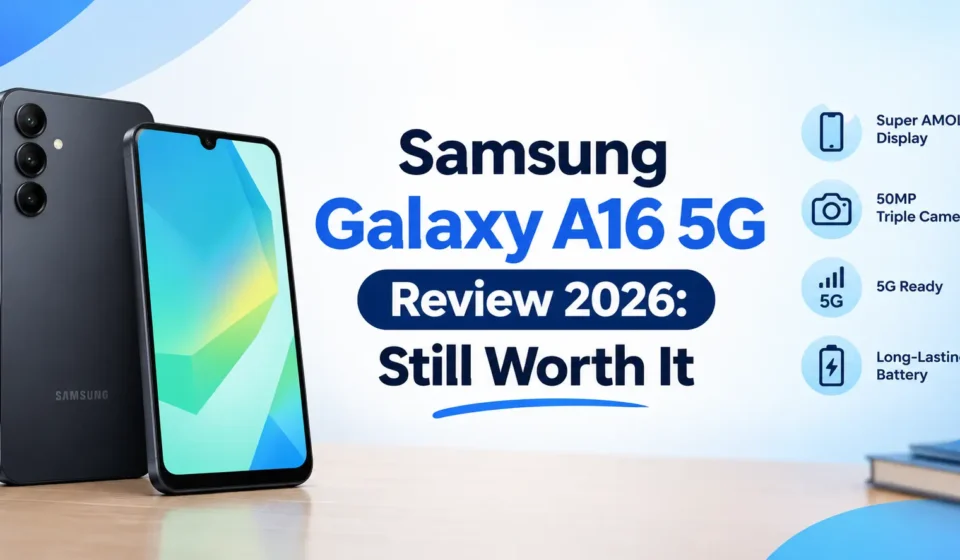
Samsung Galaxy A16 5G review: two years on, is it still the budget phone to buy?

Samsung’s cheapest 5G Galaxy became the best-selling Android phone in the world in 2025. That is not marketing spin, it is Counterpoint Research’s sales tracking. So the question in late 2026 is no longer “is this a good phone at launch.” Millions of people already own one, the phone has taken three major Android upgrades since it shipped, and Samsung has already replaced it with the Galaxy A17 5G.
This review is written from that vantage point. What has the A16 5G actually been like to live with? What broke, what got better, and does it still make sense at a street price now hovering around $140?
Short answer: the display and the update policy are still genuinely excellent for the money. The 4GB of RAM in the US model is a real problem that gets worse, not better, as Android grows. Whether you should buy one comes down almost entirely to which version you can get and how much you pay.
The short version
Buy it if: you want an AMOLED screen and long security support for under $150, you use maybe six or seven apps, and you would rather have a phone that stays patched until 2030 than one that feels quick today.
Skip it if: you keep a dozen apps open, you shoot a lot of photos in low light, you play anything more demanding than Candy Crush, or you can find the Moto G (2026) for the same money.
What’s good
- 6.7-inch Super AMOLED at 90Hz, which almost nothing else at this price offers
- Six OS upgrades and six years of security patches, and Samsung has actually delivered on that so far
- Roughly 13 to 14 hours of screen-on video playback from the 5,000mAh cell
- IP54 splash resistance, eSIM support, microSD expansion up to 1.5TB
- Daylight photos from the 50MP main sensor punch above the price
What’s not
- The US model ships with 4GB of RAM, and it shows constantly
- No headphone jack, no wireless charging, no charger in the box
- Wi-Fi 5 only, which is dated in 2026
- Ultrawide and macro cameras are close to filler
- Single bottom-firing speaker with essentially no bass
What has changed since launch
Most reviews of this phone were written in late 2024 or early 2025 and describe a device running Android 14. That phone no longer exists. Here is the actual update record for the US 5G model, SM-A166U:
| Update | Android version | US rollout |
|---|---|---|
| One UI 6.1 | Android 14 | Shipped on the device, October 2024 |
| One UI 7.0 | Android 15 | June 2025 |
| One UI 8.0 | Android 16 | Late October 2025 |
| One UI 8.5 | Android 16 | June 2026 |
Three major upgrades delivered in under two years, on a phone that cost $199. That is the single strongest argument for buying one, and it is the thing spec sheets do not capture.
Two caveats worth knowing before you get excited.
Samsung puts this phone on a quarterly security patch schedule, not monthly. The One UI 8.5 build that reached US carrier units in June 2026 carried the April 2026 patch level. You are covered, but you are usually a couple of months behind the flagships.
And the upgrades have not been painless. Owners reported new lag and battery drain in the days after both the One UI 8.0 and 8.5 rollouts. Some of that is the normal post-update reindexing that settles within a week. Some of it is a 4GB phone being asked to run software designed with 8GB devices in mind. More on that below, because it is the defining issue with this handset.
Which Galaxy A16 5G you actually get matters more than any review score
This is the part almost nobody covers, and it changes the answer completely.
Samsung sells at least two meaningfully different phones under the Galaxy A16 5G name:
- The US model (SM-A166U): Exynos 1330, 4GB RAM, 128GB storage. This is what you get from T-Mobile, Verizon, AT&T, Boost, Metro, Cricket, and most US unlocked listings.
- International models (SM-A166P and variants): either the Exynos 1330 or a MediaTek Dimensity 6300, and configurations that run to 6GB or 8GB of RAM and 256GB of storage.
An 8GB Dimensity A16 and a 4GB Exynos A16 are not the same product, and reading a glowing review of one before buying the other is how people end up disappointed. If you are shopping in the US, assume 4GB unless the listing explicitly says otherwise. If you are buying an imported or international unit, check the model number on the box.
Performance: the honest problem
The Exynos 1330 is not the villain here. It handles messaging, email, browsing, YouTube, Maps, banking apps, and social media without falling over. Published Geekbench 6 results for the phone cluster around 880 single-core and 2,000 multi-core, which is normal for the class and a real step up from the Galaxy A15 it replaced.
The problem is memory. With 4GB, One UI and its background services consume most of what is available before you open anything. What that feels like in practice:
- A half-second pause after you unlock before the home screen responds
- Apps reloading from scratch when you switch back to them, so you lose your place in a feed or a form
- The camera taking a beat to open, and another beat between shots
- Stutter when scrolling long lists in Chrome or Instagram
Every individual app works. The phone just feels a step behind you, all day. Samsung’s own community forums are full of A16 owners describing exactly this, including people who bought units brand new in 2026.
Three settings that measurably help:
- Turn RAM Plus off. Settings > Battery and device care > Memory > RAM Plus. Virtual memory on slow storage often makes swapping worse, not better, on this class of hardware. A lot of A15 and A16 owners report the phone feeling noticeably smoother with it disabled.
- Cut animation scale to 0.5x. Enable Developer options (tap Build number seven times in Settings > About phone), then set Window, Transition, and Animator duration scale to 0.5x. It does not make the phone faster, but it removes a lot of the perceived delay.
- Put unused apps in Deep sleep. Battery and device care > Battery > Background usage limits. Fewer background processes means fewer app reloads.
Gaming is a firm no beyond casual titles. On GFXBench Aztec Ruins the A16 lands around 5 to 6fps, in the same territory as its predecessor. Genshin Impact runs at low settings and looks it. Treat this as a phone for everything except games.
Display: the reason to buy it
A 6.7-inch Super AMOLED at 2,340 by 1,080 with a 90Hz refresh rate, peaking around 800 nits. At $140, that is close to unbeatable. Blacks are properly black, colours are saturated in the way Samsung panels always are, and 90Hz makes scrolling feel better than the chipset deserves.
The limitation is outdoors. In direct summer sun the adaptive brightness cannot keep up, and the glossy finish throws a lot of glare. You will find yourself cupping a hand over it. There is also no HDR support, so streaming apps serve you the standard dynamic range version.
Bezels are thick and the chin is thicker. At this price, that is a fair trade for the panel you get.
Battery: comfortably a full day, often more
The 5,000mAh cell is the least controversial part of the phone. In looping HD video tests it lands in the 13 to 14 hour range. In ordinary mixed use, light users get close to two days; heavier users end the day somewhere around 30 percent.
Charging is 25W wired, and Samsung does not include a brick. From empty you are looking at roughly 40 percent in half an hour and a full charge in about an hour and a half. No wireless charging.
Worth noting for anyone comparing: the Moto G (2026) beats it here, both on capacity and on 30W charging.
Cameras: good main sensor, filler around it
The 50MP f/1.8 main camera is the only one that matters. In daylight it produces sharp, punchy images with Samsung’s usual habit of pushing saturation and lifting shadows. Photos look good on the phone’s own AMOLED, which is largely the point at this price. Default output is 12MP pixel-binned; the full 50MP mode works but adds a few seconds of processing between shots.
At night the main camera holds together better than you would expect, though detail goes soft and colours turn muddy.
The 5MP ultrawide is usable in bright light and falls apart everywhere else. The 2MP macro is the sort of sensor that exists so the box can say “triple camera.” The 13MP selfie camera is solid, though portrait mode cuts hair edges aggressively.
Video tops out at 1080p30 with no optical stabilisation, so handheld walking footage wobbles. Locked down on a tripod or a fence post, it is fine.
If camera quality is your priority, this is the clearest reason to look at the Galaxy A17 5G instead. Samsung added OIS to the main sensor on the A17, which is the one upgrade in that generation that genuinely changes results.
Design, build, and what’s missing
Plastic frame, plastic back that Samsung markets as “Glastic,” 6.47 by 3.07 by 0.31 inches, and roughly 7 ounces. It is a big, light, unremarkable slab. The side-mounted fingerprint reader in the power button is fast and reliable, which is not always true at this price.
IP54 means it survives rain and spills. It does not mean the pool.
Missing: the 3.5mm headphone jack, which earlier A-series budget phones had. Wireless charging. Wi-Fi 6 (this is Wi-Fi 5). A second speaker. Galaxy AI, which Samsung restricts to pricier lines, though the Gemini integration that arrived with One UI 7 covers a lot of the same ground.
Present and often overlooked: eSIM support, which the A15 lacked, plus a microSD slot that takes cards up to 1.5TB. For a cheap travel or backup phone, that combination is genuinely useful.
Six years of updates: what it actually means
Samsung promised six OS upgrades and six years of security patches on the A16 5G, the first time an entry-level Galaxy got that treatment. Starting from Android 14, that path runs to roughly Android 20, somewhere around 2030.
The company has kept pace so far. But be realistic about what a 4GB phone running Android 20 will feel like. Security patches are the durable benefit here, and they are the part that matters if you bank on this phone. Feature upgrades on ageing budget hardware are a mixed blessing, as the post-update lag reports show.
Put differently: buy this for six years of patches, not six years of snappiness.
Galaxy A16 5G vs Galaxy A17 5G vs Moto G (2026)
| Galaxy A16 5G | Galaxy A17 5G | Moto G (2026) | |
|---|---|---|---|
| Street price | ~$140 | ~$170 to $200 | ~$199 |
| Display | 6.7″ AMOLED, 90Hz | 6.7″ AMOLED, 90Hz | 6.7″ LCD, 120Hz |
| Chip (US) | Exynos 1330 | Exynos 1330 | Dimensity 6300 |
| RAM (US) | 4GB | 4GB | 8GB |
| Main camera | 50MP, no OIS | 50MP with OIS | 50MP |
| Battery | 5,000mAh, 25W | 5,000mAh, 25W | 5,200mAh, 30W |
| Front glass | Standard | Gorilla Glass Victus | Standard |
| OS support | 6 upgrades from Android 14 | 6 upgrades from Android 16 | 2 OS upgrades |
Against the A17: the A17 adds OIS, Victus glass on the front, and a support window that runs two years longer. It keeps the same Exynos 1330 and the same 4GB in the US, so it does not fix the lag. If both cost about the same, buy the A17. If you already own an A16, there is no reason to upgrade.
Against the Moto G (2026): Motorola gives you double the RAM, a bigger battery, faster charging, 120Hz, and near-stock Android. Tom’s Guide measured over 19 hours in their battery test, the longest they have recorded for a budget phone. Samsung gives you a far better panel and four extra years of patches. Pick based on which of those you care about. If you want the phone that feels quickest out of the box, it is the Moto.
What it costs now
MSRP is still listed at $199.99, and you should not pay it. Realistic pricing in September 2026:
- New unlocked: $130 to $170 depending on retailer and sale
- Carrier promotions: frequently free on a line activation at T-Mobile, Metro, Boost, and Cricket
- Used and refurbished: clean units turn up on Swappa in the $60 to $90 range
At $60 to $90 used, this phone is a straightforward recommendation as a backup, a travel handset, or a first phone for a kid. At $199 new it is not, because the A17 exists at the same price with a better camera and a longer support runway.
Verdict
The Galaxy A16 5G earned its sales record honestly. Samsung put a proper AMOLED panel and an unheard-of support commitment into a $199 phone, and then actually shipped three Android upgrades to it. Nobody else in this bracket does both of those things.
It also shipped 4GB of RAM in the United States, and every month that Android gets heavier, that decision looks worse. The phone you buy today will spend the next four years feeling slightly slower than it did the day before.
So: excellent value at $140 or less, and an easy pick at used prices. At full retail, buy the A17 5G instead. And if the thing that annoys you most about cheap phones is waiting for them to catch up with your thumb, spend the same money on a Moto G and give up the AMOLED.
Also Read: Altia Systems PanaCast 2 Review (2026): Is This 2018-Era Camera Still Worth Buying?
Frequently asked questions
Is the Samsung Galaxy A16 5G still good in 2026?
For light use, yes. The AMOLED display, battery life, and ongoing security updates hold up. The 4GB of RAM in the US version means it feels sluggish under any real multitasking, and that will not improve.
Why is my Galaxy A16 5G so slow?
Almost always memory pressure from 4GB of RAM. Turning off RAM Plus, reducing animation scale to 0.5x in Developer options, and limiting background app activity all help. If it started right after a One UI update, give it about a week to finish reoptimising before assuming something is wrong.
How long will the Galaxy A16 5G get updates?
Samsung committed to six OS upgrades and six years of security updates from its October 2024 launch, which points to roughly 2030. It has already received Android 15, Android 16 with One UI 8.0, and One UI 8.5. Security patches arrive quarterly rather than monthly.
Does the Galaxy A16 5G have a headphone jack?
No. Samsung dropped it from this generation. Use USB-C or Bluetooth.
Is the Galaxy A16 5G waterproof?
It is rated IP54, which covers dust and splashes. It is not rated for submersion, so keep it out of the pool.
Galaxy A16 5G or Galaxy A17 5G?
Buy the A17 if the prices are close. It adds optical image stabilisation, Gorilla Glass Victus, and a support window that runs two years further out. Buy the A16 only if it is meaningfully cheaper. Do not upgrade from an A16 to an A17.
Can the Galaxy A16 5G play games?
Casual games run fine. Demanding 3D titles do not. Aztec Ruins scores in the 5 to 6fps range, so anything like Genshin Impact will be a compromise at best.
Does it support eSIM?
Yes, one physical SIM plus one eSIM. That is an upgrade over the Galaxy A15, and it makes the phone a decent travel option.










[…] Also Read: Samsung Galaxy A16 5G review: two years on, is it still the budget phone to buy? […]