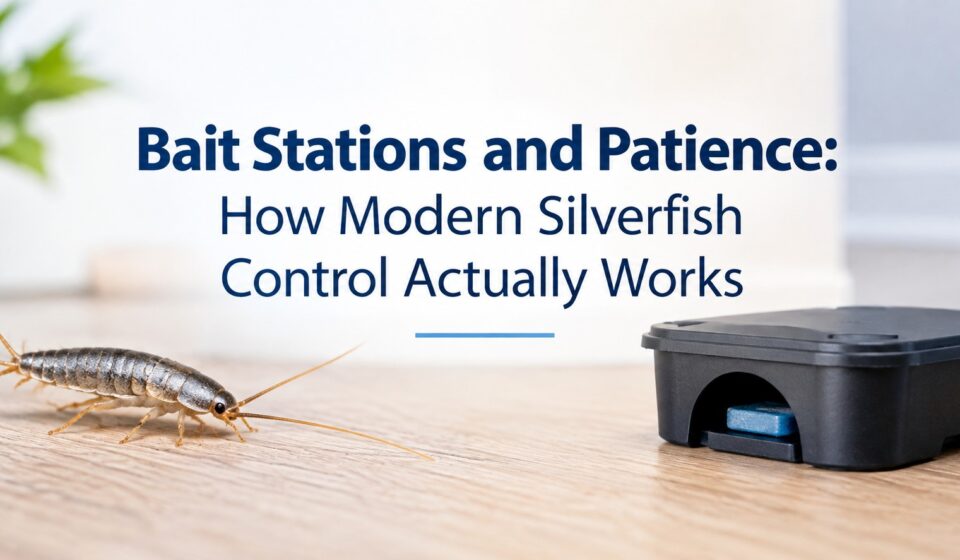

The instinctive response to finding insects indoors is to spray something. With long tailed silverfish, that instinct is not just ineffective but often counterproductive. Understanding why has shaped a control method that looks almost disappointingly simple: small bait stations, placed thoughtfully, and left alone for months.
Contact insecticides fail for structural reasons. The insects spend the overwhelming majority of their time hidden in wall cavities, beneath flooring, and inside fitted furniture, emerging only briefly and unpredictably. Spraying visible surfaces kills the few individuals encountered while leaving the hidden population untouched. Worse, strong repellent products can drive insects deeper into a building and into neighbouring rooms or apartments.
Baiting inverts the logic. Instead of chasing insects, it uses their own foraging behaviour to deliver a slow acting insecticide into the hidden population. Modern gel or granule baits containing active ingredients such as indoxacarb are consumed by foraging individuals, which then die within the harbourage. The delay is deliberate, since a bait that killed too quickly would never be transported back into the cavities where most of the population lives.
Placement determines the outcome far more than quantity does. Stations belong along the base of walls, in corners, behind and beneath kitchen units, near bathroom fixtures, close to bookshelves, and in storage areas. Insects travel along edges rather than across open floors, so a station placed in the middle of a room contributes almost nothing regardless of how much bait it holds.
Timeframes need to be understood before starting. Because these insects reproduce slowly and live for years, a properly executed programme typically runs six to twelve months, sometimes longer in larger or heavily infested properties. Activity often declines noticeably within a few months, but eggs already laid will still hatch, and stations must remain in place through that period. Guidance on skjeggkre bekjempelse consistently emphasises that removing bait too early is the most common reason a treatment fails.
Monitoring turns guesswork into evidence. Sticky traps placed in consistent locations and checked at regular intervals produce a simple count that reveals whether numbers are falling. Without that record, homeowners rely on impressions, and a single sighting after several quiet weeks can prompt an unnecessary change of approach when the underlying trend is actually good.
Pets and small children need to be considered when placing stations. Bait should be positioned in enclosed or inaccessible locations such as behind kick boards, inside cupboards, and beneath fitted units rather than left in the open, and product instructions on placement should be followed rather than treated as suggestions.
Expectations about the end point are worth setting honestly. The realistic goal is a population reduced to the point where sightings cease and traps stay empty over a sustained period, not a guaranteed absence of every individual in a building. Keeping a small number of monitoring traps in place afterwards is a low effort way to confirm the result has held.
Also Read: Why More Businesses Are Moving Call Handling to AI
Supporting measures help without replacing the bait. Reducing cardboard storage, sealing gaps around pipes and skirting, vacuuming edges and cracks regularly, and keeping humidity moderate all reduce harbourage and food. In shared buildings, coordinating treatment across adjoining units matters enormously, because a thoroughly treated apartment surrounded by untreated neighbours is simply waiting to be recolonised.