
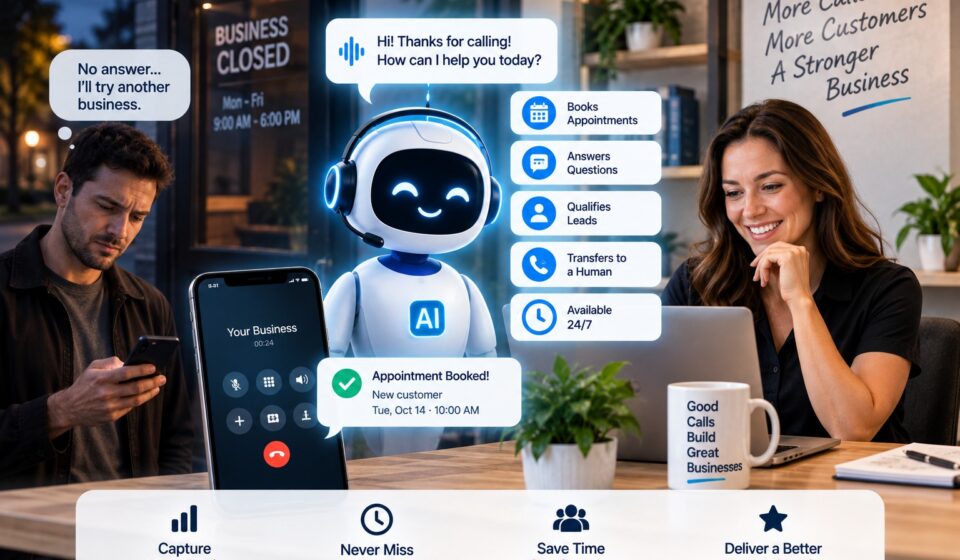

A customer calls a business at 6:40 in the evening. No one picks up, because the office closed at six. The caller does not leave a message. They tap back to the search results and dial the next company on the list. That second business just won a customer without doing anything except answering the phone.
That scene repeats across every industry that still runs on inbound calls, and a growing number of owners are responding by handing the phone to software. Some route after-hours calls to a service. Others put an AI receptionist for a business on the line for every call that comes in. The shift is not about novelty. It is about the math of a missed call, and about what voice technology can now do once someone dials your number.
TL;DR: Businesses are moving call handling to AI for three practical reasons: missed calls cost more revenue than owners realize, human coverage is expensive and limited to office hours, and voice software can now book, qualify, and route on the call itself. It works best on routine, high-volume calls. People still belong on the complex and sensitive ones.
What moving call handling to AI actually means
Call handling by AI does not mean the old phone tree that asks you to press one for sales. It also does not mean a voicemail box with a friendlier greeting. It means a conversational voice system answers the call, understands what the caller wants in plain language, and takes action before the call ends.
The difference is what happens after “hello.” A menu routes you and then waits. An answering machine records you and then waits. A modern voice agent holds a back-and-forth conversation, checks a calendar or a set of business information, and finishes the task the caller called about. That might be booking an appointment, answering a pricing question, or passing an urgent caller to a person.
That capability is recent. Speech recognition, language models, and phone systems have improved enough that a caller can often complete their request without realizing a human was never involved. Whether that is a good experience depends heavily on how the system is set up, which is a point worth returning to.
Why businesses are making the shift now
The clearest reason is that a missed call is rarely a paused transaction. It is usually a lost one. In a 2025 CallRail survey of 1,000 US consumers, 82% said they would call a competitor after a call went unanswered, and only 42% said they would leave a voicemail at all. A caller with a live need does not wait for a callback when the next option is one tap away.
Voicemail is not the safety net it used to be. Most callers who reach it hang up, and many who do leave a message have booked elsewhere by the time anyone calls back. The recording captures a fraction of the callers you miss, and it creates a callback task that often arrives too late to matter.
The second reason is coverage. A single receptionist covers roughly forty hours a week. Calls do not keep those hours. They come in during lunch, after closing, on weekends, and in the middle of a rush when the person at the desk is already on another line. Staffing every hour of every day is not realistic for most small and mid-sized businesses, and the calls that slip through are often the ones worth the most.
The third reason is expectation. Callers increasingly treat a phone number the way they treat a chat window. They expect it to respond now, not eventually. Answering on the first ring at nine at night reads as competence, and it is exactly the impression a missed call fails to make. This sits inside a wider move to put AI into everyday business operations rather than only customer-facing chat.
What an AI receptionist can actually do on a call
The label covers a range of systems, so it helps to look at the concrete tasks rather than the name. On a single call, a capable system can answer common questions from a business’s own information, check real-time availability and book an appointment, capture caller details, qualify a lead with a few set questions, and transfer to a person when the situation calls for it. Many also record and summarize the call and log it to a CRM afterward. A breakdown of what an AI receptionist can handle on a call shows how those pieces fit inside one conversation.
Two of those tasks tend to matter more than the rest. The first is booking, because for an appointment-driven business a call that ends with a slot on the calendar is the entire point. The second is the handoff. A system that recognizes when it is out of its depth and routes the caller to a human avoids the worst version of this technology, which is a confident bot trapping a frustrated person in a loop.
What the system cannot do is anything it was never given. If it has no access to your calendar, it cannot book. If no one loaded your pricing or policies, it will not know them. These tools are only as good as the information and the connections behind them, which is why setup matters more than a sales demo suggests.
Where AI call handling still falls short
Handing calls to software is not the right answer for every call. The technology is strong on routine, predictable requests and weak on the calls that need judgment, reassurance, or authority.
An upset customer who wants to be heard is a poor fit for a script, however natural it sounds. So is an ambiguous request that depends on context the system does not have, or a high-stakes conversation where a wrong answer carries real cost. In regulated fields, an automated system also raises questions about consent, recording disclosure, and how caller data is stored, and those rules vary by industry and location. Anyone deploying one in a sensitive setting should check the requirements that apply to them rather than assume the vendor has covered it.
The realistic model is not full replacement. It is a division of labor. AI takes the volume of routine calls that would otherwise reach voicemail, and people keep the conversations where being human is the value. A business that treats the software as capable of everything usually learns otherwise through an annoyed customer.
How to move call handling to AI without breaking things
The lowest-risk way in is to start narrow. Point the AI at the calls you are already losing: after-hours, overflow when every line is busy, or one request type such as booking. You capture missed demand without touching the calls your team already handles well.
From there, connect it to the tools you already run. A voice system that cannot see your calendar or write to your CRM is a costlier answering machine. The value comes from the integrations, so the setup is where a deployment succeeds or fails. Test it against real call scenarios before it goes live, including the messy ones, and listen closely to how it hands off to a person.
The cost comparison is simple enough to run yourself. Weigh the monthly cost of the software against the revenue from calls you currently miss and the hours your staff spend on the phone instead of on higher-value work. For many businesses the missed-call side of that ledger is larger than expected, which is the underlying reason this shift is happening at all.
Also Read: OpenDream AI Review (2026): Real Pricing, Honest Limits, and How to Get Usable Images
FAQ
What is an AI receptionist?
An AI receptionist is software that answers phone calls with conversational voice technology and acts on them, rather than only taking a message. Depending on how it is configured, it can answer questions, book appointments, qualify callers, and route urgent calls to a person.
How does AI call handling work?
The system answers the call, converts speech to text, interprets the request with a language model, and replies in a natural voice. When a task involves booking or a lookup, it connects to the business’s calendar, information, or CRM to complete it during the call.
Can AI actually book appointments during a call?
Yes, when it is connected to a scheduling system. It checks real availability, confirms a time with the caller, and writes the appointment back to the calendar. Without that connection it can take details but cannot book.
Is caller data safe with an AI system?
It depends on the provider and the setup. Reasonable systems encrypt data, disclose recording, and limit what they store, but standards vary. Businesses in regulated fields should confirm how recordings and personal information are handled, and check the rules that apply to them, before going live.
Will AI replace human receptionists?
For most businesses, no. It handles routine and after-hours volume while people take the complex, sensitive, and relationship-driven calls. The common pattern is AI alongside staff, not one instead of the other.
Is it worth it for a small business?
It depends on how many calls you miss and what a booked call is worth. A business losing several high-intent calls a week to voicemail usually recovers the cost quickly. One that already answers nearly every call has less to gain.
Bottom line
Go back to the caller who hung up at 6:40 and dialed the next business. The reason more owners are moving call handling to AI is that they would rather be the business that answered. The technology is not magic, and it is not a fit for every call, but for the routine ones that currently slip into voicemail, simply answering is often enough to win the booking. The practical next step is not to buy anything. It is to spend a week counting how many calls you actually miss, and when. That number tells you whether this is worth your attention.















[…] Also Read: Why More Businesses Are Moving Call Handling to AI […]