
Technology hiring has moved past the point where AI in the interview process is an experiment. It is now standard infrastructure. SHRM’s State of AI in HR 2026 report found that 39 percent of organizations have adopted AI in HR functions, with adoption reaching 60 percent among enterprises with more than 5,000 employees, compared with 33 percent at companies under 100 employees (SHRM, 2026). For CHROs, CTOs, and CEOs overseeing technology hiring at scale, the operative question is no longer whether to use AI in interviews. It is how the technology works, where it creates measurable value, and what governance it requires.
This guide answers all three questions in enterprise terms: the mechanics of AI interview tools, the financial and operational case for adoption, and the compliance obligations that now sit on board agendas.
What Is an AI Interview Tool?
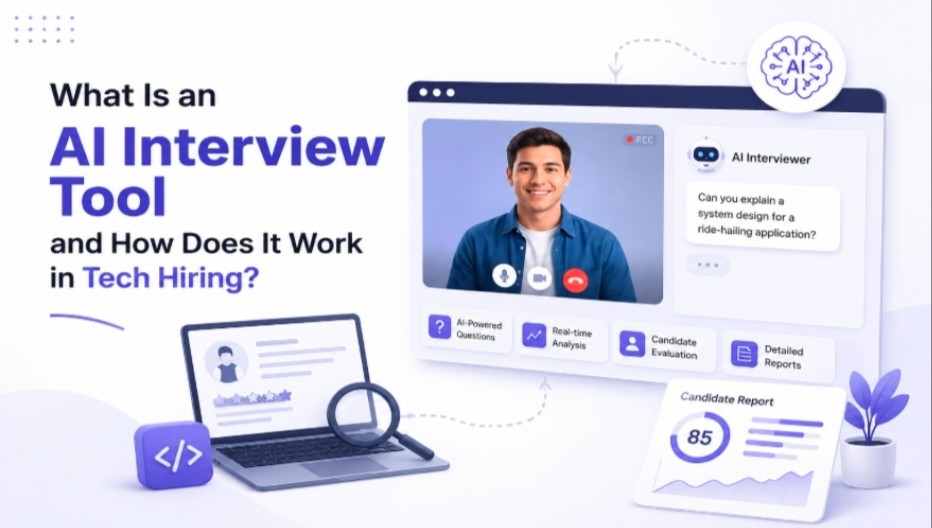
An AI interview tool is a software system that uses machine learning, natural language processing, and, in some cases, computer vision to conduct, evaluate, or support candidate interviews at scale. It is distinct from a simple video conferencing platform because it actively processes interview data to generate structured, comparable insights for hiring teams.
In tech hiring specifically, these platforms are used to:
- Conduct structured, one-way or live video interviews for technical and non-technical roles
- Score coding assessments and technical responses against predefined rubrics
- Analyze spoken and written responses for relevance, competency signals, and communication clarity
- Standardize evaluation criteria across interviewers, teams, and geographies
- Flag inconsistencies, integrity risks, or scoring anomalies for human reviewers
- Integrate interview data directly into the applicant tracking system (ATS)
Fortune 500 adoption illustrates how mainstream this category has become: 75 percent of large US enterprises, including 99 percent of Fortune 500 companies, now automate some portion of applicant screening, ranging from keyword matching to advanced AI-based candidate ranking (Harvard Business School, 2024). Separately, 93 percent of Fortune 500 CHROs report integrating AI into core business practices, with talent acquisition among the leading functions for adoption (Gallup, 2024).
How AI Interview Tools Work: The Technology Stack
AI interview platforms operate as a layered system. Understanding each layer helps executive buyers evaluate vendors on substance rather than marketing claims.
1. Data Capture Layer
The platform records or ingests candidate input, which may include:
- Video and audio from live or asynchronous interviews
- Typed or spoken responses to structured questions
- Code submitted during technical assessments
- Resume and application data pulled from the ATS
2. Analysis Layer
This is where natural language processing and, where applicable, speech and computer vision models process the raw input. Core functions include:
- Transcription of spoken responses into structured text
- Semantic analysis to match responses against role-specific competency frameworks
- Code execution and correctness testing against predefined test cases for technical roles
- Detection of proctoring or integrity signals, an increasingly important function given that interview-cheating flags rose from 9 percent to 38.5 percent of interviews analyzed within a single six-month window in 2026 (Truffle, 2026)
3. Scoring and Ranking Layer
Outputs from the analysis layer are converted into structured scores, typically benchmarked against a rubric built from the job description and prior successful hires. This layer is designed to reduce interviewer-to-interviewer variability, which is one of the most cited sources of inconsistency in enterprise hiring.
4. Human Oversight and Decision Layer
In mature enterprise deployments, AI does not make the final hiring decision. SHRM’s 2026 data shows this clearly: while 66 percent of organizations let AI assist with job description writing, only 10 percent allow AI to influence the final hiring decision (SHRM, 2026). The remaining stages, resume screening (58 percent of adopters), candidate communication (54 percent), assessments (50 percent), and sourcing (46 percent), sit in between, with AI acting as a decision-support layer rather than a decision-maker (iCIMS/Aptitude Research, 2026).
5. Integration Layer
Enterprise-grade tools connect back into the existing HR technology stack, including the ATS, HRIS, and business intelligence dashboards, so interview data becomes part of the broader talent analytics pipeline rather than a standalone data source.
Why Enterprise Technology Leaders Are Adopting AI Interview Tools
Several forces are converging to push AI interview adoption from optional to expected at the enterprise level:
- Volume pressure. Large technology employers routinely process thousands of applications per open role, making manual first-round screening operationally unsustainable.
- Consistency requirements. Predictive hiring models built on structured, AI-assisted evaluation have been shown to reduce bad hires by 75 percent and improve retention by 34 percent (LinkedIn/Workday, 2024).
- Executive expectation. Sixty-two percent of employers expect to use AI for most or all hiring stages by 2026, and 95 percent of hiring managers anticipate increased investment in AI-driven recruitment technology (Insight Global, 2025).
- Competitive parity. Industry-wide adoption is projected to reach 81 percent by 2027, driven by measurable ROI among early adopters and competitive pressure among laggards (Gartner, 2024).
Measurable Business Impact: The Numbers That Matter to the C-Suite
For executive stakeholders, the business case for AI interview tools rests on four categories of measurable outcomes.
Efficiency gains
- Organizations that deployed AI across the full recruiting process saw an average 33 percent reduction in both time-to-hire and cost-per-hire (DemandSage, 2026).
- Among organizations using AI in HR, 87 percent reported measurable efficiency improvements and 75 percent reported improved work quality (SHRM, 2026).
- Some enterprise deployments report time-to-hire reductions of up to 50 percent, with the steepest gains concentrated in resume screening and early-stage interview triage (DataRefs, 2026).
Cost impact
- Companies report 30 to 40 percent reductions in hiring costs following AI recruitment tool adoption (DataRefs, 2026).
- Thirty-six percent of HR professionals whose organizations use AI for recruiting say it directly reduces recruitment, interviewing, or hiring costs (SHRM Talent Trends, 2025).
Quality of hire
- Organizations whose recruiters use AI-assisted candidate messaging are 9 percent more likely to make a quality hire than those with minimal AI usage (LinkedIn, 2026).
The adoption-value gap
Executives should also weigh a counterpoint before approving large-scale investment. A Gartner survey of 114 HR leaders found that 88 percent report their organizations have not yet realized significant business value from AI tools, even though 61 percent describe themselves as being in advanced implementation stages (Gartner, October 2025). This gap indicates that tool deployment alone does not generate ROI. Value depends on process redesign, change management, and integration discipline, not on the software license alone.
Where AI Interview Tools Fit in the Hiring Funnel
AI adoption is not uniform across the hiring funnel. Enterprise leaders should understand where the technology is concentrated today and where human judgment remains dominant:
- Job description writing: 66 percent AI usage (SHRM, 2026)
- Resume screening: 58 percent of AI adopters (iCIMS/Aptitude Research, 2026)
- Candidate communication: 54 percent of AI adopters (iCIMS/Aptitude Research, 2026)
- Skills assessments: 50 percent of AI adopters (iCIMS/Aptitude Research, 2026)
- Candidate sourcing: 46 to 81 percent, depending on organization size and data source (iCIMS/Aptitude Research, 2026; DataRefs, 2026)
- Interview scheduling: 62 percent (DataRefs, 2026)
- Video interview analysis: 56 percent (DataRefs, 2026)
- Final hiring decisions: 10 percent (SHRM, 2026)
The pattern is consistent across independent studies: AI is heavily used at the top of the funnel and in operational tasks, and deliberately constrained at the point of final decision-making.
Risk, Bias, and Regulatory Considerations for Enterprise Leaders
Regulatory exposure has become a board-level issue for any enterprise using AI in hiring, particularly for companies operating across US states or with any hiring footprint touching the EU.
United States
- NYC Local Law 144 requires an independent bias audit of any Automated Employment Decision Tool within the past year, public posting of audit results, and at least 10 business days of candidate notice before use. Penalties run from 500 dollars for a first violation to 1,500 dollars per subsequent violation, assessed per day and per affected candidate (VerityAI, 2026).
- The Illinois AI Video Interview Act requires consent and transparency when AI is used to analyze video interviews, and Illinois HB 3773, effective January 2026, extends bias-prevention duties across broader employment AI use (Employsome, 2026).
- The Colorado AI Act (SB 205), effective February 2026, regulates high-risk AI systems in employment and imposes algorithmic discrimination duties (Employsome, 2026).
European Union
- Under the EU AI Act, recruitment AI is classified as high-risk under Annex III. High-risk obligations, including human oversight, log retention of at least six months, candidate notification, and in some cases a fundamental rights impact assessment, apply from August 2, 2026 (VerityAI, 2026).
- Penalties for high-risk system non-compliance run up to 15 million euros or 3 percent of global annual turnover, whichever is higher, with the most serious violations capped at 35 million euros or 7 percent of global annual turnover (VerityAI, 2026; The Hire Hub, 2026).
- These obligations apply globally to any organization hiring for roles based in the EU or affecting EU candidates, regardless of where the employer is headquartered (VerityAI, 2026).
Governance implication for the C-suite: Vendor liability does not replace employer liability. Regulatory guidance under Local Law 144 has clarified that compliance responsibility sits with the employer, even when the AI system is licensed from a third-party vendor (The Hire Hub, 2026). This makes vendor due diligence, audit documentation, and human-oversight protocols a direct governance responsibility rather than a delegated IT function.
Candidate Trust and Employer Brand Implications
The efficiency case for AI interview tools is strong, but candidate sentiment data indicates a trust gap that enterprise leaders cannot ignore.
- Sixty-three percent of job seekers say they have experienced an AI-run interview within the past six months (Greenhouse 2026 Candidate AI Interview Report, n equals 2,950).
- Only 26 percent of applicants trust AI to evaluate them fairly (Greenhouse, 2026).
- Sixty-seven percent of job seekers report feeling uneasy about AI-led hiring systems (Greenhouse, 2026).
- Sixty-six percent of US adults say they would not want to apply for a job where AI is used in hiring decisions (Pew Research Center, n equals 11,004, 2023).
The strategic response emerging among enterprise adopters in 2026 includes three practices worth building into any deployment: disclosing to candidates which stages of the process use AI and which use human review, adding identity verification at the interview stage for finalist rounds, and configuring blind-screening modes that evaluate skills-relevant data only, without exposing names, schools, or demographic proxies (Pin, 2026). Organizations that skip candidate disclosure tend to see response rates and source-of-hire quality decline, which erodes the productivity gains the technology was meant to deliver (Pin, 2026).
Evaluation Criteria for Enterprise AI Interview Platforms
When evaluating vendors, technology and HR leadership should assess platforms against the following criteria:
- Bias audit history. Has an independent bias audit been completed within the past 12 months, and is the impact ratio methodology documented and shareable.
- Human oversight design. Does the platform structurally prevent AI from making unassisted final hiring decisions.
- Regulatory documentation. Can the vendor supply audit trails, log retention, and documentation aligned with EU AI Act and Local Law 144 requirements.
- Transparency tooling. Does the platform support candidate-facing disclosure of AI involvement at each stage.
- ATS and HRIS integration depth. Does interview data flow natively into existing talent analytics infrastructure, or does it require manual reconciliation.
- Technical assessment rigor. For technology roles specifically, does the platform support live code execution, automated test-case scoring, and role-specific technical rubrics rather than generic evaluation criteria.
- Data governance. Where is candidate data stored, how long is it retained, and what security certifications does the vendor hold.
The Future of AI Interview Tools in Tech Hiring
Industry projections point to continued, and likely accelerating, adoption:
- AI adoption in recruiting is projected to reach 81 percent by 2027, driven by competitive pressure and measurable ROI from early adopters (Gartner, 2024).
- The global AI recruitment market, valued at approximately 660 to 707 million dollars in 2025, is projected to reach 752 million dollars in 2026, growing at a compound annual growth rate of 7.2 to 7.4 percent through the mid-2030s (Mordor Intelligence/Straits Research, 2025).
- Ninety-three percent of recruiters plan to increase AI use in 2026 (DemandSage, 2026).
The trajectory suggests that AI interview tools will continue moving from a screening convenience to a core layer of enterprise talent infrastructure. The organizations best positioned to capture the projected value are those that pair adoption with governance: documented bias audits, transparent candidate communication, and clearly bounded human decision authority.
Key Takeaways for Executive Decision-Makers
- AI interview tools are now standard at enterprise scale, with 60 percent adoption among companies over 5,000 employees, but deployment alone does not guarantee value (SHRM, 2026; Gartner, 2025).
- The strongest, most consistently cited returns are in time-to-hire and cost-per-hire, each reduced by approximately 33 percent on average among full-process adopters (DemandSage, 2026).
- Regulatory exposure under the EU AI Act and NYC Local Law 144 is a direct governance responsibility, not a delegated vendor concern, with penalties reaching up to 7 percent of global annual turnover under the EU framework (VerityAI, 2026).
- Candidate trust remains a material risk factor, with only 26 percent of candidates trusting AI to evaluate them fairly, making disclosure and human oversight essential to protecting employer brand (Greenhouse, 2026).
- Vendor evaluation should center on bias audit history, human oversight design, and integration depth, not on feature volume alone.