


Construction estimating is one of the most essential steps between a set of drawings and a potential construction budget. Before a contractor submits a bid, the project has to be translated into quantities, labor requirements, material costs, devices, subcontractor expenses, overhead, and different monetary concerns.
A small error at this level can emerge as a lot larger after construction starts. Missing several hundred linear ft of piping, undercounting framing materials, overlooking an electrical factor, or using an incorrect labor rate can affect the final bid and, ultimately, mission profitability.
Professional construction estimating organizations help contractors, subcontractors, builders, architects, and owners organize these statistics earlier than construction starts offevolved.
However, estimating carriers are not equal. Some give attention to complete multi-trade estimates, even as others specialize in lumber, MEP, electrical work, bidding, outsourced estimating, or broader preconstruction support.
This guide examines 10 construction estimating groups in the USA, explains their one of a kind regions of focus, and shows how expert estimating can affect a project’s financial picture.
What Does a Construction Estimating Company Actually Calculate?
A construction estimate is more than a final dollar amount.
Depending on the task, an estimator may calculate:
- Material quantities
- Labor hours
- Equipment necessities
- Subcontractor prices
- Waste allowances
- Delivery and transportation prices
- General situations
- Overhead
- Contingency
- Profit
Alternates and allowances
A regular estimating workflow can seem like this:
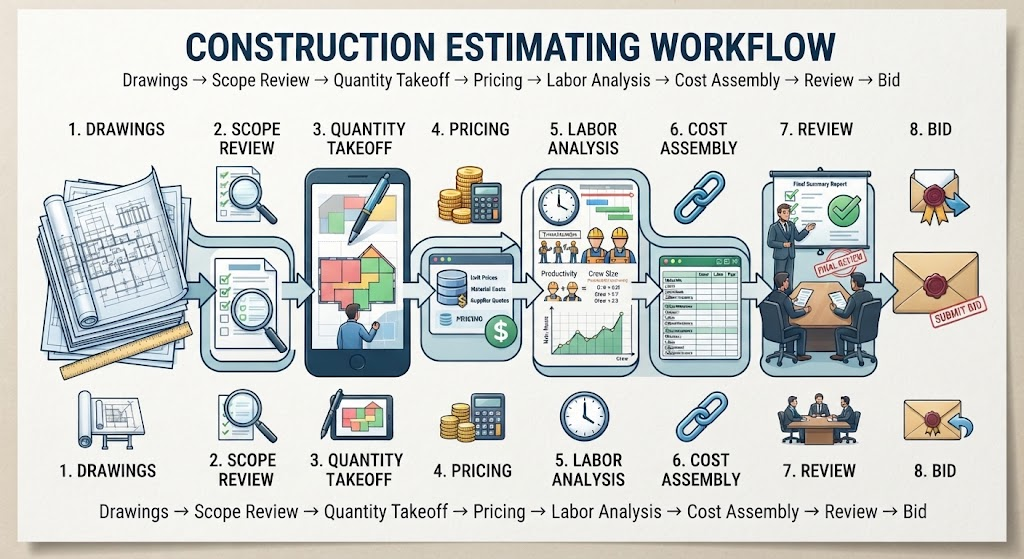
The degree of detail depends on the venture’s level.
A developer may also to start with want a wide conceptual budget, while a contractor getting ready a final bid may require lots of individual quantities.
1. USA Estimators
USA Estimators offers construction estimating and quantity takeoff offerings throughout unique mission sorts and construction trades.
Its method is especially applicable when a undertaking containsseverala scopes that need to be delivered together into one prepared estimate.
Where it can add cost
Instead of looking at concrete, framing, roofing, finishes, electrical, and mechanical work as unrelated calculations, a multi-trade estimating process can regroup them right into a common value form.
This can help contractors identify trades that represent the most important quantities of the finances.
- Where fabric portions are concentrated
- Which scopes want supplier quotations
- Where allowances or assumptions are being used
- How man or woman alternate expenses contribute to the final bid
- For contractors operating on multi-change projects, this project-wide visibility can be more useful than examining one scope in isolation.
2. NEDES Estimating
NEDES Estimating provides construction estimating and quantity takeoff offerings for residential, industrial, and commercial projects.
Its estimating services cover more than one construction division and individual trades.
A different advantage: scope-level evaluation
One beneficial way to study NEDES is through the alternate-stage approach.
For example, a commercial venture may be separated into:
| Division | Example Scope |
| Concrete | Foundations, slabs, footings |
| Metals | Structural steel and miscellaneous metals |
| Thermal/Moisture | Waterproofing |
| Finishes | Drywall, flooring, painting |
| Plumbing | Fixtures and piping |
| HVAC | Ductwork and equipment |
| Electrical | Power, lighting fixtures and devices |
This approach can make it less complicated to become aware of which scope is using a budget increase instead of simply looking at one final challenge number.
3. Smart Constructs
Smart Constructs combines estimating with technical services such as CAD, BIM, engineering, drafting, and other preconstruction support.
This creates a one-of-a-kind price proposition from an estimating issuer targeted best on price calculations.
Why the connection matters
Construction estimates rely upon design data.
- If a drawing changes, portions may also change.
- If a wall moves, framing and finishes may change.
- If a mechanical system changes, electrical requirements may additionally change.
- If BIM coordination identifies a clash, the final construction scope can also require adjustment.
Having estimating and technical services operating within an associated workflow can therefore be useful on projects in which design data is evolving.
Particularly applicable for
- Commercial buildings
- Complex MEP projects
- Design-construct work
- BIM-supported projects
- Projects requiring technical documentation
4. Construction Estimator
Construction Estimator makes a speciality of outsourced estimating services, quantity takeoffs, bid estimates, project scheduling, and related documentation assistance.
Its method can be taken into consideration from a capacity-management perspective.
Imagine a contractor generally gets five bid invites every week.
During a hectic period, that number rises to twelve.
The contractor won’t want to permanently expand the in-house estimating department for a temporary workload growth.
Outsourced estimating can offer any other alternative.
- Potential benefits
- Additional estimating manpower
- Dedicated estimating aid
- Single-exchange or project-degree estimating
- Assistance during excessive-quantity bid durations
- Reduced stress on internal estimators
The financial benefit isn’t always the estimating rate. The larger query is whether or not extra estimating potential allows a organization to check and pursue possibilities it otherwise couldn’t take care of.
5. Cost Estimator
Cost Estimator offers production fee estimating for residential, industrial, and business projects in conjunction with initial and specialty estimating of services.
One useful way to recognize this type of serviceis ththroughhe project lifecycle.
An estimate can change because the design develops
Concept Stage
Contractor-specific pricing, quotations, overhead, and other factors are included.
This progression indicates why a conceptual estimate need not be anticipated to have the same level of certainty as an in-depth bid estimate.
6. Lumber Estimator
Lumber Estimator focuses specifically on lumber and wood-related construction estimating.
Its services encompass lumber takeoffs, framing takeoffs, roof truss estimating, sheathing, plywood, timber framing, reduced lists, and other wood-associated scopes.
Why a specialized lumber estimate can matter
- Consider a timber-framed building.
- A broad estimate might say:
- Framing allowance = $250,000
A specified lumber takeoff can go a lot further:
| Component / Material | Quantity | Unit |
| 2×4 studs | 3,850 | Pieces |
| 2×6 studs | 2,420 | Pieces |
| Plates | 8,600 | LF (Linear Feet) |
| Headers | 1,150 | LF (Linear Feet) |
| Floor joists | 7,900 | LF (Linear Feet) |
| Roof rafters | 6,700 | LF (Linear Feet) |
| OSB sheathing | 41,000 | SF (Square Feet) |
These numbers are hypothetical and are included to best demonstrate how a specialised takeoff can turn a broad allowance into measurable buying information.
That stage of detail may be especially useful for framing contractors, builders, and lumber suppliers.
7. MEP Estimation
MEP Estimation makes a speciality of mechanical, electrical, and plumbing estimating.
MEP scopes deserve unique attention due to the fact they contain numerous interconnected components.
A mechanical estimate might contain:
HVAC gadget
- Ductwork
- Piping
- Valves
- Pumps
- Insulation
- Controls
An electrical estimate may consist of:
- Panels
- Conductors
- Conduit
- Lighting
- Switches
- Receptacles
- Equipment connections
A plumbing estimate can include:
Domestic water
- Sanitary piping
- Storm drainage
- Fixtures
- Valves
- Water warmers
The estimating gain
Breaking MEP into character structures permits contractors to see where the money is being spent as opposed to treating the whole package deal as one allowance.
8. Cost Bidding
Cost Bidding emphasizes estimating and bidding throughout residential, commercial MEP, and specialty construction.
Its workflow can be viewed as a development:
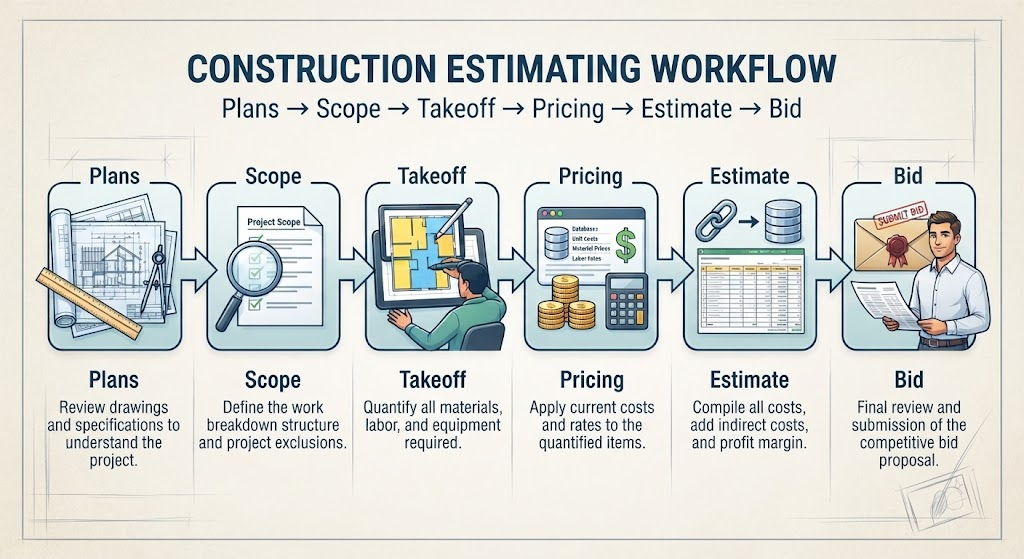
Why this distinction matters
Takeoff on my own does not necessarily inform a contractor what quantity to put up.
Suppose a takeoff identifies:
10,000 SF of floors
That nevertheless leaves numerous questions:
- Which floors specification?
- What is the fabric unit rate?
- What is the setup labor?
- Is adhesive included?
- What waste percentage applies?
- Are delivery costs blanketed?
- Is demolition required?
- Does the contractor want to add overhead and profit?
Bid guidance connects these inquiries to the final range.
9. Electrical Estimating
Electrical Estimating focuses especially on electrical estimating and takeoffs.
Electrical construction can include hundreds or thousands of individual items, depending on task size.
| Category | Examples |
| Distribution Panels | Transformers, switchgear |
| Wiring | Conductors, feeders, branch circuits |
| Raceway | Conduit and fittings |
| Lighting | Fixtures, controls, emergency lighting |
| Devices | Receptacles, switches, sensors |
| Low Voltage | Data, communications, security |
| Labor | Installation and productivity |
| Equipment | Lifts and uniqueness system |
This specialization may be especially applicable for electric contractors who need their very own distinct scope in place of a broad percent allowance inside a standard production estimate.
10. Construction Estimates
Construction Estimates provides estimating and quantity takeoff services for residential, commercial, and business projects.
The cost of a project-specific approach is that the estimating format may be formed around the actual requirements of the work.

A business building may additionally require extensive structural, MEP, glazing, fire safety, and finishes evaluation.
- Potential blessings
- Project-unique scope agency
- Residential and industrial applications
- Industrial estimating
- Quantity takeoffs
- Specialty alternate calculations
- Cost-focused venture analysis
Comparing the 10 Construction Estimating Companies
Rather than asking which business enterprise is universally best, contractors can examine carriers in step with the type of estimating problem they need to solve.
| Company | Main Area of Focus | Useful When You Need |
| US Estimators | Multi-trade estimating | A vast task cost image |
| NEDES Estimating | Trade-level estimating | Detailed scope business enterprise |
| Smart Constructs | Estimating + technical services | Cost and design records collectively |
| Construction Estimator | Outsourced estimating | Additional estimating ability |
| Cost Estimator | Budget and cost estimating | Estimates across challenge stages |
| Lumber Estimator | Lumber and framing | Detailed timber quantities |
| MEP Estimation | MEP | Mechanical, electrical, and plumbing analysis |
| Cost Bidding | Bid preparation | Turning takeoffs into bid facts |
| Electrical Estimating | Electrical | Detailed electrical scope |
| Construction Estimates | General estimating | Project-specific takeoffs and estimates |
A popular contractor may also want a multi-trade estimate, even as an electrical subcontractor should want a much deeper analysis of 1 exchange.
A Practical Construction Estimating Example
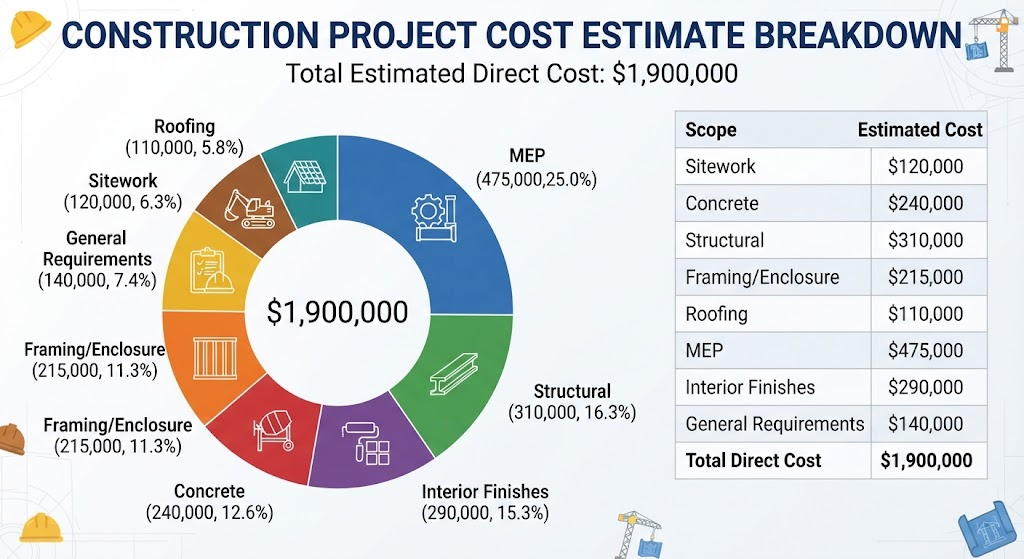
Consider a hypothetical 15,000-square-foot business challenge.
An estimator develops the followingdirect-value calculation:
Now expect:
| Component / Category | Rate / Percentage | Amount |
| Direct Cost | — | $1,900,000 |
| Contingency | 5% | $95,000 |
| Overhead | 7% | $139,650 |
| Profit / Income | 6% | $128,080 |
| Illustrative Final Bid | — | $2,262,730 |
This is a hypothetical instance, not a present-day construction quotation.
The purpose is to reveal how projection can flow from measured scope to a very last commercial bid.
What Happens When One Estimate Is Wrong?
Suppose the MEP allowance in the instance is:
$475,000
If the real MEP requirement is 6% better:
$475,000 × 0.06 = $28,500
That represents a capability $28,500 direct-value distinction.
Now consider comparable discrepancies going on throughout concrete, finishes, structural work, and electric structures.
This is why expert estimating includes more than adding portions together. The estimator needs to pick out the scopes in which particularly small percent changes could have significant financial consequences.
Project Cost Visualization
In this hypothetical assignment, MEP represents the biggest direct-cost category.
That no longer implies MEP is routinely the most difficult scope. Complexity also can come from design coordination, equipment specifications, installation situations, labor productivity, and incomplete records.
How to Select an Estimating Company
The selection ought to begin with the assignment rather than the provider.
Consider the task type.
A residential redecorate, health center, warehouse, office building, and multifamily development can require very special estimating tactics.
Identify the specified degree of detail.
Ask whether or not you need:
- Conceptual budgeting
- Preliminary estimating
- Material takeoffs
- Complete price estimating
- Trade-precise estimating
- Bid education
- Change-order estimating
- Review the deliverable
An estimate may be delivered as an Excel workbook, PDF file, marked-up drawings, quantity schedule, or any other format.
Final: Construction Estimating Is Becoming More Data-Driven
Modern construction estimating increasingly combines digital takeoff software, BIM, CAD drawings, cloud collaboration, cost databases, spreadsheets, and automated measurement. Artificial intelligence can also assist with document processing, drawing recognition, classification, and quantity extraction.
But automation does not remove the need for construction judgment.
Five Frequently Asked Questions
1. What is the difference between a construction estimate and a bid?
A construction estimate calculates the expected cost of performing the work. A bid uses that cost information to establish the amount a contractor intends to submit to the client. A bid may include overhead, profit, contingencies, exclusions, allowances, and other business considerations.
2. Can an estimating company prepare estimates for only one trade?
Yes. Many estimating providers offer trade-specific services. Examples include lumber, electrical, mechanical, plumbing, concrete, roofing, drywall, and other construction scopes. Specialized estimating can be useful when one trade requires significantly more detail than a general project estimate.
3. Why do two estimating companies sometimes produce different totals for the same project?
Different estimates can use different assumptions, labor productivity rates, material prices, waste factors, subcontractor quotations, exclusions, and levels of detail. The important step is to compare the assumptions and scope behind the numbers rather than looking only at the final total.
4. How does a contractor know whether an estimate is detailed enough?
The estimate should provide enough information for the contractor to understand how the total was developed. Depending on the project, this may include quantities, units, material prices, labor costs, equipment, subcontractor amounts, assumptions, exclusions, and markups. A large project generally requires more detailed documentation than a simple preliminary budget.
5. Can a construction estimate be updated when the drawings change?
Yes. Estimates can be revised when addenda, design changes, revised specifications, or scope modifications are issued. Contractors should confirm beforehand how revisions are handled and whether additional estimating fees apply.