From Floor Stack to Racking Systems: A Complete Guide to Pallet Storage Options for US Businesses Using Custom Wood Pallets

Warehousing decisions rarely get the attention they deserve until something goes wrong. A product line expands, throughput increases, or a facility changes hands, and suddenly the way pallets are stored becomes a real operational concern rather than a background assumption. For businesses that rely on wood pallets, the storage method is not a neutral choice. It directly affects floor space efficiency, load integrity, worker safety, and the lifespan of the pallets themselves.
This is particularly relevant for operations that have moved away from standard pallet dimensions toward pallets built to their specific load requirements. When a business invests in pallets designed around its products rather than industry averages, it becomes important to match the storage system to that investment. The wrong racking configuration or floor stacking habit can undermine the structural advantages that custom-built pallets are meant to provide.
This guide works through the main storage options available to US businesses, the conditions under which each one makes sense, and the relationship between storage choice and pallet performance over time.
Understanding Pallet Storage as an Operational Decision
Pallet storage is not simply about where pallets sit between uses. It encompasses how loads are supported during holding periods, how pallets are accessed when needed, how weight is distributed across a facility floor, and how the storage method interacts with the physical construction of the pallet itself. For businesses that have transitioned to custom wood pallets, these considerations carry more weight because the pallets themselves are engineered with specific load paths and structural logic in mind.
When reviewing pallet storage approaches, the central question is not which method looks most efficient on paper but which method preserves load integrity, keeps the workforce safe, and matches the actual movement patterns of the facility. No storage system works well in isolation from the operations it supports.
US businesses operate under OSHA regulations governing warehouse safety, and the Occupational Safety and Health Administration has published guidance specifically on pallet handling and storage practices, noting that improper stacking and storage are among the leading causes of warehouse injuries and product damage. Decisions about racking, floor stacking height limits, and load orientation are not purely logistical. They carry regulatory and liability implications as well.
How Storage Method Affects Pallet Longevity
Custom wood pallets are built to handle specific weight distributions, often tailored to a particular product SKU or shipping configuration. When these pallets are stored in ways that place stress on points not designed to bear weight, the result is premature structural degradation. Boards crack, blocks shift, and what was a carefully constructed platform becomes unreliable within a fraction of its expected service life.
Floor stacking loaded pallets, for instance, transfers the full weight of upper pallets onto the top deck of lower ones. If those pallets were designed primarily for fork entry and racking support rather than top-deck compression, stacking introduces stress the pallet was not built to manage. Over time, this leads to board separation and deck warping, both of which create safety hazards at the point of use.
Floor Stacking: When It Works and When It Doesn’t
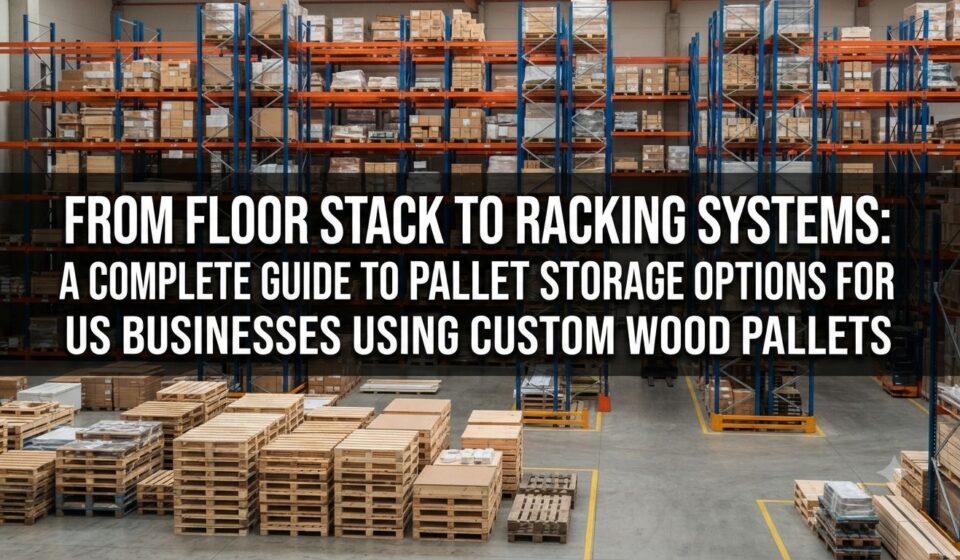
Floor stacking refers to the practice of placing loaded or unloaded pallets directly on the warehouse floor, typically in organized rows or blocks. It requires no infrastructure investment and allows immediate scalability in facilities where storage needs fluctuate. For high-volume operations with rapid product turnover, floor stacking can be a practical solution when the product cycle is fast enough that pallets don’t sit long enough to cause structural concerns.
The limitations of floor stacking become visible when inventory moves slowly or when product lines vary significantly in weight. Stacking multiple loaded pallets introduces compression forces that can degrade the pallet decking and create unstable columns of product, especially when the floor surface is uneven or when pallets of different dimensions are mixed in the same stack.
Load Classification Before Stacking Decisions
Before defaulting to floor stacking, operations should classify their loads by density, fragility, and dwell time. Dense, uniform loads with short dwell times are generally better candidates for floor stacking than fragile or irregularly weighted products that may shift during the period they remain in storage. For businesses using custom wood pallets with specific deck configurations, understanding how those pallets were engineered helps determine whether floor contact and compression loading are within their design intent.
Selective Pallet Racking: The Standard for Reason
Selective pallet racking is the most widely used racking system in US warehouses, and its adoption reflects a straightforward operational logic: it provides direct access to every pallet position without requiring other loads to be moved first. Each pallet sits on horizontal beams supported by upright frames, and a standard forklift can reach any position in the system independently.
For facilities managing a range of SKUs or operating on a first-in, first-out inventory discipline, selective racking is often the right foundation. It accommodates custom wood pallets of varying footprints provided the beam spans and frame depths are configured to match the pallet dimensions in use. This is an important point because a racking system configured for standard pallet sizes may not properly support a pallet built to non-standard specifications, creating overhang or inadequate beam contact.
Matching Racking Configuration to Pallet Geometry
When a business transitions to custom wood pallets, it cannot assume that existing racking infrastructure will continue to function safely without review. Beam span, pallet support width, and load capacity ratings must all be evaluated against the actual dimensions and weight of the pallets being stored. A pallet that extends beyond the beam face on each side, or one that rests on only a portion of the beam, creates bending stress conditions that the racking system may not have been rated to handle.
This kind of mismatch is common in facilities that upgrade their pallet specifications without simultaneously auditing their storage systems. The result is not always immediately visible, but it accumulates as a structural risk over time.
Drive-In and Drive-Through Racking for High-Density Needs
Drive-in and drive-through racking systems eliminate the aisle structure found in selective racking and replace it with deep lanes that a forklift enters to place or retrieve pallets. This design substantially increases storage density for a given floor area, making it attractive for operations that store large quantities of a single SKU or product type.
Drive-in systems are accessed from one end only, which means inventory follows a last-in, first-out rotation. Drive-through systems have entry and exit points at opposite ends, allowing first-in, first-out rotation. The choice between these two configurations depends almost entirely on inventory management requirements rather than on pallet type.
Structural Demands on Pallets in Dense Racking
In drive-in and drive-through environments, pallets are supported only at their outer edges by rails running along the lane. The center of the pallet deck carries the full load without intermediate support. This places significant demands on the structural integrity of the pallet, particularly on the deck boards spanning the width of the load. Custom wood pallets intended for this storage format should be built with deck board thickness and spacing appropriate for the span distances specific to the racking configuration in use.
Businesses that use standard pallets in these environments and later switch to custom wood pallets should communicate their racking specifications to their pallet manufacturer. The racking dimensions should inform the pallet build, not the other way around.
Cantilever Racking for Non-Standard Load Shapes
Cantilever racking uses horizontal arms extending from vertical columns to support loads without a front face obstruction. It is most commonly associated with long, irregular, or oversized materials such as lumber, pipe, or sheet goods, but it has applications in any situation where the load dimensions make conventional beam racking impractical.
For businesses storing products that extend beyond standard pallet footprints, or that use custom wood pallets built for oversized loads, cantilever racking can provide a more stable and accessible storage solution than attempting to fit non-standard loads into beam racking designed for conventional dimensions.
Pallet Flow Racking and First-In, First-Out Operations
Pallet flow racking uses inclined roller or wheel tracks to move pallets from the loading end to the picking end by gravity. As a pallet is removed from the front, the next pallet in the lane rolls forward to take its place. This creates a continuous first-in, first-out rotation without requiring staff to reposition loads manually.
Operations managing perishable goods, time-sensitive products, or inventory with strict rotation requirements often find pallet flow racking reduces both handling time and the risk of product aging in storage. The system functions best when pallets are consistent in dimension and weight, which is one of the practical advantages of using custom wood pallets in this environment. Consistency in pallet construction leads to consistent flow rates, reducing the risk of jams or uneven lane loading.
Mezzanine and Multi-Level Storage Considerations
Some facilities add vertical storage capacity through mezzanine platforms or multi-level racking structures that allow storage above ground-level operations. These systems extend usable cubic footage without expanding the facility footprint, which is particularly relevant in urban distribution centers or facilities operating in high-cost real estate markets.
When custom wood pallets are used in multi-level storage, weight load paths become a more precise concern. Each level must be rated for the loads it will carry, and the pallets themselves must be appropriate for the access method in use at each level. Mezzanine-level storage often involves different handling equipment than ground-level operations, and pallet design should account for the entry and exit methods applicable to each zone.
Conclusion: Aligning Storage Systems with Pallet Design
The decision about how to store pallets is inseparable from the decision about which pallets to use. When businesses choose custom wood pallets to meet specific load requirements, that choice should carry through to how those pallets are stored, handled, and supported between uses. A storage system that was adequate for standard pallets may introduce new risks when pallet dimensions, weight distribution, or structural design change.
US businesses evaluating their warehousing approach benefit most from treating pallet selection and storage system design as a connected planning process rather than two independent decisions. Reviewing racking configurations against pallet specifications, understanding the structural implications of different storage formats, and aligning inventory rotation requirements with the storage method all contribute to fewer product losses, safer working conditions, and longer pallet service life.
The options covered in this guide span a wide range of operational contexts, from simple floor stacking in high-turnover environments to engineered flow racking in precision distribution operations. The right answer depends on what a facility actually handles, how often inventory moves, and how the pallets in use were built to perform. Those three factors, taken together, narrow the decision considerably and make a sound storage choice more straightforward to reach.