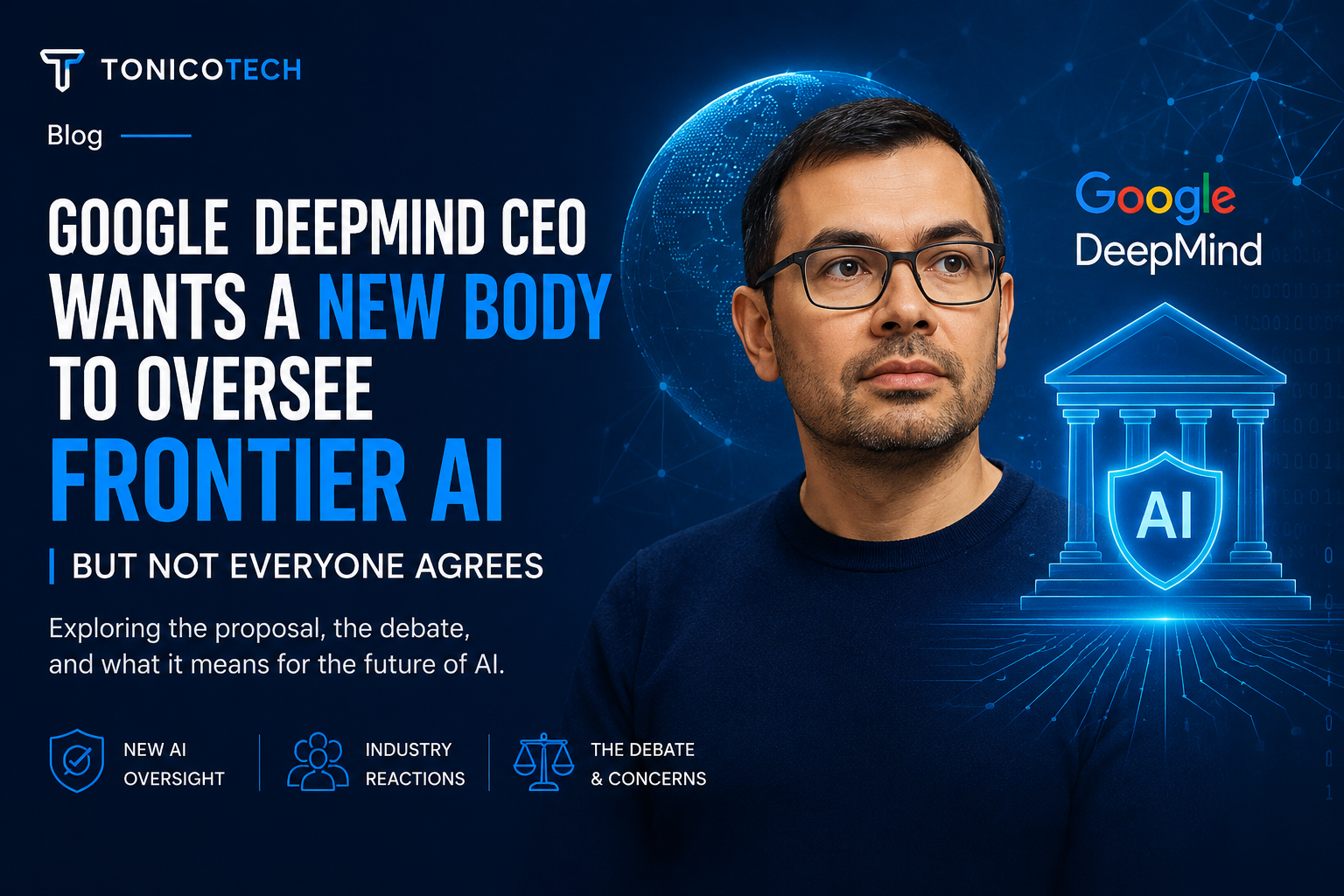

Google DeepMind CEO Demis Hassabis has publicly called for a dedicated frontier AI standards body, modeled on financial self-regulatory organizations like FINRA, to develop assessment protocols and conduct national-security-level testing of the most powerful AI models. Experts are broadly in agreement that stronger oversight is needed, but are divided on whether the U.S. should build a new institution or properly fund the testing infrastructure it already has.
Key Facts at a Glance
- The proposal was made by Demis Hassabis, CEO of Google DeepMind, in a LinkedIn post
- He recommended modeling the body on FINRA — a federally overseen public-private self-regulatory organization
- The body would work with U.S. federal agencies and national labs to test frontier AI for national security risks
- NIST’s Center for AI Standards and Innovation (CAISI) already has pre-deployment evaluation agreements with most major AI labs
- Critics warn of regulatory capture — a body funded by frontier labs may protect incumbents over the public interest
- Some experts argue a building-code model (like nuclear plant permitting) is more appropriate than a financial regulation model
- Hassabis frames the push as necessary before AGI arrives — calling this a “precious window” to shape the technology
What Is the Frontier AI Standards Body Proposal?
The frontier AI standards body proposal is a call from Google DeepMind CEO Demis Hassabis for a new institution specifically tasked with overseeing the testing and governance of the world’s most capable AI models — known as frontier AI. Writing on LinkedIn, Hassabis argued that AI development has reached a point where competitive and geopolitical pressures are pushing capabilities faster than our collective understanding of the risks involved.
His proposed body would be responsible for developing standardized assessment protocols, coordinating with U.S. federal agencies and national laboratories, and conducting evaluations in areas tied to national security. He suggested structuring it as a federally overseen public-private partnership, similar to the Financial Industry Regulatory Authority (FINRA), and staffed with independent technical experts and open-source community representatives.
Why Does Hassabis Think a New AI Standards Body Is Needed?
Hassabis believes a new AI standards body is needed because the pace of frontier AI development has outrun the world’s ability to understand what it’s building. In his view, the AI field is currently in “an extremely intense, multilayered commercial and geopolitical race” — and while that competition drives progress, it also means nobody, not even the leading experts, can say with certainty where things are headed next.
His case rests on a principle of cautious optimism under uncertainty: when the stakes are high enough and the unknowns large enough, proceeding without systematic oversight isn’t just risky — it’s the wrong call. He argues that public policy in this moment needs to do three things at once: promote innovation, incentivize responsibility, and foster international collaboration on safety. A dedicated standards body, in his view, is the institutional mechanism for threading all three needles at once.
What Do AI Safety Experts Say About the Proposal?
Most AI safety experts agree that rigorous pre-deployment testing of frontier models is necessary — but opinions split sharply on whether a new institution is the right vehicle for delivering it.
Those in favor point to two specific gaps that existing oversight doesn’t address. First, open-weight AI models — models whose weights are publicly released — cannot be recalled after the fact. Once released, any dangerous capability they possess exists permanently, in the hands of anyone who downloaded them. Second, leading labs like Anthropic and OpenAI already share non-public models with partners and testers before official release, which means a dangerous capability could already be circulating before any government body even knows it exists. A standards body with pre-deployment authority could theoretically close both gaps.
The security risk argument carries serious weight. The attack surfaces created by frontier AI are expanding faster than most organizations understand, particularly in enterprise and government environments. For some experts, systems with this risk profile demand oversight at the same level we apply to nuclear, biological, or chemical weapons — not because AI is definitely as dangerous as those technologies, but because the possibility is real enough that waiting would be irresponsible.
Should the U.S. Build a New AI Body or Strengthen Existing Ones?
This is the central fault line in the debate. The U.S. already has institutional infrastructure for AI evaluation — specifically NIST’s Center for AI Standards and Innovation (CAISI), which has pre-deployment evaluation agreements in place with most of the major AI labs. Proponents of strengthening what exists argue that standing up an entirely new institution takes time, money, and political capital that could be spent making the current system actually work at scale.
The argument is straightforward: ad hoc, lab-by-lab safety testing won’t hold up as AI capabilities advance. What’s needed is a properly funded, rigorous version of what CAISI already does — not a new layer of bureaucracy sitting on top of it.
The counterargument is that the existing infrastructure was built for a different era of risk. Independent audits have already shown inconsistent methodologies across assessors, and the science of AI evaluation is still young enough that no institution, old or new, has the definitive playbook.
Is FINRA Really the Right Model for AI Oversight?
Several experts pushed back on using FINRA as the template — and the objections are substantive. FINRA was built to police conduct in a mature, well-understood industry where losses are financial and, crucially, recoverable. AI risk doesn’t look like that. The potential failure modes of frontier AI — compromised biosecurity, autonomous cyberattacks, or worse — aren’t recoverable in the way a botched securities trade is.
A more fitting model, some argue, is something closer to how the U.S. permits nuclear power plants: explicit tolerated failure probabilities are set upfront, requirements are derived from those tolerances rather than negotiated with committees, and compliance is checked at multiple stages — design, construction, commissioning, and ongoing operation. That framing focuses the regulation on what it’s actually trying to prevent, rather than what the industry is comfortable agreeing to.
What Are the Risks of AI Self-Regulation?
The biggest risk of AI self-regulation is regulatory capture — where the body created to oversee an industry ends up protecting that industry’s interests instead of the public’s. It’s a well-documented pattern across sectors, and AI has structural features that make it especially vulnerable.
Frontier labs are investing billions and moving at extraordinary speed. Governments move slowly. Independent safety researchers often rely on volunteers and grants. In a public-private partnership where frontier companies define the agenda simply because they have the most people, the most data, and the most compute at the table, the risk is that the resulting standards end up setting a floor that’s convenient for incumbents and inconvenient for new entrants — not a floor defined by what’s actually needed for safety.
There’s also a geopolitical dimension that a purely domestic standards body struggles to address. Trying to control AI risk through a U.S.-only institution, without binding global partnerships, is roughly analogous to trying to prevent nuclear proliferation through agreements with individual states rather than a treaty framework.
Frequently Asked Questions
What is frontier AI?
Frontier AI refers to the most capable, cutting-edge AI models being developed by leading labs — systems that push the boundaries of what AI can do and are considered most likely to introduce novel risks.
What did Demis Hassabis propose?
Google DeepMind’s CEO called for a new standards body to oversee frontier AI, modeled on FINRA, that would develop assessment protocols and coordinate national-security-level testing with U.S. agencies and national labs.
Does the U.S. already have AI safety testing institutions?
Yes. NIST’s Center for AI Standards and Innovation (CAISI) already has pre-deployment evaluation agreements with most major AI labs. Critics of the Hassabis proposal argue this capacity should be strengthened rather than supplemented with a new institution.
What is regulatory capture in the context of AI?
Regulatory capture is the risk that a standards body funded and governed primarily by frontier AI companies ends up setting standards that benefit those companies — protecting incumbents and raising barriers to competition — rather than standards driven by genuine public safety goals.
Why does Hassabis say standards need to be set before AGI?
Hassabis argues the world has a “precious window” before artificial general intelligence arrives to establish the governance structures and testing norms that will determine how AGI is developed and deployed. Waiting until AGI exists to build that framework would be too late.
The Takeaway
The call for a frontier AI standards body from one of the most prominent figures in AI research is a significant moment — not because the idea is without flaws, but because it reflects a growing acknowledgment inside the industry itself that the current pace of development has outstripped the oversight frameworks meant to govern it. Whether the answer is a new institution, a better-funded version of NIST’s existing capacity, or some hybrid, the underlying problem is real: no one has fully reliable methods for testing what frontier AI models can do before they’re in the world. The debate about which institution should do that testing matters a great deal less than actually building the capability to do it.
At Tonic of Tech, we track how AI policy and governance are evolving alongside the technology itself — because who builds the rules matters just as much as who builds the models.