

The Cyber Relax AI massage chair is Fujiiryoki’s flagship, sold in the US as the JP4000 and priced at $10,999.99 direct from the manufacturer’s store. Every page you’ll find about it is a product listing, which means you get the feature list and none of the parts that decide whether you’ll be happy with it two years from now: whether the roller mechanism suits your body, whether it fits through your door, and whether the cheaper JP3000 sitting right next to it does 90% of the same job.
I’ve pulled the specs from Fujiiryoki’s own US product page rather than reseller copy, because reseller listings for this chair contradict each other on several numbers. Where they disagree, I say so.
Quick verdict
Buy it if you want a Japanese-built chair with precise, targeted work on the neck, shoulder blades, and lower back, and you’re willing to pay for five years of in-home service. The AI scanning here is the real differentiator, not a marketing label.
Skip it if you’re over 6’2″, if you mostly want broad full-body compression rather than deep point work, or if your budget tops out around $6,000, where 4D chairs from Osaki and Kyota get you most of the way there.
Who makes it, and why that matters
Fujiiryoki has been building massage chairs in Japan since the 1950s. The JP4000 is designed and assembled in Japan, which is unusual at any price and increasingly rare above $10,000, where most “premium” chairs are Chinese-built under a Japanese or American brand name. In the US the chair reaches customers through Synca Wellness, which also handles warranty service, so you’ll see the Synca name on paperwork even though the badge says Fujiiryoki.
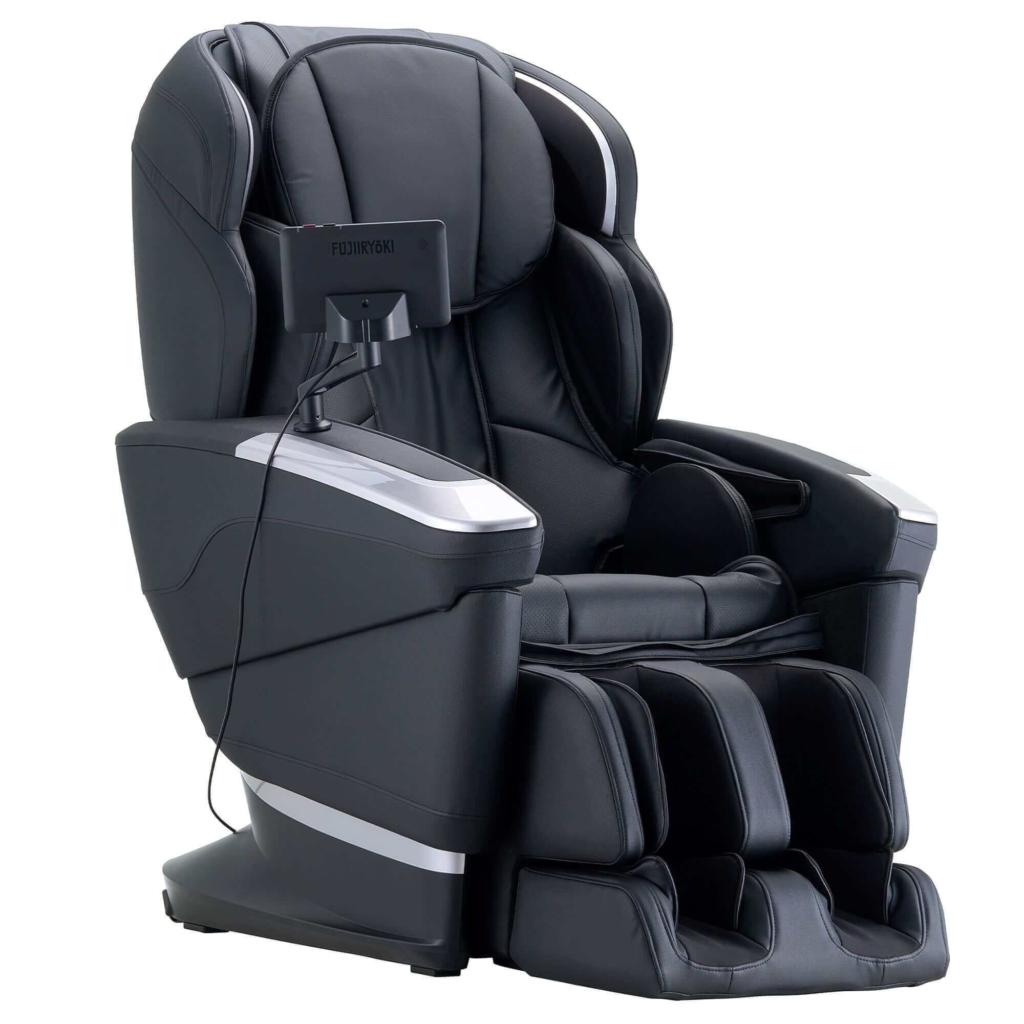
The chair weighs about 211.6 lbs and draws 125W. That weight tells you something useful: it’s a heavy steel frame, not a lightweight shell.
What “5D AI” actually means on this chair
Marketing pages throw around 5D without explaining it. Here’s the mechanical reality.
Most chairs add dimensions to roller movement in order: up and down the track, in and out for width, forward and back for depth (that’s 4D, where depth varies during a stroke). Fujiiryoki’s fifth dimension is speed and pressure modulation controlled in real time by the AI, using what they call the 5D-AI Mecha Plus mechanism paired with a high-precision brushless motor.
The part that earns the name is the scan. Fujiiryoki calls it AI Double Sensing+. A shoulder position detection system measures where your shoulders actually sit, then a backline detection system maps your spinal curve across eight separate points. The chair then holds consistent intensity from shoulders to glutes along that measured curve rather than running a generic S-track path and hoping your back matches it.
You can override any of it. Kneading intensity is adjustable at each of the eight spinal points individually, and you can save those settings, plus air pressure and recline angle, for two users.
If you’ve sat in a chair where the rollers dug hard into your lower back and skated over your shoulders, that’s the problem this scanning solves. It’s the single best argument for the JP4000 over a chair costing half as much.
Two massage balls instead of four
This is the most important thing to understand before you buy, and no retailer page frames it as a trade-off.
Most competing flagships use four rollers. Fujiiryoki deliberately uses two, arguing that a two-ball head can reach narrow areas a four-ball head can’t. The clearest example is the rhomboid technique, where the two balls work inside the shoulder blade, which is roughly where desk work leaves most people wrecked.
The trade-off is real. Two balls cover less surface at once, so broad sweeping strokes across the whole back feel less enveloping than a four-roller chair. If you like the sensation of two large hands pressing over a wide area, sit in this chair before buying. If you want something to find the specific knot under your shoulder blade, this mechanism is better at it.
There’s a technique called 3D Wavelet that taps and kneads at the same time, which no human therapist can do with one hand. It sounds gimmicky. It’s the one people tend to keep coming back to for the lower back.
Also Read: AI Bola Review 2026: What It Is, How It Works, and Alternatives
The numbers, and which ones matter
| Spec | JP4000 |
|---|---|
| Massage techniques | 98 total, including 53 kneading variations |
| Auto courses | 40 (9 full body, 15 targeted, 13 stretch, 2 recommended) |
| Stretch programs | 13 (6 full body, 7 targeted) |
| Air massage zones | 8 regions, 7 strength levels each |
| Heat | Two systems: repositionable back/abdomen heat pads plus foot sole heating, roughly 100–113°F |
| Control | 8-inch color touch panel |
| Audio | Bluetooth speakers |
| User memory | 2 profiles |
| Weight | ~211.6 lbs |
| Power draw | 125W |
| Origin | Japan |
| Warranty | 5 years parts, frame, and in-home service |
A note on airbag counts: you’ll see 42 airbags on one retailer site and 86 on another. Fujiiryoki’s own spec page doesn’t publish a number, only that there are eight adjustable air regions fed by a high-flow, high-pressure pump. Treat any specific airbag count you see in a product listing as unverified.
The features I’d actually flag as useful day to day, rather than spec-sheet filler:
- Heat pads that unzip and move to the front, so you can warm your abdomen instead of only your lower back. Nobody else does this well.
- Foot sole rollers that work after airbags grip your ankles and insteps, so your foot can’t slide away from the pressure.
- Armrests that slide with you as the chair reclines, which sounds trivial until you’ve used a chair where your forearms fall out of the air cells at full recline.
- A 30-minute Mindfulness course that uses airbags only, no rollers. Good for evenings when you want to come down rather than get worked over.
Will it fit your room, and will it fit you?
This is where large chair purchases go wrong.
Your doorway needs to be at least 27.5 inches wide, plus about another 0.7 inches of clearance for the people carrying it. Once placed, leave 19.6 inches behind the chair for the backrest to recline and 11.8 inches in front for the footrest to extend. It’s not a zero-wall design, so pushing it flat against your baseboard won’t work.
On body fit, retailers list a height range of roughly 5’2″ to 6’2″ and a 300 lb capacity, while some listings claim the double leg rest extension accommodates up to 6’4″. Those can both be true in a loose sense, since a taller person’s legs will fit before their shoulders line up correctly with the roller path. If you’re over 6’2″, the scan will place the shoulder point as high as it can and you may still feel the rollers working lower than you want. Go sit in one.
Price and where to buy: Costco vs Johnson Fitness vs Fujiiryoki
As of August 2026, the JP4000 lists at $11,999.99 and sells for $10,999.99 in Onyx and Ivory on Fujiiryoki’s own store, with Johnson Fitness matching that discounted figure. Costco carries it under the name Fujiiryoki Cyber Relax AI 5D Massage Chair, and Costco’s price moves with member promotions, so it’s worth checking both on the day you buy.
What actually separates the three sellers:
| Fujiiryoki store | Johnson Fitness | Costco | |
|---|---|---|---|
| Typical price | $10,999.99 | $10,999.99 (from $11,999.99) | Varies with member promos |
| Setup | White glove delivery and setup available, packaging removed | In-store trial at many locations, extended plans sold at checkout | Standard carrier delivery; check your postal code at checkout |
| Try before you buy | No | Yes, at Johnson Fitness showrooms | Occasionally on warehouse floors |
| Return path | Manufacturer terms | Retailer terms, restocking fees are common on chairs | Costco’s return policy |
Two things worth knowing. First, restocking fees on massage chairs run 15% to 20% across the industry, so a $10,999 mistake can cost you $2,000 to undo. Costco’s return policy is the most forgiving of the three. Second, the manufacturer warranty is five years of parts, frame, and in-home service regardless of who sells it, which makes extended protection plans sold at checkout much less compelling than the sales pitch suggests. Read what the add-on covers in years six and beyond before you pay for it.
Also Read: AI Transformation Is a Problem of Governance: The 2026 Maturity Framework
What I’d hold against it
No zero-gravity marketing here doesn’t matter much, since the Total Relax Position lays you near flat and does the same job. These are the real complaints:
The two-ball mechanism won’t satisfy people who want wide, heavy full-back pressure. There’s no calf roller mechanism to speak of; the legs are worked by air, which is gentler than the mechanical calf kneading some competitors offer. The 8-inch touchscreen is genuinely good but it’s tethered, so you’re reaching for a panel rather than holding a small remote. And at $10,999, you’re paying a real premium for Japanese assembly and the scanning system; the massage itself is not four times better than a well-built $4,000 chair, because nothing at this price is.
Alternatives worth a sit
The Synca JP3000 is the closest call. It’s the previous flagship from the same manufacturer, with 38 auto programs against the JP4000’s 40, and it frequently sells at the same $10,999.99 price at Johnson Fitness. When both are the same price, take the JP4000 for the improved scanning and the 13 stretch programs. When the JP3000 is discounted below it, that gap gets hard to justify.
The Cyber Relax AI Executive edition is a trim variation of the same platform, worth comparing on upholstery and included services rather than on massage performance.
If you want mechanical calf rollers and broader back coverage, look at the D.Core Stratus-JP and the Osaki JP Nexus 4D in the same bracket.
Bottom line
The Cyber Relax AI massage chair is the right pick for someone who wants precision over power: measured shoulder placement, an eight-point spinal map, and a two-ball head that reaches places most chairs skate past. Sit in one first if you can, because the two-ball design is a genuine preference split, not a spec you can evaluate on paper. If it feels right for your back, the Japanese build and the five-year in-home service make the price easier to defend than most chairs in this bracket.
Also Read: BrandRank.AI Normalization Transformation Rules: The Complete 2026 Guide to Winning AI Visibility
Frequently asked questions
Is the Cyber Relax AI massage chair made in Japan?
Yes. Fujiiryoki lists Japan as the country of origin for the JP4000, and it’s assembled there rather than badged.
How much does it cost?
$10,999.99 at Fujiiryoki’s store and Johnson Fitness as of August 2026, down from a $11,999.99 list price. Costco pricing fluctuates with member promotions.
What’s the warranty?
Five years covering parts, frame, and in-home service, administered in the US by Synca Wellness. Coverage starts at purchase, applies to the original owner only, and isn’t transferable.
What size room do I need?
Allow 19.6 inches of clearance behind the chair and 11.8 inches in front. The chair needs a doorway of at least 27.5 inches to get in.
How long does assembly take?
Around an hour, and delivery services that include setup will handle it.
Is the JP4000 good for sciatica or chronic back pain?
It’s a wellness product, not a medical device, and Fujiiryoki’s US materials don’t make treatment claims. If you have a diagnosed spinal condition, disc injury, osteoporosis, or you’re pregnant, ask your doctor before using any massage chair.














[…] Also Read: Cyber Relax AI massage chair review: what Fujiiryoki’s JP4000 actually does for $10,999 […]