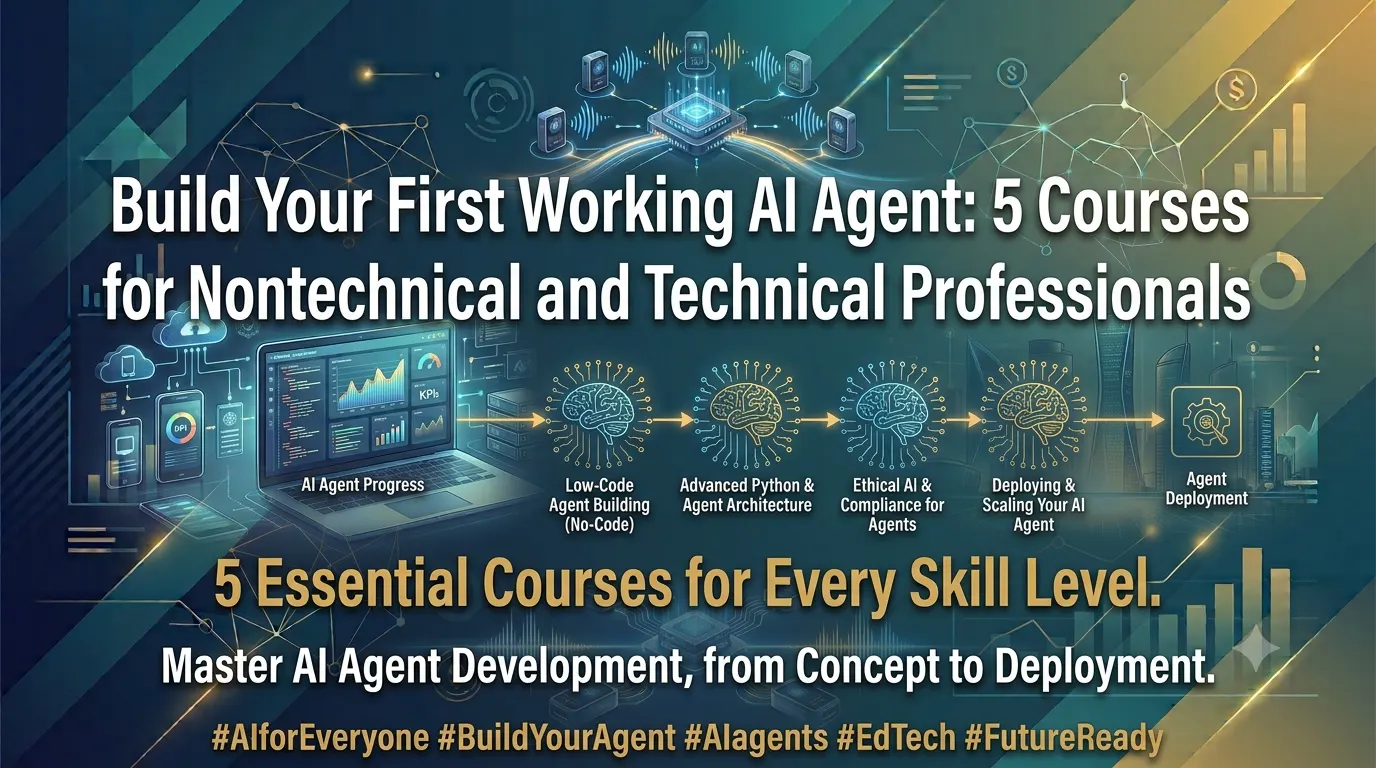

AI agents become easier to understand once you build one. A simple agent can receive a goal, work with information or tools, take an action, and return a useful result. That first project could automate research, organize requests, analyze documents, or complete part of a recurring workflow.
The starting point will differ by role. Nontechnical professionals may prefer visual automation and no-code tools, while developers may want Python, APIs, memory, tool calling, and multi-agent architecture.
These five US-focused courses cover both routes, from workplace automation to agents built directly in Python.
5 AI Agent Courses to Compare in 2026
| # | Program | Fees | Eligibility | Duration | Credentials |
| 1 | Postgraduate Program in AI Agents and Generative AI for Business Applications – Texas McCombs | $3,450 | Professionals across functions; foundational pre-work included | 13 weeks | Certificate of Completion + CEUs |
| 2 | Implementing Agentic AI: Building Your Organizational Playbook – MIT Sloan Executive Education | $1,900 | Technical and nontechnical leaders; no formal prerequisite stated | 3 weeks | Certificate of Completion + 1.0 EEU |
| 3 | AI-Native Professional: Workflows and Agents for Productivity – Great Learning | $600 | No coding or technical prerequisites | 6 weeks | Professional Certificate |
| 4 | AI Agents and Agentic AI in Python: Powered by Generative AI – Vanderbilt University | $59/month through Coursera Plus | Basic Python; no prior AI or ML required | 4 weeks | Vanderbilt University Career Certificate |
| 5 | AI Agents: From Prompts to Multi-Agent Systems – UC Davis | $59/month through Coursera Plus | Beginner level | About 9 hours | Shareable Course Certificate |
1. Post Graduate Program in AI Agents and Generative AI for Business Applications – The McCombs School of Business at The University of Texas at Austin
Texas McCombs progresses from GenAI, LLMs, prompting, and RAG into agent tools, memory, reasoning, Agentic RAG, MCP, and multi-agent systems. Its coverage of ai agents business applications is reinforced through projects spanning customer support, financial document analysis, and logistics.
Delivery & Duration: Online, 13 weeks, with recorded learning, expert mentorship, and Texas McCombs faculty sessions.
Credentials: Certificate of Completion and CEUs from Texas McCombs.
Program Highlights: 3 projects, 15+ case studies, 15+ tools, RAG, Agentic RAG, LangChain, LangGraph, LangSmith, MCP, human feedback, grounding, and agent security.
Outcomes: Learners build AI workflows, context-aware agents, and multi-agent applications while developing methods for evaluating reliability.
Why Choose This Course?
- It accommodates different technical backgrounds through code and no-code approaches.
- Projects extend into working agent systems, including reasoning, collaboration, and human review.
2. Implementing Agentic AI: Building Your Organizational Playbook – MIT Sloan Executive Education
MIT Sloan approaches Agentic AI through business processes rather than solely through software development. Participants select an existing workflow and consider how agents could change its tasks, controls, governance, and operating model.
Delivery & Duration: Self-paced online, 3 weeks, with 4 to 5 hours of core study per week.
Credentials: Certificate of Course Completion from MIT Sloan School of Management and 1.0 EEU.
Program Highlights: Agent use cases, workflow redesign, implementation planning, governance, operational risk, scaling, and an organizational playbook.
Outcomes: Participants develop an agent-driven workflow and a structured plan for introducing it responsibly within an organization.
Why Choose This Course?
- It works for technical and nontechnical professionals without requiring a coding-first learning path.
- The coursework uses an existing business process, keeping the agent exercise connected to workplace implementation.
3. AI-Native Professional: Workflows and Agents for Productivity – Great Learning
This ai agent development course is designed for professionals who want to build without programming. Learners progress from prompting and grounded research to connected tools, trigger-based automation, and agents that perform practical workplace tasks.
Delivery & Duration: Live online, 6 weeks, with approximately 3 to 4 hours of weekly commitment.
Credentials: Professional Certificate from Great Learning.
Program Highlights: ChatGPT, Claude, Gemini, Perplexity, NotebookLM, Activepieces, Google Workspace, no-code automation, connected workflows, AI agents, and a capstone.
Outcomes: Learners create a knowledge system, automated workflows, a competitive intelligence agent, and a functioning multi-step capstone.
Why Choose This Course?
- There are zero coding prerequisites, making it suitable for functional professionals.
- Learners build throughout the six weeks, so the first working systems appear before the final capstone.
4. AI Agents and Agentic AI in Python: Powered by Generative AI – Vanderbilt University
Vanderbilt provides a more technical route for learners who already know basic Python. The specialization explains agent loops, tools, APIs, self-prompting, memory, error recovery, safety patterns, and multi-agent collaboration.
Delivery & Duration: Self-paced online, approximately 4 weeks at 10 hours per week.
Credentials: Career Certificate from Vanderbilt University through Coursera.
Program Highlights: Python, OpenAI API, tool calling, agent loops, memory, multi-agent collaboration, safety patterns, optimization, and failure handling.
Outcomes: Learners create autonomous agents that work with APIs, external information, errors, and other agents.
Why Choose This Course?
- Basic Python is enough to get started, with no prior AI or machine learning experience required.
- Agent architecture is taught from first principles rather than relying entirely on a single framework.
5. AI Agents: From Prompts to Multi-Agent Systems – University of California, Davis
UC Davis offers a more direct path from generative AI concepts to agent workflows and orchestration. Learners study function calls, RAG, human oversight, connected agents, feedback loops, and multi-agent systems.
Delivery & Duration: Self-paced online, approximately 9 hours across five modules.
Credentials: Shareable course certificate through Coursera.
Program Highlights: Prompt frameworks, function calling, RAG, agent workflows, human-in-the-loop design, parallel agents, feedback loops, and multi-agent systems.
Outcomes: Learners create agentic workflows and progress toward a multi-agent system while considering testing, guardrails, and practical risks.
Why to Choose This Course?
- The short format suits learners who want to test Agentic AI before committing to a longer program.
- It progresses beyond prompting into orchestration, giving beginners exposure to how multiple agents can work together.
Conclusion
A first AI agent does not need to solve a large enterprise problem. A focused research agent, document assistant, workflow coordinator, or automation can teach you how goals, context, tools, actions, and human checkpoints fit together.
When comparing agentic ai courses, consider how you want to build. No-code programs can help business professionals create working systems with less technical preparation, while Python-based courses provide more control over integrations, architecture, failure handling, and multi-agent behavior.